
A new friction stir additive manufacturing patent proposes a smarter way to feed several metal wires through one rotating tool.
Most wire feed friction stir additive manufacturing, or FSAM, concepts are a bit constrained. Typically using a single channel through a rotating spindle means one wire size, one material stream, and not much flexibility once the hardware is built. That is workable for straightforward deposition, but it becomes limiting if the goal is to scale throughput, blend materials, or adapt the same machine for both small and large structures.
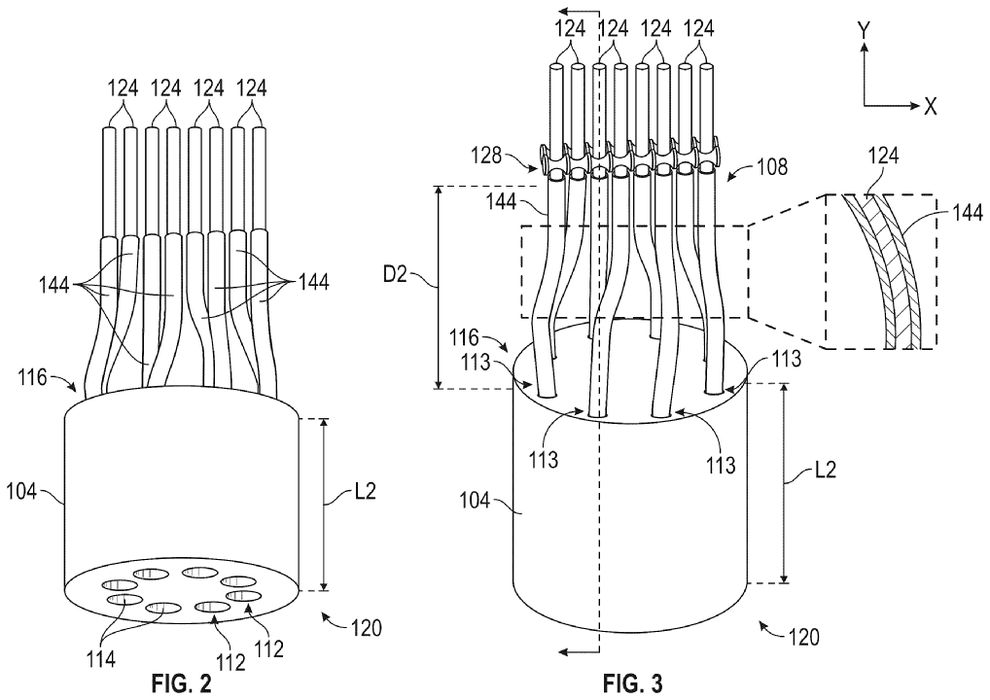
This patent tries to break that bottleneck by replacing the single internal path with multiple spindle channels running through one rotating spindle. Each channel can accept a wire, and those wires can be the same material, different materials, or different gauges. The system also adds sleeves inside the channels so the wires are better supported as they are pushed into the rotating spindle, where friction softens the material before deposition.
It is not LPBF, not DED, and not WAAM either. Instead, it sits with solid state metal processes that want to avoid full melting, reduce energy use, and potentially improve metallurgy by limiting thermal extremes. For readers watching large format metal AM, that alone makes it worth attention.
Why The Sleeves Matter
The most practical idea here may not be the multi wire claim by itself, but how the patent tries to make it usable. Pushing several wires into a rotating spindle sounds simple until those wires buckle, cross, tangle, or feed unevenly. The patent addresses that with internal sleeves, guide channels, and paired rollers that grip and drive the wires in a controlled way.
The sleeves are particularly clever. They can share the same outer diameter while offering different inner diameters, meaning the machine could swap sleeves to accept different wire gauges without redesigning the spindle itself. In principle, that could let an operator tune feed capacity to the job: two wires for a smaller part, perhaps twelve for a larger structure, with the spindle hardware mostly unchanged.
The guide arrangement is also notable. The patent describes a linear wire array feeding into a rotating guide and then into the spindle channels, with curved sleeves steering the wires inward or outward as needed. That is the sort of detail that separates a lab concept from a mechanism someone is at least trying to industrialize. It suggests the inventors have spent time thinking about wire management, not just claiming broad process territory.
Still, this remains a patent idea, not a demonstrated machine with benchmark data. The text mentions a dramatic size difference relative to older bar fed systems, suggesting sub 500 lb equipment versus roughly 3,000 lb for some prior systems. It also claims better energy efficiency because the process softens material without fully melting it. Both claims are plausible, but neither is backed here by deposition rates, power draw, bead geometry, bond strength, or microstructure results.
Where This Could Land
If the concept works as intended, the biggest beneficiaries would likely be aerospace, defense, shipbuilding, and heavy industry users that care more about large metallic structures, joints, and stiffeners than fine cosmetic resolution. The patent explicitly points to forming parts, welds, joints, and stiffeners, which makes it sound closer to structural fabrication than precision component manufacturing.
There is also one more twist here: the patent is owned by none other than Blue Origin, the aerospace company competing with SpaceX. It’s therefore very likely this tech would be used first by Blue Origin, and only later licensed to others — but probably not to SpaceX.
Even so, the patent asks a good question: if one wire through one spindle is not enough, why not turn the spindle into a manifold?
Via Patentscope
