
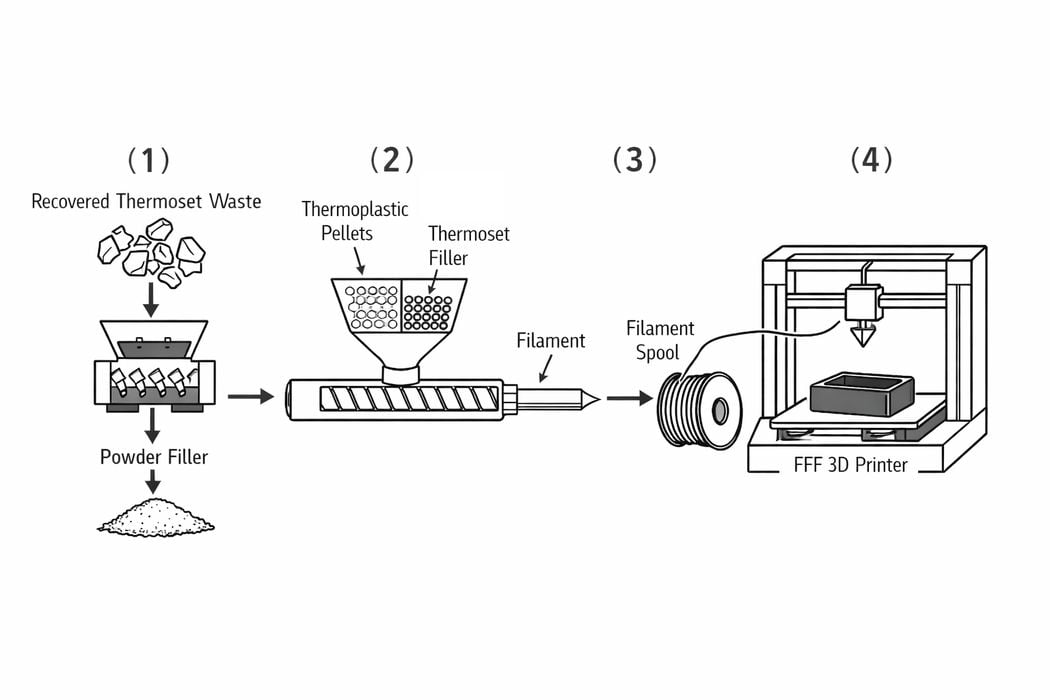
You may soon be 3D printing thermoset filament.
What? Thermosets are very different from the thermoplastics used in FFF 3D printer filament. While thermoplastics can be heated and reformed several times, thermosets solidify only once. Resin 3D printers use thermosets, as you cannot remelt resin prints and make them back into the original material.
So how do you get a thermoset filament?
Proterial has filed a Japanese patent on a simple but potentially useful idea: turn hard-to-recycle thermoset waste into filler for FFF filament, and provide a way to handle thermoset waste streams.
The patent, JP-2026054806-A, appeared on March 30, 2026 and is titled “Method for manufacturing filaments and resin molded products, and method for material recycling thermosetting polymers.” As patents go, this one is fairly direct. The concept is to produce a 3D printing filament that contains a thermoplastic polymer as the main ingredient, along with filler made from reused thermosetting polymer.
Thermosets are not like PLA, ABS, or PETG. Once cured, their molecules are crosslinked and cannot melt back into a usable flow state. In other words, you can’t recycle thermosets by remelting them into fresh feedstock. The usual approach is most often mechanical: grind them up, turn them into powder or particulates, and use that material in some secondary role.
A Composite Filament Recycling Route
That appears to be exactly what Proterial is proposing. The patent says the filament contains at least fifty percent by mass thermoplastic polymer, while the reused thermosetting polymer filler can make up more than zero percent and up to fifty percent by mass.
The patent’s abstract describes the simple workflow: recovered thermoset waste is processed into filler, blended with thermoplastic material, extruded into filament, and then used in three-dimensional molding. There’s nothing magical about that flow. That’s actually why it’s so interesting: this could actually work.
The company seems to be working within physical reality: cured thermoset waste remains cured, but it may still have value as a functional filler inside a printable thermoplastic matrix.
For 3D printing, that opens up a few possible benefits. First, there’s the obvious sustainability angle. Thermoset scrap from molding, composites, electronics, coatings, and related sectors is notoriously awkward to reuse. If even a portion of that material can be diverted into printable compounds, that could reduce disposal volume and offset some virgin resin demand.
Second, there may be property tuning opportunities. Fillers can change stiffness, dimensional stability, surface feel, thermal behavior, and cost. Depending on the thermoset source and particle size, the result might be useful for non-cosmetic parts, jigs, fixtures, or application-specific compounds where ultimate ductility is not the priority.
Useful Idea, But Still a Patent
That said, this is still a patent, not a product launch. And patents are full of ideas that never become commercial reality.
There are some questions, however. What thermoplastic is being used? PLA, polypropylene, nylon, ABS, or something else? What type of thermoset waste is being recovered? Epoxy, phenolic, melamine, fiber-reinforced composite scrap? Those choices matter a lot. So does particle size, loading consistency, and compatibility between filler and the thermoplastic.
Then there are FFF printing concerns: Add too much filler and printability may suffer. Nozzles may wear faster. Layer adhesion may weaken. Brittleness may increase. Handling could become trickier if the filament loses toughness. None of those issues kill the idea, but they could determine whether this becomes a niche compound or a widely usable material.
If this goes anywhere, the next thing to watch would be material specifics and print performance data. Without those, this patent is simply a credible recycling concept, not yet proof of a new filament category.
