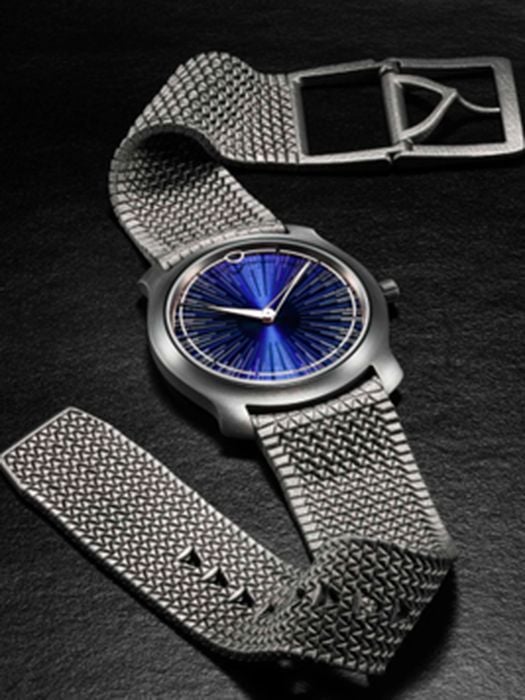
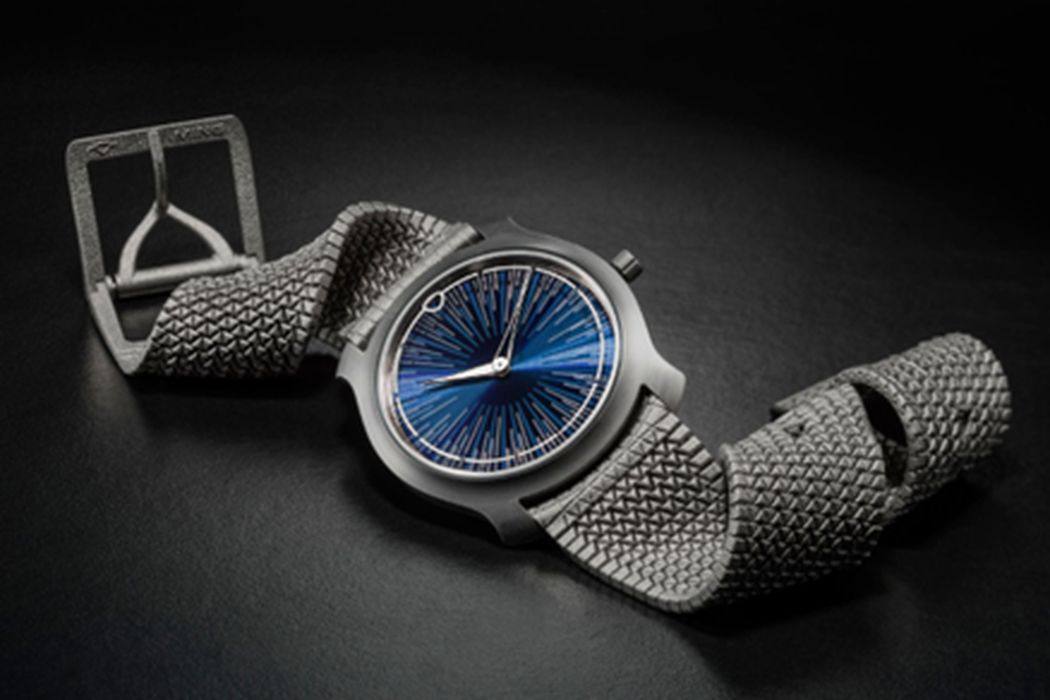
Charles R. Goulding and Nimra Shakoor spotlight how MING’s 3D printed titanium Polymesh strap leverages sub-70-micron additive manufacturing and complex lattice geometries to redefine luxury watchmaking while qualifying for significant R&D Tax Credits.
MING, a Malaysian brand, has collaborated with Sisma S.p.A in Italy and ProMotion SA in Switzerland to create the Polymesh watch strap (Wired). It is engineered for comfort through motion, similar to other modern performance-oriented straps, with the advantage of durability compared to typical rubber straps and lighter weight compared to metal bracelets. The product sits between a watch strap and a bracelet and does not contain any pins or screws.
The key innovation lies in its structure and manufacturing. With tolerances of under 70 microns—roughly the thickness of a human hair—the strap is produced through additive manufacturing in an inert gas environment. The process involves the layer-by-layer sintering of titanium powder, followed by extensive post-processing to remove visible layer lines and surface imperfections. This finishing stage is critical to achieving a smooth, fabric-like feel despite the underlying metal lattice structure (Worn & Wound).
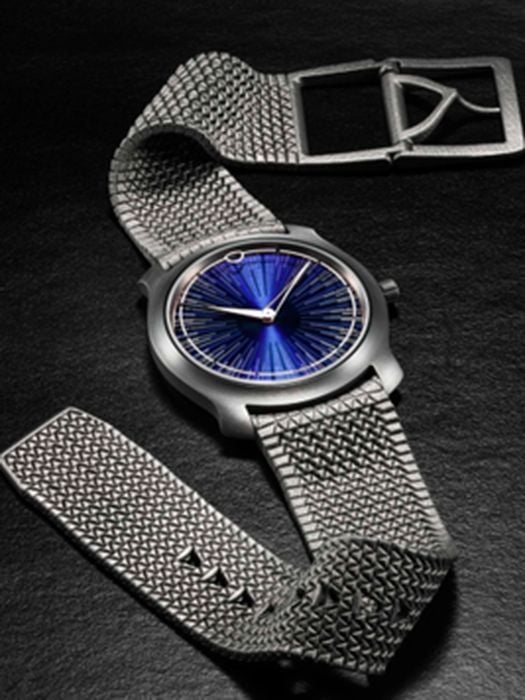
The geometry itself is highly engineered: the strap is composed of a repeating triangular lattice structure that forms a flexible mesh. According to MING, the development process took approximately seven years, involving significant materials research to balance flexibility, strength, and wearability. The entire structure is produced as a single, fully articulated piece, with hundreds of interlinked elements printed in place rather than assembled afterward. This level of geometric complexity relies on additive manufacturing and would be impractical to achieve through conventional subtractive methods such as machining. Key challenges included preventing unintended fusing between moving elements during sintering and managing the reactivity of titanium powder during production, which requires strict environmental control due to its combustibility in fine particulate form (Hodinkee).
MING has experimented with advanced manufacturing techniques before. Prior projects under its Special Projects Cave initiative explored complex internal geometries in sapphire using femtosecond lasers, as well as novel composite materials and ultralight constructions (The 1916 Company). Additive manufacturing had also been used internally during development, with scaled 3D printed prototypes helping refine articulation and movement in the Polymesh design (MING Journal). The Polymesh therefore represents a shift from experimentation to application—its first major use of additive manufacturing in a finished, consumer-facing component rather than solely as a design and prototyping tool.
Other watchmakers have also increasingly adopted 3D printing, though often in more limited or experimental roles. Across the industry, the technology is still primarily used for prototyping rather than large-scale production. Independent brands such as Holthinrichs have used metal additive manufacturing to produce sculptural cases with geometries that would be difficult to achieve through conventional machining, while newer entrants such as Apiar have explored 3D-printed titanium components in small-scale production (Oracle Time).
As 3D printing technology improves, leading jewelry providers such as Stuller, Inc. are providing high-end jewelry to the world’s leading luxury brands.
How does MING’s 3D printed titanium Polymesh strap qualify for R&D Tax Credits?
3D printed watch components, such as MING’s titanium Polymesh strap, qualify for Section 41 R&D Tax Credits because they involve the development of improved products through a process of experimentation. By utilizing additive manufacturing to create a monolithic, articulated structure with tolerances under 70 microns, companies incur Qualified Research Expenses (QREs) related to technical wages, titanium powder supplies, and the integration of specialized sintering software.
Beyond watchmaking, additive manufacturing is expanding across luxury industries. In jewelry, firms such as Stuller have integrated 3D printing into workflows for filigree work, complex gemstone settings, and customized pieces, enabling geometries that can reduce material waste while increasing design flexibility. In fashion and accessories more broadly, additive manufacturing is increasingly used in cases where structural complexity or customization is a priority.
This shift is also reflected in how the technology is perceived. Early 3D printing was often associated with visible layering and rapid prototyping aesthetics. Today, advances in metal sintering, powder-bed fusion, and post-processing techniques mean that printed components can be visually comparable to traditionally machined parts. As a result, additive manufacturing is increasingly valued not for its “printed” appearance, but for its ability to enable geometries that are otherwise difficult or impossible to manufacture.
Technical Innovation: The Geometry of the Polymesh Strap
The Polymesh represents a transition from rapid prototyping to final-stage consumer application of additive manufacturing in luxury watchmaking. Unlike traditional metal bracelets that require manual assembly of pins and screws, the Polymesh is a single, fully articulated piece.
- Materials Research: A seven-year development cycle was required to optimize the balance of flexibility, strength, and wearability.
- Geometric Complexity: The strap utilizes a repeating triangular lattice structure that encodes comfort directly into the metal’s geometry.
- Manufacturing Precision: Produced via layer-by-layer sintering of titanium powder in an inert gas environment to manage material reactivity and combustibility.
R&D Tax Credit Eligibility for Additive Manufacturing
Companies implementing 3D printing for luxury goods or industrial components can recover costs through the following R&D-eligible activities:
| Expense Category | Eligible Activity | Impact on Tax Credit |
| Technical Wages | Time spent by engineers creating, testing, and revising 3D printed prototypes. | Primary driver of credit value. |
| Supplies | Costs of titanium powder or filaments consumed during the iterative development process. | Direct recovery of material waste. |
| Process Improvement | Integrating 3D printing hardware/software to achieve sub-70-micron tolerances. | Enhances process-related claims. |
Rather than emphasizing 3D printing as a novelty, it uses it as an enabling technology for a new kind of mechanical structure—one where flexibility, weight, and comfort are encoded directly into the geometry of the material itself. Unlike traditional metal bracelets, which rely on assembled links, or rubber straps, which are molded, the Polymesh is a monolithic yet articulated structure defined at the microscopic level.
Beyond Watchmaking: Luxury Industry Applications
The shift toward powder-bed fusion and advanced post-processing allows 3D-printed parts to meet the aesthetic standards of traditional machining.
- Jewelry: Firms like Stuller, Inc. utilize 3D printing for complex gemstone settings and filigree work to reduce material waste.
- Fashion & Accessories: Additive manufacturing is prioritized for designs requiring high structural complexity or mass customization.
The strap is available for purchase through select online retailers at approximately US$2,000.