
Stick Tech has published a patent application for getting a finished part off the build surface.
The application, EP-4741139-A1, under the title “Method for Printing and Printer”. The assignee is Stick Tech Oy of Finland.
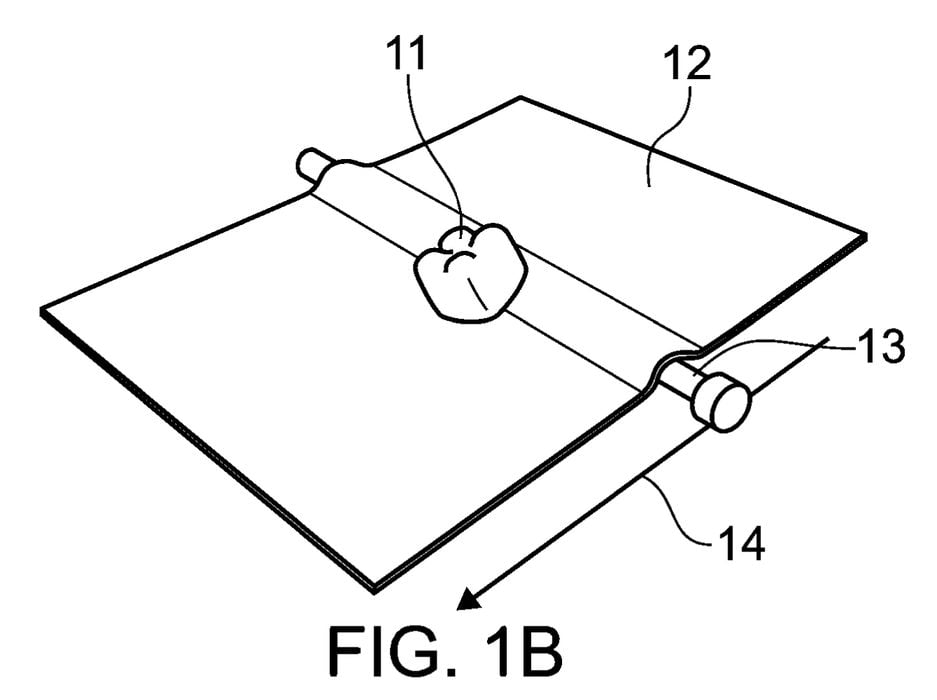
The idea is straightforward. A printer produces an object on a removable sheet using a printing material. After printing, the operator or machine bends the sheet, causing the printed object to detach.
That sounds almost too simple to patent, and sounds much like the way everyone removes prints from today’s flexible build plates. But the interesting part is the specification of the sheet itself.
In the patent, the removal sheet is made from an elastomer and is designed to bend with an inner bend radius of 50 to 800 percent of the sheet thickness, measured according to ISO 10619-1:2018, adapted method B. In other words, this is not merely a flexible build plate. It is a controlled flexible interface whose bending behavior is part of the print removal method.
Anyone using FFF, resin, or even some paste-based 3D printing systems knows the removal problem. Too little adhesion and the print fails. Too much adhesion and the part, surface, and probably the operator suffer.
Desktop FFF systems usually solve this with spring steel PEI plates, magnetic build sheets, glue sticks, textured beds, or even freezer tricks to shrink the print off the plate. Resin users deal with adhesion on the build platform and peel forces at the vat interface. Industrial systems use more elaborate fixtures, coatings, removable trays, or post-processing workflows.
Stick Tech’s patent appears to focus on a different mechanical approach: print on a sheet that can deliberately deform after the build, using elastomeric flexure to break the attachment between object and surface.
That could reduce manual labour in applications where many small parts are printed, especially if part removal can be automated. A sheet that bends predictably might let a printer, conveyor, or post-processing station pop off finished parts without scraping, prying, or damaging delicate features.
This could be especially attractive in production-oriented 3D printing, where the removal step is often a quiet bottleneck. The printer may be fast, but if a person must stand there with a scraper after every build, throughput is still limited by operator time.
What Is Stick Tech Thinking About?
Stick Tech Oy is not one of the familiar desktop printer names such as Prusa, Bambu Lab, Creality, or Anycubic. Nor is it a major AM system vendor like Stratasys, EOS, HP, Formlabs, or Nikon SLM Solutions. In fact, they have a registered domain name (sticktech.com), but no website. They are quite small, and very likely a startup company.
The title says both “method for printing” and “printer”, suggesting the company is not merely claiming a consumable sheet. It may be considering a system where the removal sheet is part of the machine architecture.
The image at the top reveals how this system is intended to work: a “stick” seems to slide under the elastomer surface, generating a bend that cracks the print off the plate. This could easily be incorporated into a continuous 3D printer that would make itself ready for the next print.
That implies several important questions. Does the sheet survive hundreds of cycles? Does it maintain dimensional stability during printing? Does it work with high-temperature polymers, photopolymers, silicones, dental materials, or composites? Can it support accurate first-layer geometry, or does its compliance introduce variation? There just isn’t any information on this yet.
A Patent, Not A Product
As always, a patent application is not a product announcement. EP-4741139-A1 does not prove Stick Tech is shipping a printer, build surface, or automated part removal system. It only shows that the company is trying to protect a particular method involving a bendable elastomer removal sheet. It may be that they intend on selling the concept to established 3D printer manufacturers for incorporation into their equipment.
If Stick Tech can turn controlled sheet bending into reliable, repeatable print ejection, it could be extremely useful.
Via Espacenet
