
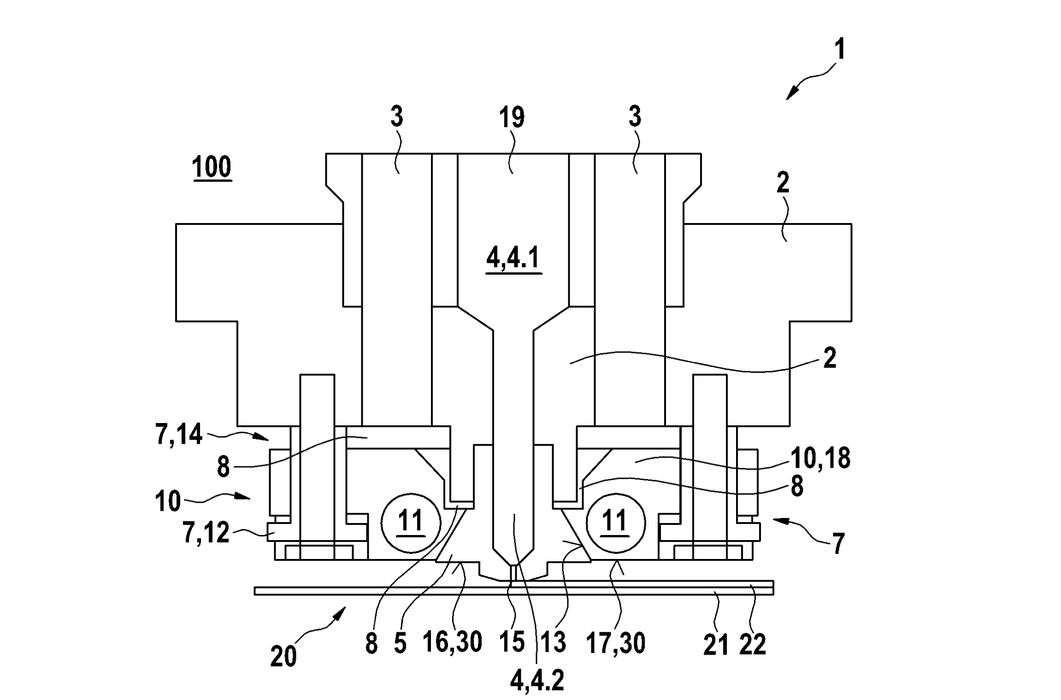
Bosch has filed a German patent application for a 3D printer printhead with a heated ring around the nozzle.
In FFF-based 3D printing, temperature control at the very end of the melt path can be the most important temperature. Most FFF systems actually heat a block of metal upwards of the nozzle.
The patent was filed by Robert Bosch GmbH and published in May 2026. It describes a printhead for a 3D printer that includes the usual heated housing to create softened material, plus an additional heating ring with heating elements positioned near the nozzle.
In other words, Bosch is not merely heating the material somewhere upstream and hoping the melt exits at the right temperature. The company is proposing a second, localized heating stage right at the nozzle.
A More Controlled Melt Path
The problem being solved is that the softened material must be hot enough when it leaves the nozzle to bond properly to the previous layer. If the melt temperature drops too much before extrusion, layer adhesion suffers. That can reduce mechanical strength, create weak parts, and increase warping.
Bosch gives an interesting example. With commonly used materials such as Polyamide 6 with 30% glass fibre, normally extruded around 280°C, the actual temperature after extrusion can reportedly be up to 150°C below the desired value.
That is a large thermal gap, and one can see why layer adhesion can fail.
The proposed heating ring places heaters close to the thermally conductive region between the nozzle and the ring body. Bosch says this allows faster response to temperature fluctuations because the thermal mass around the nozzle is relatively small.
The patent also describes an increasing temperature profile. The upper melt chamber can remain at a more material-friendly temperature, while extra energy is added only at the nozzle. That could be especially useful for materials that degrade if held too hot for too long, including certain polyamides and flame retardant polymers.
This is the interesting part: Bosch is trying to separate “melt preparation” from “final bonding temperature”. That is a more sophisticated approach than simply making the whole hot end or chamber hotter.
Small Details, Real Implications
The patent includes several mechanical features that show this is more than a vague idea.
There is an air gap between the printhead housing and the heating ring to reduce unwanted thermal coupling and account for thermal expansion. There is also a conical contact surface between the heating ring and nozzle, intended to maintain good heat transfer even as parts expand.
Bosch also describes a nozzle arrangement where the distance between the nozzle opening and the lower nozzle or heating ring surface is preferably between one and 2.5 millimeters. During printing, the same preferred gap applies between the part and the underside of the nozzle or ring.
That is important because a hot ring sitting too close to the part could cause contamination, sticking, overheating, or physical damage. Too far away, and the system may lose some of the intended thermal benefit.
The patent further proposes thermally insulating material on the underside of the nozzle or heating ring, such as polyamide film or fibre composite material. That seems aimed at preventing excessive heat transfer into small parts when the head lingers in one area.
High temperature and fibre-filled extrusion remain difficult because the process window is pretty narrow. If Bosch can control melt temperature at the point of extrusion without cooking the material upstream, it could improve reliability for functional parts.
Via Espacenet
