
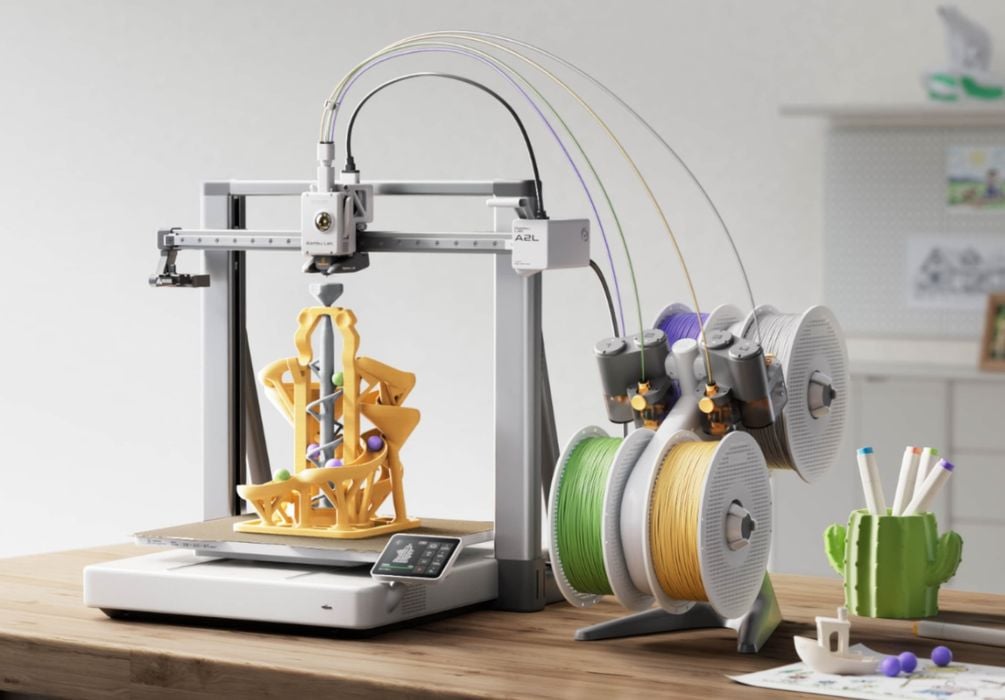
Bambu Lab announced a new and larger desktop FFF 3D printer, the A2L.
This is quite a switch for Bambu Lab, who have been focusing on enclosed systems for quite some time. The A2L is a kind of larger A1 system, which was announced in 2023 after the earlier A1 mini. There are now three “A” series models that all have different sizes: A1 mini, A1, A2L.
Let’s get to the specs. While the visual styling of the A2L is quite reminiscent of the A1, it is much larger, with a build volume of 330 x 320 x 325 mm. Only the H2S is larger at 340 x 320 x 340 mm. The original A1 is 256 x 256 x 256 mm.
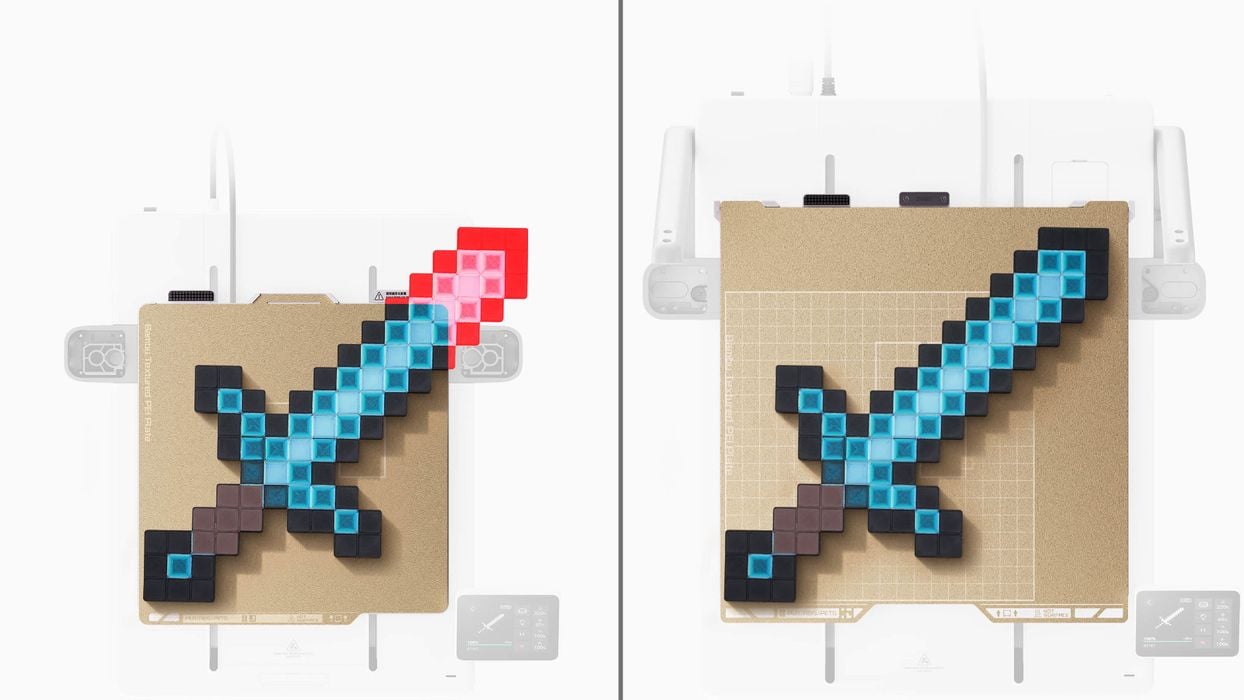
The size explains the “L” in the product name. It’s a large machine.
But what about that “2” in the name? In other Bambu Lab products, that typically refers to the “Generation” of the system, with 1 being the original and 2 being a more advanced system. What makes the A2L “2”-worthy?
It turns out there are two new technical features on the A2L. Both features are designed to counteract an inevitable problem when extending the build volume on a bedslinger-style system like the A series: wobble at the top.
Bedslingers slide the build plate back and forth on the Y-axis very rapidly during printing. This design lowers the cost of mechanicals, and works just fine for smaller parts. But when you print taller items, there is a problem.
As the bed sweeps back and forth, tall objects start swinging. Imagine holding a cardboard tube vertically and rapidly shifting it to and fro. The top of the tube will be increasingly “behind” the movement at the bottom, leading to it being out of position at the moment of FFF deposition.
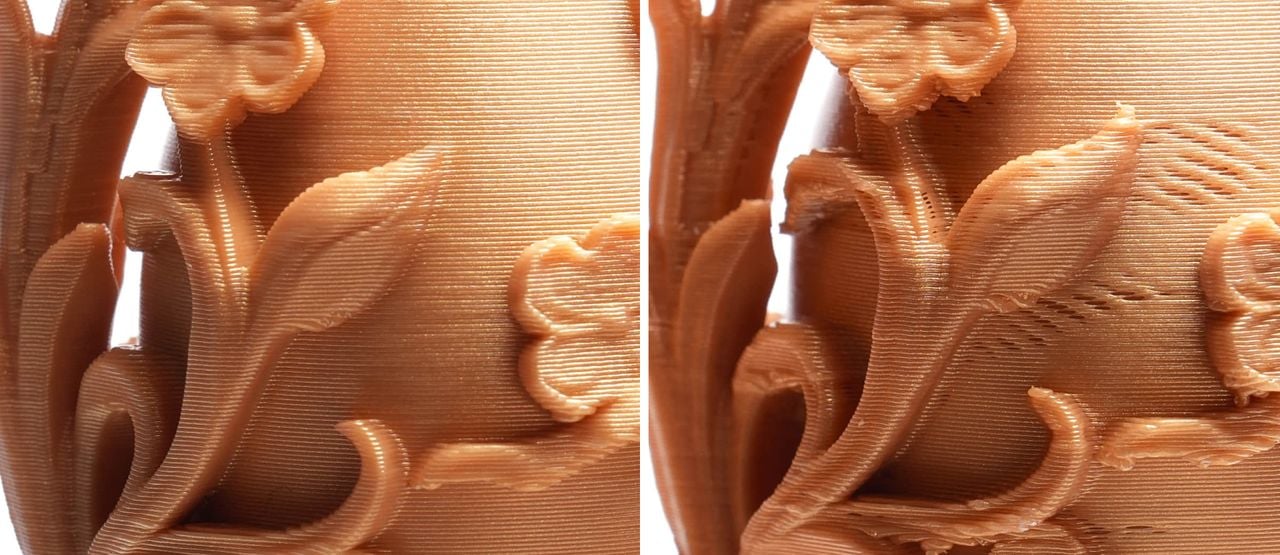
Anyone printing tall items on a bedslinger will have seen this effect. It manifests as wobbly layers and ringing patterns that get worse the higher you go. On the A1 and A1 mini especially, this is less of an issue. But when you boost the Z-height to 325mm it’s a big quality problem.
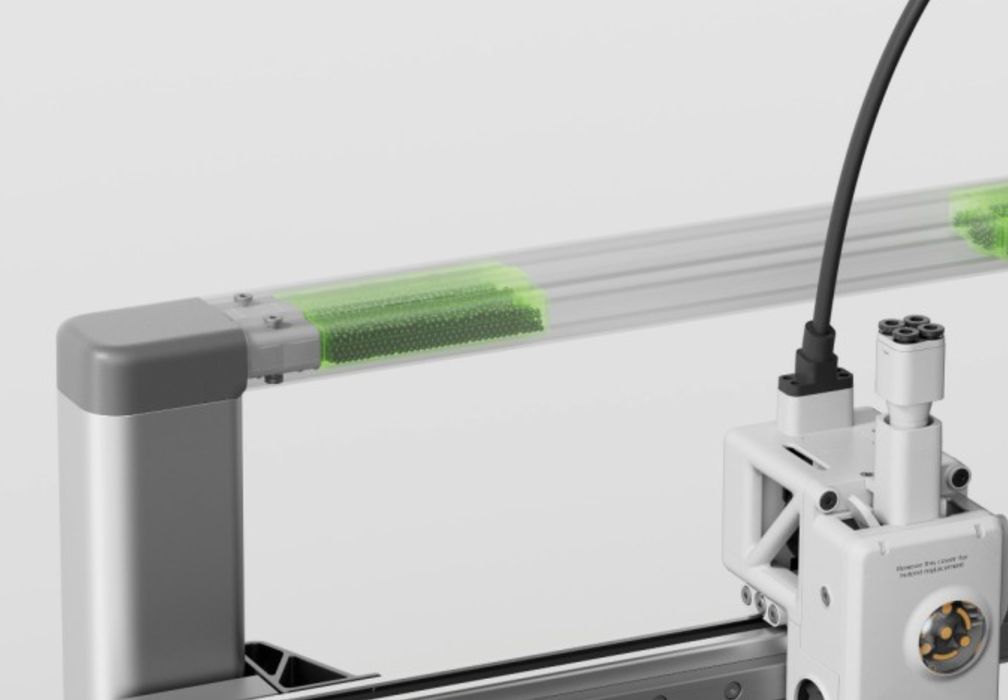
Bambu Lab has introduced two features on the A2L to solve this problem. The first is called “in-frame granular damper”. Basically, they put some material inside the frame that slides around and counteracts the wobbling momentum. It’s very similar to how tall buildings are protected from earthquakes.
The second method is called “Adaptive Vibration Compensation”. Vibration compensation is not new; it’s been around for a while and was one of the main features that allowed for high-speed 3D printing. The new feature here is that instead of calibrating just once, the A2L is able to “intelligently retune for different bed loads and toolhead positions in real-time”.
Both features do not appear on any other Bambu Lab machine, suggesting that future devices might include them. But for now, it’s only available on the A2L.
Aside from those, the A2L also includes a PMSM servo extruder that should provide more reliable extrusion, a mechanical nozzle clumping detector on the purge mechanism, and is fully compatible with the AMS2 Pro, although it normally ships with an AMS Lite.
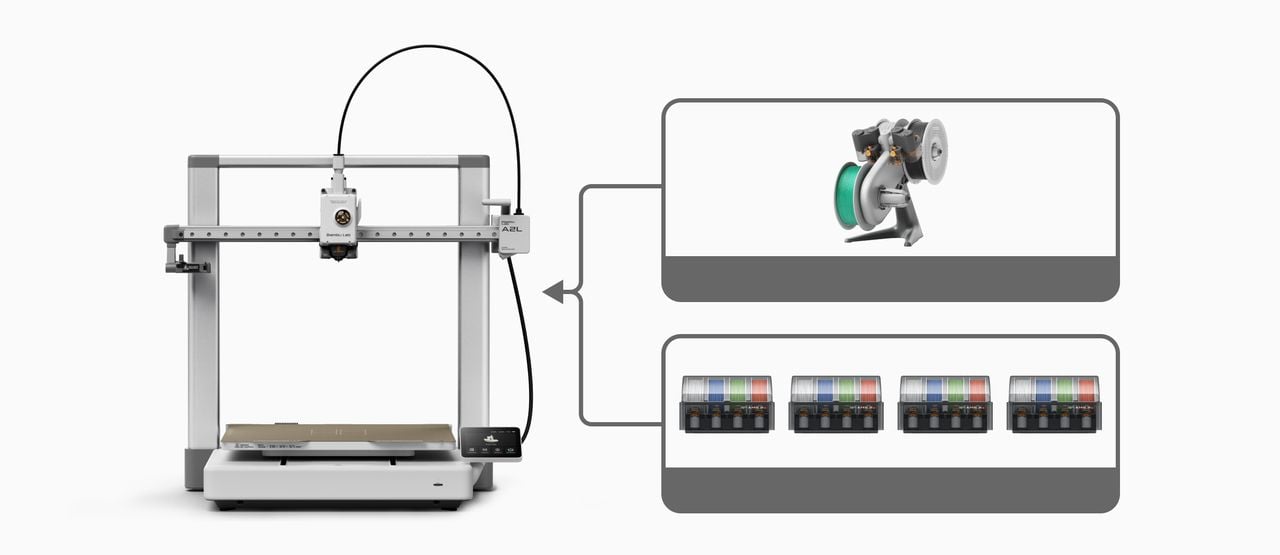
In fact, the A2L can use up to 19 colours in a single print job by attaching four AMS 2 Pros with a single AMS Lite with three active spools on it.
There is also a modular mounting point where you can optionally add a cutting and pen module. This would, for example, be able to precisely cut (or draw on) paper or cardboard with the same A2L hardware. This is available through the “Blade Cutting Upgrade” optional feature.
There’s one interesting limitation on the A2L: the bed temperature can only go as high as 80C, unlike the 100C on other A series units. This is because the much larger area would require a huge amount of power to heat. In addition, high heat is only required for materials like ABS, which you shouldn’t be printing on an open-air device anyway. Therefore, Bambu Lab smartly limited the bed temperature.
The A2L looks to be an interesting machine for anyone seeking a much larger build volume for printing huge objects in PLA, but not wanting to spend the price of a large enclosed system.
Via Bambu Lab
