
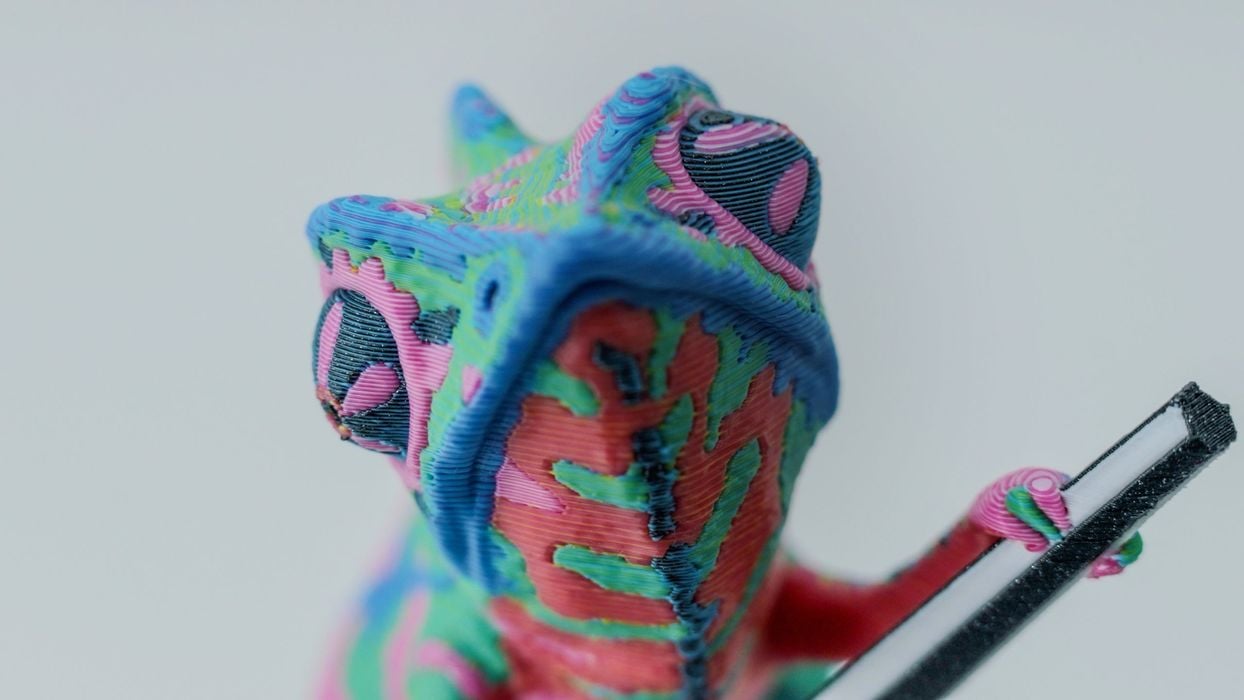
Prusa Research has added an open-source “ColorMix” workflow to PrusaSlicer and EasyPrint that can turn a handful of loaded filaments into dozens of visible color tones.
The idea has been brewing for a few months in the 3D print community: if your printer can swap filaments between layers, you can “mix” colors optically rather than being limited to whatever spools are mounted. Early experiments appeared as slicer forks and utility tools, including Ratdoux’s OrcaSlicer-FullSpectrum and Justin H. Rahb’s filament-mixer for predicting outcomes, plus sharing projects like PeggyPalette. Prusa’s announcement effectively productizes that approach for its own software ecosystem.
What Prusa is shipping is a new way to prepare multi-color print jobs. Instead of treating “mixed colors” as a long list of manually configured extruder ratios, the company wants it to feel like painting: load filaments, pick colors from a palette, and trust that the on-screen preview is close to the real print. Decorative parts, figurines, cosplay props, and gifts all require decent color fidelity.
Halftone Thinking, Not Paint Mixing
ColorMix relies on a concept familiar from 2D printing: halftoning. Inkjet printers create the illusion of continuous tones by placing tiny dots of cyan, magenta, yellow, and black (CMYK) at different densities. In fused filament fabrication (FFF), there are no dots on paper, but there are very thin layers of plastic. If you alternate colors by layer finely enough, the human eye blends them at normal viewing distance, producing intermediate tones.
Prusa’s internal team focused on layer-interleaved mixing that most multi-filament systems can already do, including single-nozzle changers (MMU-style or Bambu AMS-style) and toolchangers. Toolchangers like the Original Prusa XL can be faster because they avoid repeated purges, but they introduce a different risk: inaccurate XY offsets between nozzles can make colors appear inconsistent across a surface. Single-nozzle systems avoid nozzle alignment issues but pay for each swap in purge time and waste.
Prusa also highlights why it is preparing a dedicated five-filament set: CMY plus black and white (CMYKW). Many common four-spool setups lean on CMYW, which can struggle to make a convincing black, often producing a bluish dark gray instead. On a five-tool XL, adding a true black filament makes the palette more usable and reduces the need for “fake black” mixes.
What’s Actually New Here
The key claim is accuracy and usability. Prusa engineer Ondrej Bartas described why earlier predictors were limited: some models were tuned for oil paint behavior, not printed plastic, and others assumed stacked translucent layers viewed from above, which is closer to HueForge-style work than side-view 3D parts. Prusa’s approach starts from a halftone equation and then calibrates it against measured FFF test prints, using a repeatable methodology where base filaments and their mixes are measured in the same session to reduce instrument drift errors.
There are also practical constraints baked into their workflow. Layer-interleaved mixing cannot produce every possible percentage smoothly, because ratios are discrete: a 50:50 mix is a simple alternation, while something like 30:70 would require a long repeating block that reduces vertical detail and can create visible striping. Prusa says it targeted the ratios that are realistically printable (such as 1:1, 1:3, 3:1, and a balanced three-color mix), and then focused on getting those predictions right.
Prusa is publishing the ColorMix model under the MIT license and tying it into its OpenPrintTag Material Database, which could become important over time. The company openly notes gaps: its measurements were primarily Prusament PLA on a Prusa XL, and coefficients may differ for PETG, ABS, or specialty “effect” filaments like glitter and galaxy blends, where reflectance can depend on viewing angle. In other words, this is a shipping feature, but it is also a data collection play.
If the community contributes enough measurements, the model could become a de facto shared reference for “full spectrum” multi-filament printing across slicers. If not, it may remain a great Prusa-centric experience that is hard to replicate elsewhere.
Either way, it is another signal that the next leap in multi-material printing may come from software that makes color simple, not from adding yet another spool holder.
Via Prusa Research
