
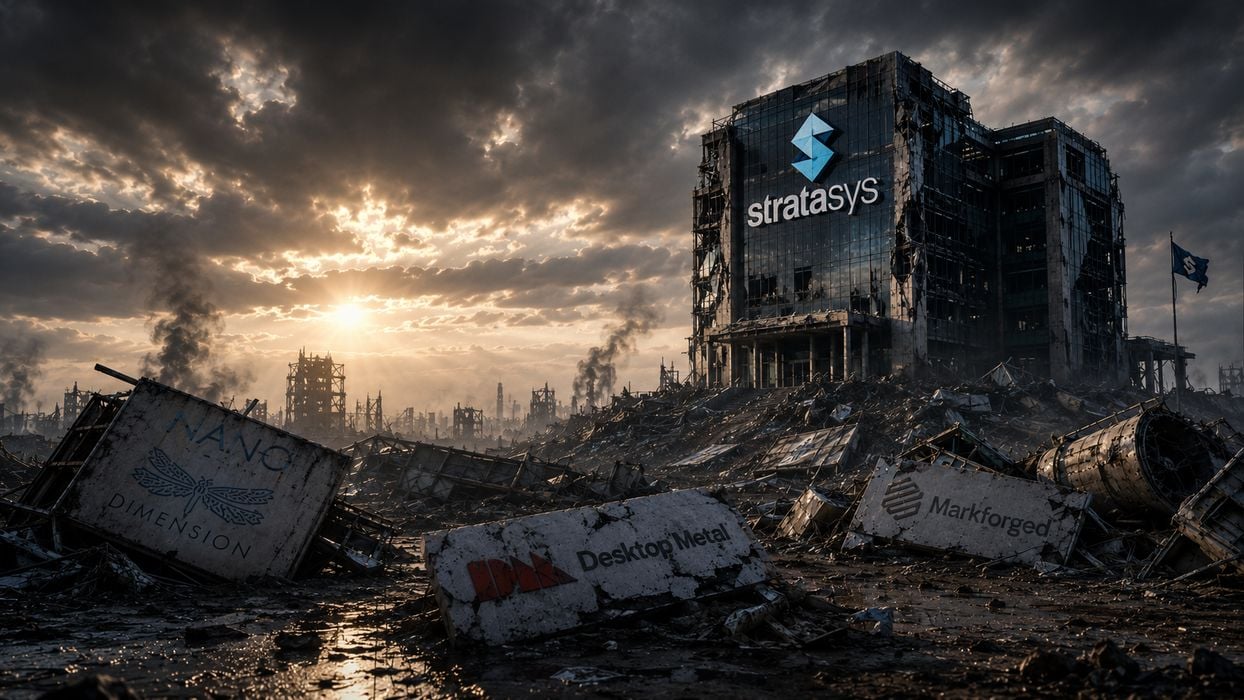
Let’s look at the timeline of the startling corporate moves involving Stratasys and Nano Dimension.
Last week might have been the conclusion to the long-running Stratasys/Nano Dimension corporate battle. The news last week was that Nano Dimension sold Markforged (or a big part of it) to rival Stratasys for seemingly peanuts. That in itself doesn’t sound like a big story, but it is the culmination of three years of corporate wrangling involving the two companies and several others.
Back in 2021-22, the 3D print industry was vastly different in terms of financials. Then investors—many of whom had little understanding of the technologies—invested staggeringly huge sums of money into several high-profile 3D printer manufacturers. The idea was that they’d have a good chance of taking over manufacturing with their new, shiny technologies.
Of course, that didn’t happen because the technologies were not truly capable of performing large-scale manufacturing in an economical manner. That didn’t stop the companies, though, as they promoted their businesses as good bets on the future in order to collect that sweet investment cash.
And they did. Increasingly huge amounts of money were collected by companies who sold off small fractions of their shares and thus created huge valuations, sometimes in the multi-billions. All this without matching evidence from sales progress.
What would they do with all that cash? Some of the players, most notably Nano Dimension, sought to corner the market on 3D printing by acquiring multiple smaller companies. Nano Dimension acquired Digital Metal, Markforged, Desktop Metal, and others over a lengthy period.
But then it all crashed out. Here’s the full sequence of events for those interested:
March 2023: Nano Dimension launched an unsolicited partial tender offer for Stratasys.
Stratasys rejected it, calling it inadequate and recommending shareholders not to tender.
May 25, 2023: Stratasys announced an all-stock merger with Desktop Metal, structured as Desktop Metal shareholders receiving 0.123 Stratasys shares per Desktop Metal share.
This was positioned as an AM consolidation move across polymer, metal, binder jetting, dental, production, and industrial applications.
May–July 2023: Nano Dimension kept pursuing Stratasys, raising/revising its partial tender offer, eventually to $25 per share.
Stratasys repeatedly rejected Nano’s offer and maintained support for the Desktop Metal transaction.
June 2023: 3D Systems entered with its own proposal to combine with Stratasys.
Stratasys also rejected/resisted 3D Systems’ approach while continuing to back the Desktop Metal merger.
July 31, 2023: Nano Dimension’s Stratasys tender offer expired/was discontinued.
Nano said the offer conditions were not satisfied and it would return tendered shares; it also withdrew its board nominees.
2023–2024: Nano Dimension faced a prolonged shareholder revolt led by activist investor Murchinson.
The dispute focused on Nano’s cash-heavy balance sheet, acquisition strategy, governance, board control, and CEO Yoav Stern’s leadership. Murchinson had been pushing to replace directors and force tighter accountability.
Sept. 2023: 3D Systems made another binding offer for Stratasys.
The offer was still active around the Stratasys shareholder vote, but did not result in a transaction.
Sept. 28, 2023: Stratasys shareholders rejected the Desktop Metal merger.
Stratasys terminated the Desktop Metal merger agreement. Desktop Metal shareholders had approved it, but Stratasys approval was required.
July 2024: Nano Dimension agreed to acquire Desktop Metal for roughly US$183M.
This replaced the failed Stratasys–Desktop Metal path with Nano as the acquirer.
Oct. 3, 2024: Desktop Metal shareholders approved the Nano Dimension merger.
MarketWatch reported that about 60% of Desktop Metal shares voted in favour, with closing then expected after remaining approvals.
Dec. 2024: Nano shareholders elected Murchinson-backed directors and removed CEO Yoav Stern from the board.
Ofir Baharav and Robert Pons were elected, replacing Stern and Michael Garrett; Nano later confirmed board composition changes. Murchinson also said shareholders rejected Stern’s compensation package by about 75% of eligible votes.
Dec. 2024–2025: Nano Dimension shifted into a new-management/new-board phase.
With activist-backed directors installed and Stern no longer on the board, Nano’s post-acquisition strategy around Desktop Metal and Markforged increasingly looked like a reset: review assets, preserve cash, and rationalize what it had just bought.
Late 2024–Mar. 2025: Nano tried to avoid/delay completing the Desktop Metal acquisition; Desktop Metal sued.
Delaware Chancery Court ordered Nano to complete the transaction.
Apr. 2, 2025: Nano Dimension completed the Desktop Metal acquisition.
Desktop Metal became an indirect wholly owned subsidiary of Nano Dimension and ceased to be publicly traded.
Apr. 25, 2025: Nano Dimension completed its acquisition of Markforged.
Nano then controlled both Desktop Metal and Markforged, two formerly public AM companies.
Apr.–July 2025: Desktop Metal began a strategic review after being acquired.
Reports described cash/debt pressure and potential restructuring or asset sales.
May 2025: Nano Dimension began pruning its acquired companies, shuttering/selling Admatec, DeepCube, Fabrica, and Formatec after years of acquisition-led expansion.
This signaled that the post-Stern / activist-influenced Nano was no longer simply accumulating assets; it was cutting non-core or underperforming pieces and refocusing on profitability.
May 2026: Nano Dimension agreed to sell Markforged to Stratasys for US$42.5M cash, while retaining the Markforged metal binder jetting product line.
This means Stratasys, which failed to acquire Desktop Metal in 2023, is now buying Markforged assets from Nano Dimension instead. The deal is expected to close in the second half of 2026.
In the end, Stratasys is still standing and has a nice new piece to its portfolio, Markforged. Meanwhile, Nano Dimension seems to be a shell of its former self, having divested almost all of its 3D print assets. It is not clear what they intend to do going forward. I’d say this is a win for Stratasys.
