
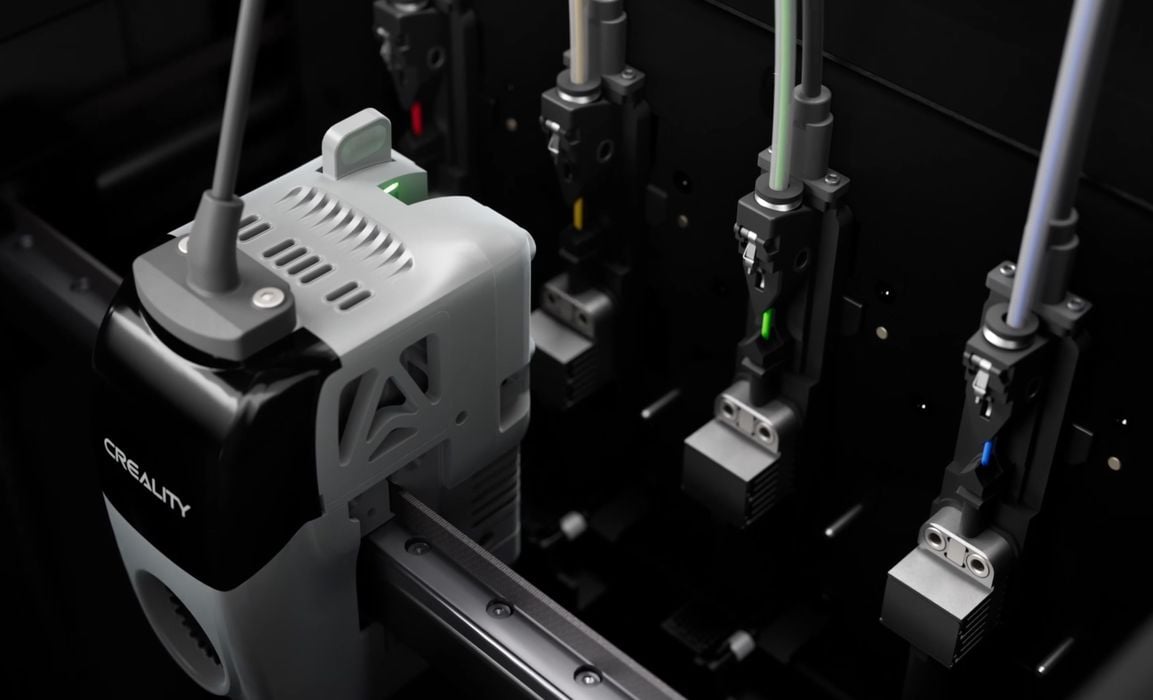
Creality has joined the no-waste 3D printing club with the surprise announcement of “KliTek”.
The company, one of the largest producers of desktop 3D printers, had a gap in their product line until this announcement. Competitors Snapmaker, Bambu Lab, and Prusa Research have all announced and released zero-waste FFF devices using a variety of approaches. Snapmaker uses a tool-changing system, Bambu Lab uses their Vortek concept, and Prusa Research partnered with Bondtech to use their INDX system.
Now, Creality has its own system: KliTek.
Their approach is similar to those used by the other companies: they can quickly swap nozzles onto the toolhead, apparently in less than five seconds. There are four nozzles that are garaged at the back of the build chamber. To perform a swap, the toolhead moves to the back and “clicks” onto a nozzle to capture it. A reverse move can deliver a nozzle back into the garage.
KliTek enables Creality to produce machines that are zero-waste. That’s because no (or limited) purging is required when changing nozzles. 3D printer operators are now catching on to the increasing problem of waste, which effectively drives up the cost of materials to produce prints by as much as 10X. Zero-waste systems have proven extremely popular, and it’s now very clear that the era of wasteful FFF 3D printers is now closing.
But does this mean that Creality has merely caught up with the competition? Is their KliTek technology the same?
There are actually a couple of very interesting differences that could differentiate Creality’s approach from the others.
One I’ve already mentioned is speed: they say the system can change nozzles in only five seconds. That would include not only picking up a new nozzle, but also putting away the old one. In other words, less than 2.5 seconds for a nozzle operation, which is pretty fast.
They’ve also simplified the maintenance on this system. They say that replacement of a nozzle is faster due to the design. They say:
“Users can easily replace the nozzle assembly by removing two screws and unplugging the USB-C cable.”
But the big deal is how they handle TPU. They’ve somehow designed this extrusion system to more easily handle the difficult TPU material.
Normally, TPU requires special treatment because it is flexible: it can wrap around extruder gears, bend out of the filament path, and fold up where it shouldn’t. Because of this, most 3D printers require extremely slow print speeds when printing TPU. That works, but wow, it can really slow down a print job.
KliTek apparently can print TPU up to 7X faster than other 3D printers. They say that for TPU95A, one of the harder TPUs, it can achieve 15 cubic mm per second, which is enormously more than the usual specs on other systems. For the much softer TPU85A, KliTek can achieve three cubic mm per second, which is also way faster than normal.
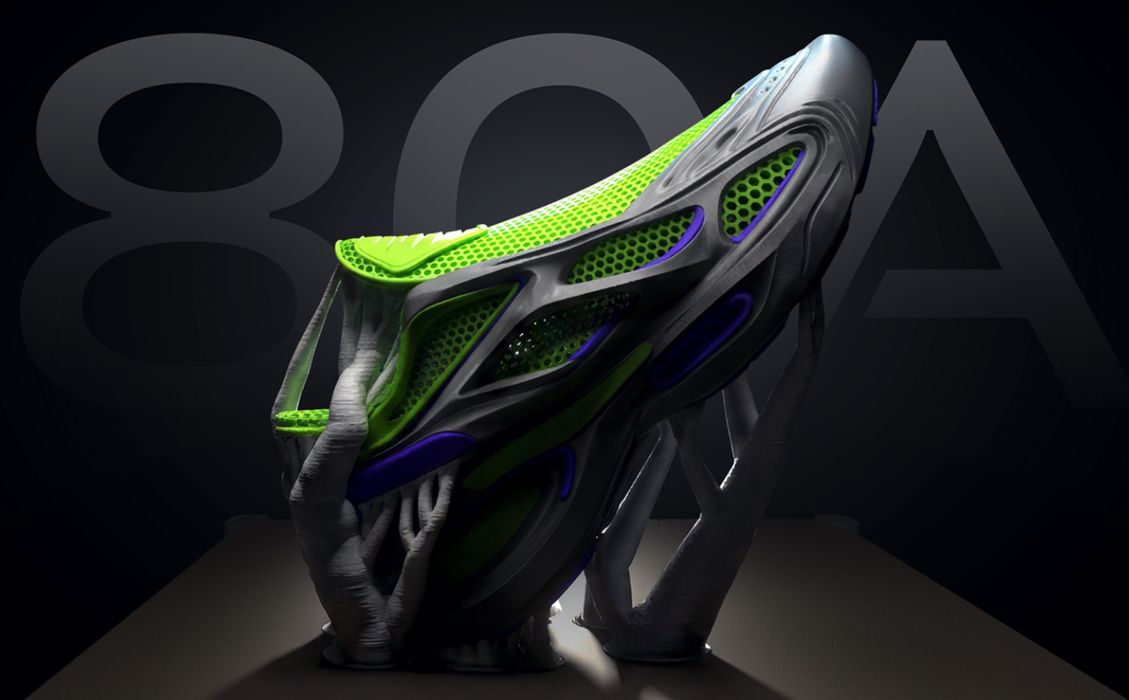
It seems that all four of the nozzles are “TPU capable”, which is another big advantage. Bambu Lab’s Vortek system, for example, requires TPU to enter through a second nozzle. That means it can handle only one TPU per job. Meanwhile, KliTek can handle up to four! Imagine a part printed with multiple TPU materials of different softness.
By the way, the four nozzles enable a KliTek system to use the full spectrum color gradient approach to reproduce a wide range of colors when using only cyan, magenta, yellow and black filaments. This is similar to other systems, and not a differentiating factor.
This is all very interesting, but Creality has not yet indicated which machine will be the first to use KliTek, aside from a brief mention of a “K3” machine. They say this technology will first appear in Q3 2026, so we have several months to wait.
Via Creality
