
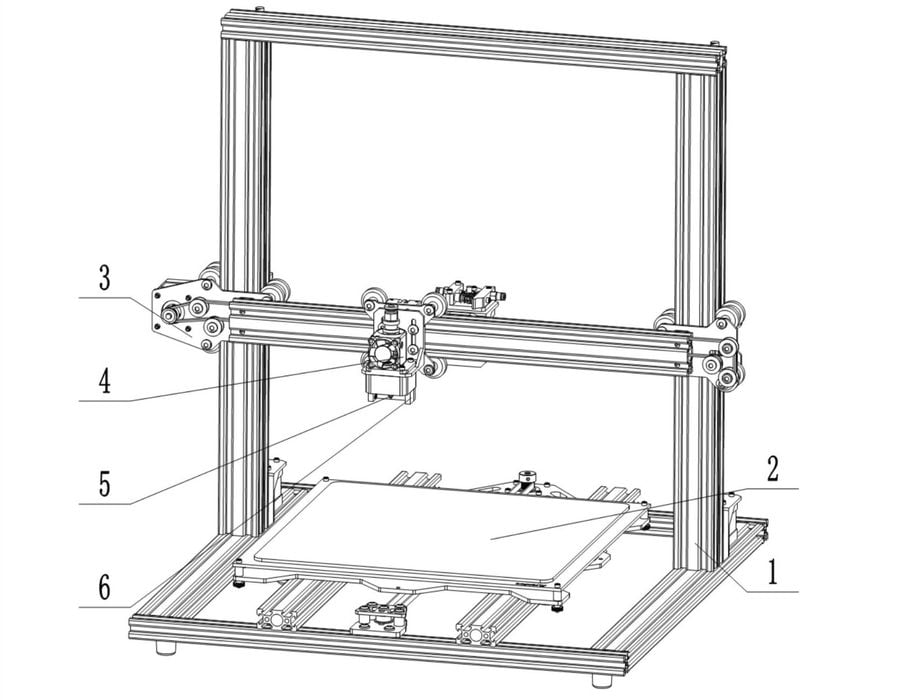
A newly granted Chinese utility model patent proposes a self-cleaning, retractable filament sensor for FFF 3D printers.
Patent CN224465273U was assigned to Qingdao Future Intelligent Creation 3D Printing Co., Ltd. on July 7, 2026.
The problem being solved here is one every FFF 3D printer operator would experience: filament runout sensors are useful, but their exposed optical components can become dirty or damaged. Then it doesn’t work reliably.
According to the patent, dust drawn through the toolhead cooling system can settle on infrared sensors. Vapors generated while printing PLA or ABS may also condense on the detection surfaces, while fragments or lubricants from materials such as PETG can interfere with the optical path.
All that contamination could weaken the infrared signal and trigger false filament alarms. Meanwhile, tools or hands might damage the sensor while an operator cleans the build platform, adjusts the machine, or even simply changes material.
The proposed solution is more mechanical than electronic.
The infrared emitter and receiver sit inside a monitoring structure mounted beneath the extrusion assembly. Each sensor rides in a sliding support fitted into a protected slot.
When the extrusion system powers up, two electromagnets pull a transmission plate. Rods attached to that plate move angled supports, which then push the infrared emitter and receiver outward into their operating positions.
The sensors remain exposed while printing and monitor whether the filament is present.
When printing stops, the electromagnets switch off. Return springs move the angled supports backward, retracting both optical components into the housing.
In other words, the sensitive portions of the runout sensor “disappear” when the machine is idle.
Protective plates move with the sensor supports and carry soft nylon brushes. Each time the sensors extend or retract, the brushes sweep across their detection surfaces. Flexible corrugated covers also expand and contract around the sliding mechanism to prevent dust from entering the internal cavities. That’s pretty ingenious.
Rather than merely enclosing the sensor, the design uses normal machine startup and shutdown cycles to perform a small cleaning operation automatically.
That could be useful on printers operating in dusty workshops or production environments where small maintenance tasks accumulate across larger farms of equipment. A runout sensor that generates false alarms can interrupt long builds and consume operator time, even when no material failure has occurred.
But I have a concern: this is a fairly elaborate mechanism for a component that is normally very inexpensive and completely stationary.
The assembly adds electromagnets, springs, sliding parts, brushes, covers, and a transmission plate to the moving toolhead. That could increase weight, manufacturing cost, and the number of components capable of wearing out or becoming misaligned. More parts usually mean more breakage.
The patent also appears primarily intended to detect filament presence. It may recognize the lack of a filament in front of the sensor, but a simple infrared beam generally cannot confirm that material is actually moving. A jammed filament segment could remain inside the sensor while extrusion has already stopped.
Mechanical flow sensors, encoder wheels, and extrusion force monitoring can provide more information, although those approaches have their own reliability and maintenance issues.
Whether this actually appears in a product is questionable: the existing inexpensive approaches might be good enough for most setups.
Via Espacenet
