
A new ELEGOO patent application describes a mechanical approach to making multi nozzle FFF 3D printers easier to set up and switch.
The filing is CN122077926A, assigned to Shenzhen Intelligent Pai Technology Co., Ltd., a.k.a. ELEGOO. It was published on May 26, 2026. The title translates from Chinese roughly as “An FFF Printing Multi Nozzle Quick Positioning Switching Mechanism.”
The patent focuses on a common issue in multi nozzle material extrusion systems: how to switch among several print heads while keeping the selected nozzle properly aligned with the filament feed path.
That sounds simple until you think about the mechanics involved. In a multi nozzle FFF system, each nozzle may be intended for a different material, color, layer requirement, or tool condition. If the nozzle does not align correctly with the filament path, material can leak, snag, or blob up around the nozzle and rotary plate. That can reduce reliability and even damage the machine.
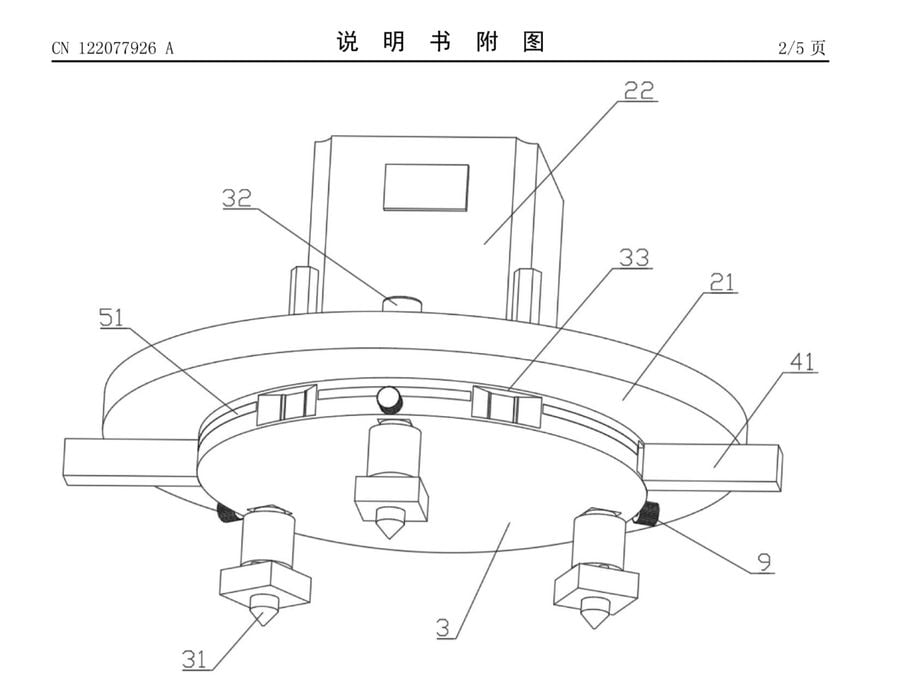
The proposed mechanism in the patent places several nozzles on a rotating disk. A drive motor turns the disk to bring the required nozzle into position. The system includes a guide rail, moving plate, mounting plate, drive motor, rotary plate, material guide nozzle, and several positioning components intended to lock or assist the rotary plate when the nozzle reaches the correct location.
The interesting part is not simply the rotating nozzle carousel. We have seen plenty of tool changing and multi nozzle concepts in FFF over the years. The useful feature here is the combination of automatic positioning aids and manual service features.
The patent describes paired limiting assemblies that position the rotary disk just so the selected nozzle stops opposite the material guide nozzle. These assemblies include positioning holes, limiting rods, springs, grooves, magnets, magnetic strips, and rounded contact surfaces. In other words, the design tries to make the nozzle arrive at the right place, stay stable, and avoid small alignment errors caused by motor precision, or friction.
Stepper motors can be controlled precisely, but real printer mechanisms still have tolerances, vibration, wear, and material buildup. A purely motor driven rotation system might look accurate in a CAD design but might become unreliable after many tool changes. A mechanical capture system can make the final positioning less dependent on perfect motor behavior.
The patent also describes a ring shaped rod that connects to the nozzle and engages a sliding groove. Magnets appear to help hold the ring in a stable position during setup, and a threaded rod can limit or release the ring. There is even a hand knob to reduce the difficulty of turning the threaded rod during nozzle inspection or maintenance.
That suggests that ELEGOO is also thinking about operator experience, not only print function. Multi nozzle machines often promise more automation, but they can also introduce more manual effort. If the operator must spend significant time aligning nozzles, cleaning leaked filament, or diagnosing misfeeds, the value of additional nozzles would quickly fizzles out.
A reliable quick positioning system could improve throughput in small production environments where operators need to switch materials or nozzles frequently. It could also make a lower cost multi nozzle system more believable, especially in desktop or prosumer printers where complex tool changers are too expensive.
As FFF printer manufacturers look for ways to differentiate beyond speed, multi material and multi nozzle systems have become pretty popular. The hard part is making them boringly reliable. This patent appears to focus exactly that problem: not by adding software complexity, but by using mechanical guidance to make nozzle switching more reliable.
Will ELEGOO deploy this method into an actual printer?
Via Espacenet
