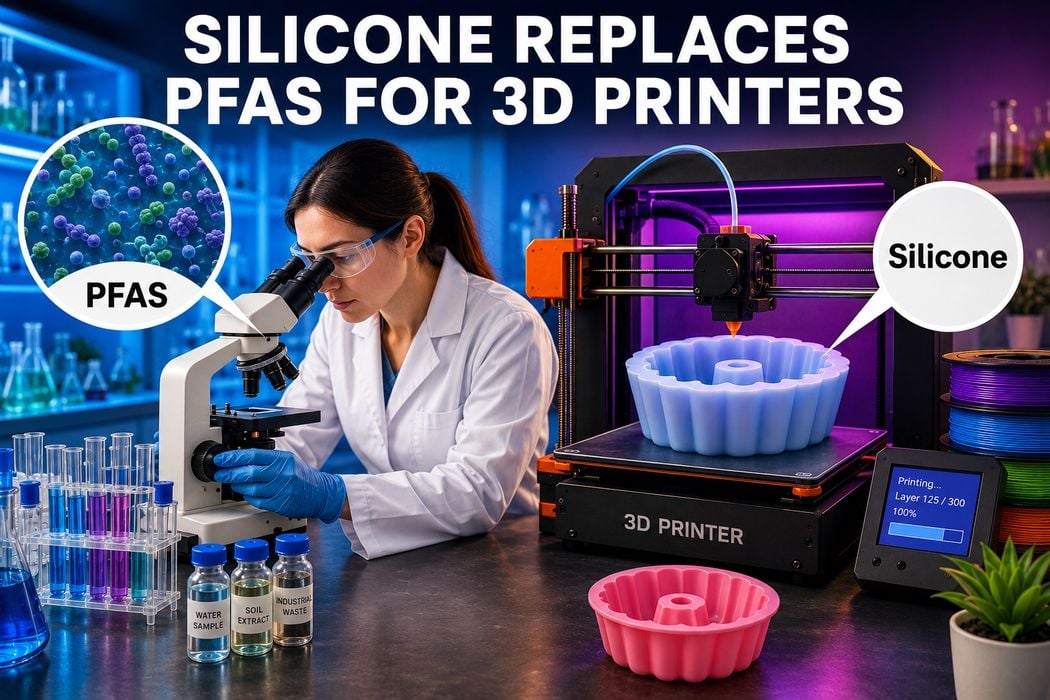
Charles R. Goulding and Preeti Sulibhavi examine why silicone additive manufacturing, FDA compliance, and PFAS-free materials are becoming critical priorities for the future of food production.
The 3D printing industry has spent years talking about food-safe manufacturing, but the definition of “food safe” is changing rapidly. Regulators, material suppliers, and food equipment manufacturers are now under pressure to eliminate or reduce exposure to PFAS compounds, often referred to as “forever chemicals,” while also meeting increasingly strict FDA compliance requirements.
One regulation gaining renewed attention is FDA Title 21 CFR 177.2600, a standard that governs rubber articles intended for repeated use in food contact applications. While the regulation itself is not new, its practical importance has increased as food manufacturers reassess every seal, gasket, tubing system, silicone mold, and elastomer component that comes into contact with food.
For additive manufacturing companies, especially those focused on food production, this represents both a challenge and a major opportunity.
What FDA CFR 21 177.2600 Actually Covers
FDA CFR 21 177.2600 applies to rubber materials used repeatedly in contact with food. The regulation establishes extraction limits and compositional requirements designed to ensure that these materials do not transfer harmful substances into food during normal use.
The standard is particularly important for:
- Silicone molds
- Food-grade tubing
- Gaskets and seals
- Conveyor components
- Dispensing systems
- Elastomeric parts in food machinery
Historically, many food manufacturers focused primarily on whether a material could survive heat, cleaning chemicals, or repeated use cycles. Today, however, the discussion has expanded beyond durability into chemical safety and long-term exposure risks.
That shift is largely being driven by growing concern surrounding PFAS compounds.
PFAS Changes Are Reshaping Food Manufacturing
PFAS chemicals became popular because they resist heat, grease, oil, and water. Those characteristics made them attractive for food packaging, industrial coatings, lubricants, and non-stick surfaces.
The problem is that many PFAS compounds do not break down naturally. Researchers have increasingly linked long-term exposure to environmental and health concerns, which has triggered both regulatory scrutiny and lawsuits.
The FDA has already finalized a phase-out of certain PFAS compounds used as grease-proofing agents in paper and paperboard food packaging. At the same time, organizations such as NSF International and GreenScreen have introduced new certification programs intended to verify PFAS-free manufacturing environments and materials.
This broader regulatory movement is now spilling into industrial food manufacturing equipment, including additive manufacturing systems.
For the 3D printing industry, this creates a new reality. It is no longer enough to simply advertise a filament or resin as “food safe.” Manufacturers increasingly need traceable supply chains, chemical disclosure documentation, extraction testing, and third-party certifications.
Why This Matters to Additive Manufacturing
3D printing has become deeply embedded in food manufacturing operations.
Additive manufacturing is now used to produce:
- Custom tooling
- Food molds
- Production fixtures
- Robotic end effectors
- Conveyor components
- Packaging prototypes
- Dispensing systems
- Replacement parts for processing equipment
In many factories, 3D printing allows rapid customization without waiting weeks for machined replacement parts.
The problem is that food-contact regulations were originally designed around traditional manufacturing methods, not layer-by-layer fabrication.
A printed component may involve:
- Multiple additives
- Adhesion promoters
- UV-curable chemistries
- Fillers
- Colorants
- Support materials
- Surface coatings
Even if the base polymer appears compliant, the complete printed part may not be.
Surface roughness also complicates food safety. FDM-printed parts can contain microscopic crevices that trap bacteria, while some resin systems may contain uncured residual compounds if post-processing is incomplete.
As regulations tighten, additive manufacturing companies will need to validate entire workflows, not just raw materials.
How does silicone additive manufacturing solve chemical compliance challenges?
Integrating advanced elastomer 3D printing into food-grade equipment production eliminates chemical contamination while accelerating production flexibility:
- Inherent Material Purity: Formulating specialized, platinum-cured silicones ensures that printed components remain fundamentally free of PFAS, heavy metals, and toxic chemical fillers.
- On-Demand Geometric Tailoring: 3D printers deposit liquid silicone layer-by-layer based on CAD models, enabling the creation of complex internal cavities and custom seals without manufacturing molds.
- Validated Material Traceability: The digital nature of additive manufacturing enables precise lot tracking and parameter logging, simplifying compliance verification for food-contact safety standards.
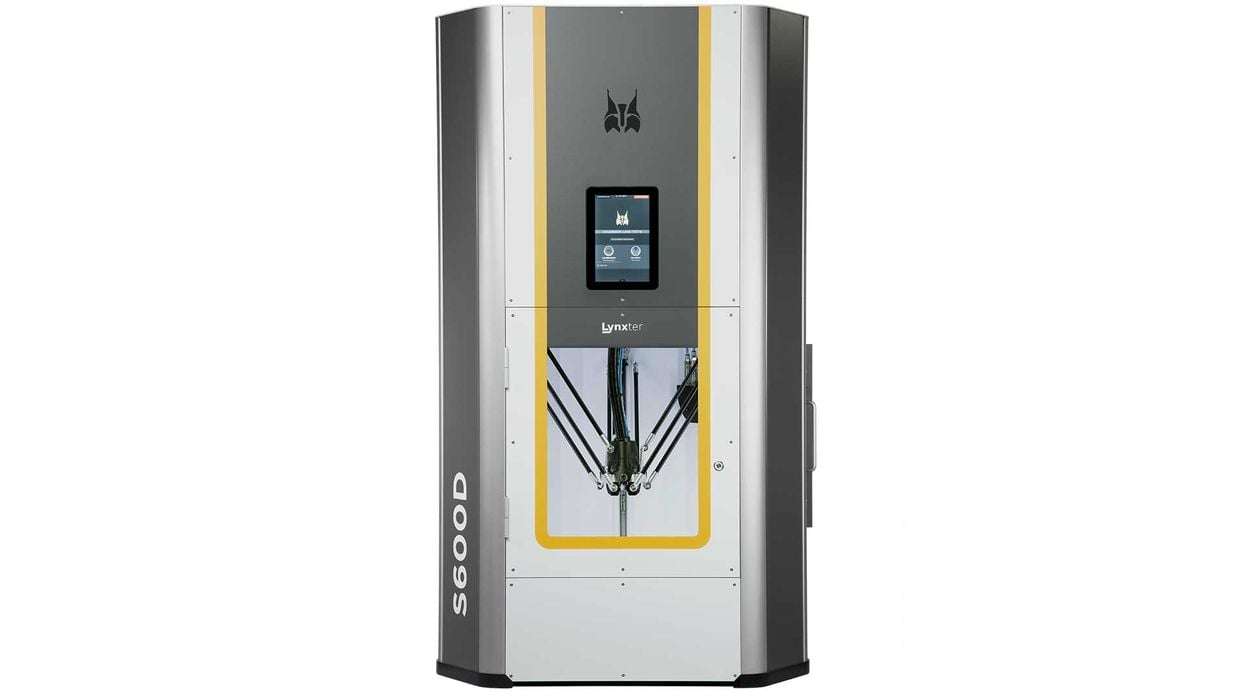
French company Lynxter has positioned itself at the center of this movement with industrial silicone 3D printing systems aimed at medical, industrial, and food-related applications.
Headquartered in Bayonne, France, Lynxter was founded in 2016 and has grown into one of Europe’s more visible silicone additive manufacturing firms. Industry estimates place the company at roughly 40 to 50 employees with annual revenue estimated near US$20 million in 2025.
The company’s product portfolio includes modular industrial printers capable of processing liquid silicone rubber and other technical materials. These systems are increasingly attractive for industries that require chemically resistant and temperature-stable parts. Food manufacturing is a particularly promising target.

Henny Penny and the Food Equipment Connection
Another company relevant to this transition is “Henny Penny Corporation.”
Headquartered in Eaton, Ohio, Henny Penny is a major manufacturer of commercial foodservice equipment, particularly pressure fryers, holding cabinets, and high-volume restaurant systems used by chains worldwide.
Founded in 1957, the employee-owned company has grown into a substantial industrial operation with more than 1,000 employees globally. Revenue estimates for 2025 place the company at roughly US$400 million annually.
While Henny Penny is not a pure additive manufacturing company, it represents the exact type of industrial food equipment manufacturer that increasingly benefits from 3D printing.
Modern food service equipment companies now use additive manufacturing for:
- Rapid prototyping
- Tooling
- Replacement parts
- Internal airflow components
- Custom fixtures
- Production aids
- Low-volume end-use components
Commercial kitchens place extreme stress on equipment through constant heating cycles, grease exposure, cleaning chemicals, and repeated sanitation procedures. Components that once relied on conventional machining are increasingly being redesigned for additive manufacturing to improve lead times and customization.
This trend becomes especially important as food equipment suppliers face stricter material disclosure expectations.
A company like Henny Penny must now evaluate not only mechanical performance, but also whether materials used in seals, tubing, coatings, and printed components align with evolving FDA and PFAS-related expectations.
Additive manufacturing can help solve several of these challenges simultaneously.
For example, 3D printing enables localized production of validated replacement parts using traceable materials. It also allows rapid redesigns when certain compounds or additives become restricted.
Instead of waiting months for retooling, manufacturers can digitally update a part and produce revised geometries quickly.
That flexibility could become a major competitive advantage as chemical regulations continue evolving.
How can FDA-compliant silicone 3D printing eliminate PFAS and qualify for R&D tax credits?
Silicone additive manufacturing (3D printing) utilizes high-purity, PFAS-free liquid silicone rubber (LSR) to optimize the production of industrial food processing components while satisfying strict regulatory mandates. By transitioning from traditional compression molding to digital fabrication, manufacturers can produce complex seals, custom gaskets, and dynamic tubing systems that explicitly conform to FDA Title 21 CFR 177.2600 extractables thresholds. Resolving the technical uncertainties of multi-axis silicone extrusion, polymer cross-linking mechanics, and chemical extraction testing establishes an iterative process of experimentation that directly qualifies for substantial Section 41 R&D Tax Credits.
Why are legacy food processing components facing regulatory elimination?
Traditional food-contact components are undergoing intense scrutiny from state and federal regulators due to severe material safety risks:
- Per- and Polyfluoroalkyl Substances (PFAS) Contamination: Legacy fluoropolymer seals and non-stick coatings release “forever chemicals” into food supply lines, triggering aggressive environmental phase-outs.
- Strict FDA Extraction Thresholds: Standard rubber materials often fail the rigorous chemical extraction limits mandated by FDA Title 21 CFR 177.2600 for repeated-use food contact applications.
- Tooling Constraints for Custom Geometry: Conventional manufacturing requires expensive, static steel molds, preventing food equipment plants from deploying low-volume, site-specific seal designs quickly.
How does PFAS-free silicone material development qualify for R&D tax incentives?
Engineering, printing, and verifying food-safe elastomer components involves resolving distinct chemical and mechanical uncertainties, aligning precisely with Section 41 R&D Tax Credit criteria.
| Core R&D Technical Activity | IRS Four-Part Test Alignment | Financial Recovery Impact |
| Material Formulation & Tuning | Resolves technological uncertainty regarding elastomer cross-linking, curing kinetics, and structural stability. | Captures qualified engineering hours spent synthesizing and testing novel PFAS-free liquid silicone compounds. |
| FDA CFR Extraction Testing | Conducts a systematic process of experimentation via chemical analysis to evaluate material extraction limits. | Recovers internal labor costs of laboratory technicians and the direct costs of chemical reagents consumed during testing. |
| Extrusion Toolpath Optimization | Overcomes mechanical engineering challenges regarding material viscosity, nozzle deposition, and layer adhesion. | Offsets internal labor expenditures of computational and systems engineers designing automated print profiles. |
The Bigger Picture
The tightening focus on FDA CFR 21 177.2600, PFAS elimination, and food-contact safety reflects a broader shift happening across manufacturing.
Consumers rarely think about the seals inside industrial food equipment, the coatings used in packaging systems, or the materials inside processing machinery. Yet these components interact with food every day.
The combination of FDA oversight, state regulations, independent certifications, and improved material science is gradually reducing exposure risks that once received little attention.
The additive manufacturing industry is becoming part of that transition.
Companies developing safer silicones, validated elastomers, traceable polymers, and chemically transparent manufacturing processes are helping move industrial food production toward higher safety standards.
These developments are likely reducing consumers’ exposure to forever chemicals compared with just a few years ago. Public awareness of these regulatory changes matters less than the work happening behind the scenes. The FDA, materials experts, food manufacturers, and the 3D printing industry are increasingly scrutinizing these chemicals and manufacturing processes to protect consumers well before most people hear about them.