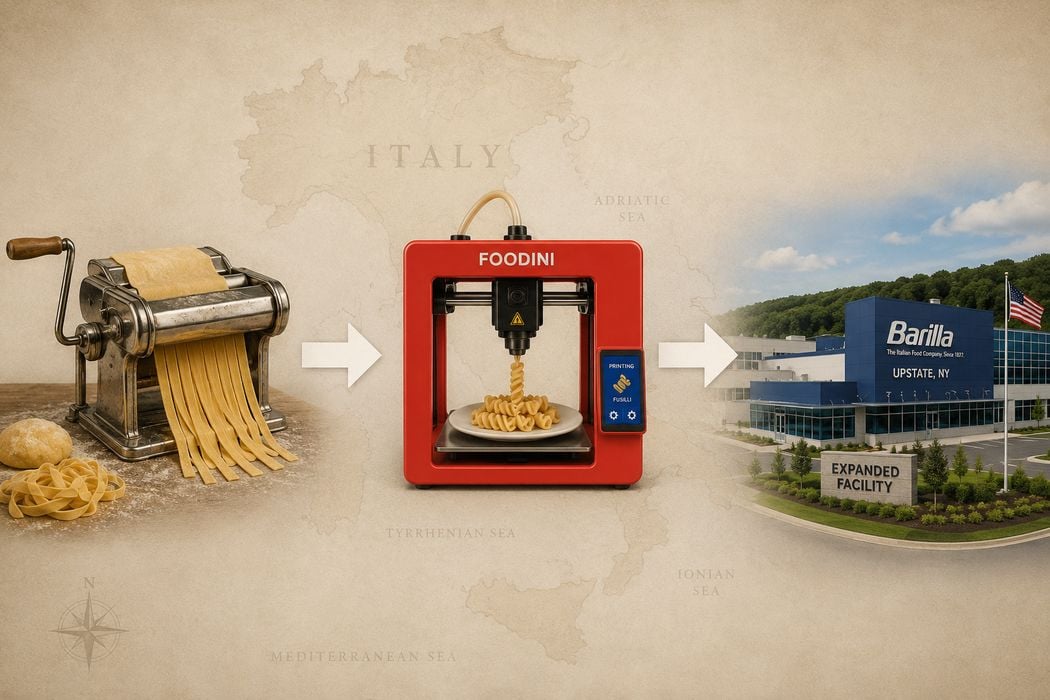
Charles R. Goulding and Preeti Sulibhavi consider how Italy’s culinary traditions are merging with industrial-scale 3D food printing to redefine pasta production in America.
Pasta lovers in New York have a reason to celebrate. Barilla is investing nearly US$170 million to expand its manufacturing operations in upstate New York, adding new production capacity, packaging lines, and nearly 100 new jobs in the process. The expansion is actually taking place at Barilla’s existing manufacturing facility in Avon, NY, in Livingston County.
For fans of food manufacturing technology, the project is interesting for another reason: Barilla has quietly become one of the world’s most innovative food-tech companies, particularly in the area of 3D printed pasta.
The company’s expansion announcement does not explicitly mention additive manufacturing or 3D printing systems at the Avon facility. However, Barilla’s broader investment strategy strongly suggests the company is continuing to blend traditional pasta production with advanced automation, digital design tools, and experimental food-printing technologies.
That means the future of pasta production in New York may involve more than just spaghetti and penne rolling off conventional extrusion lines.
A Major Expansion for Barilla in New York
According to New York State officials, Barilla’s two-phase expansion project includes construction of a new 52,000-square-foot building, one additional production line, and three new packaging lines. The project is expected to create more than 90 new jobs.
Governor Kathy Hochul described the project as part of the state’s effort to strengthen advanced manufacturing and agribusiness industries in upstate New York.
Barilla has operated the Avon facility since 2007, producing pasta products distributed across the United States. The expansion significantly increases the company’s North American manufacturing footprint at a time when demand for pasta remains strong.
What Technology Will the Factory Use?
Barilla has not publicly released a complete technology roadmap for the Avon expansion, but the announced infrastructure provides clues.
The addition of new production and packaging lines almost certainly means increased industrial automation. Modern pasta manufacturing plants rely heavily on robotic handling systems, machine vision inspection, automated drying systems, digitally controlled extrusion equipment, and sophisticated packaging automation.
Large-scale pasta manufacturing today is far removed from old-school food processing. Facilities like Barilla’s operate with tightly controlled environmental systems, automated ingredient handling, computerized moisture management, and AI-assisted quality control.
The new packaging lines in particular are likely to include:
- Robotic case packing systems
- Automated palletizing
- Machine vision inspection systems
- Smart conveyor tracking
- Real-time production analytics
- Energy-efficient drying and climate control
- In-line food safety equipment including metal detection
The project is also being framed by New York State as an advanced manufacturing investment, not merely a warehouse expansion.
Barilla and 3D Printing
Barilla is one of the best-known companies experimenting with 3D printed pasta technology.
The company has spent more than a decade developing additive food manufacturing concepts. Barilla first gained attention in 2014 and 2015 after launching a competition for printable pasta designs and partnering with engineers developing pasta extrusion printers.
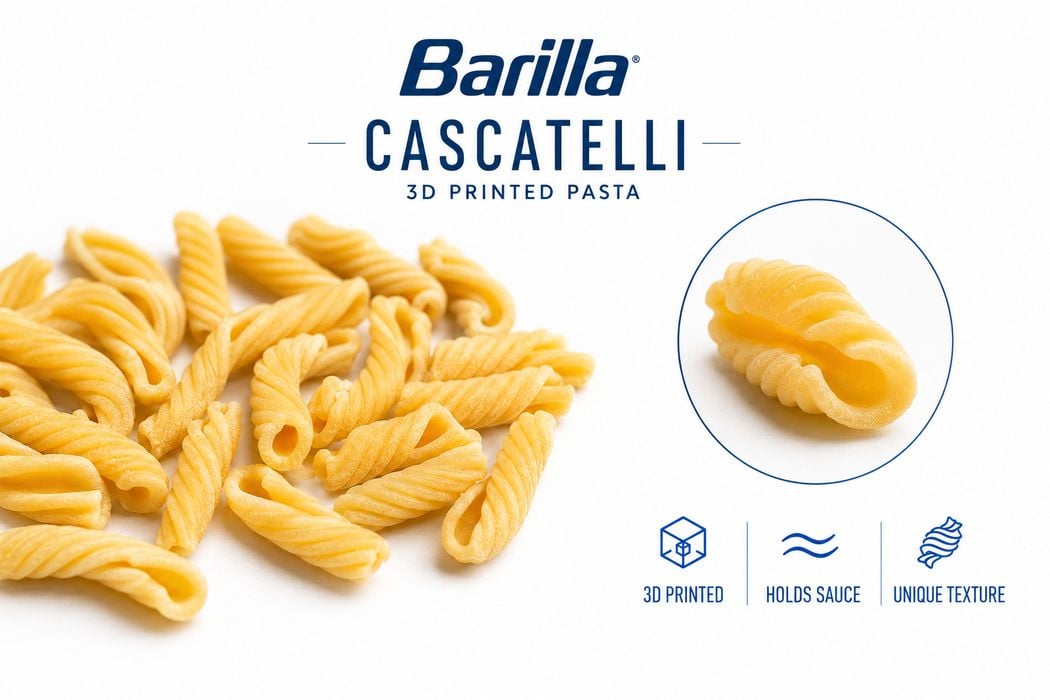
By 2016, Barilla was publicly demonstrating prototype pasta 3D printers capable of producing custom shapes (i.e., “Cascatelli”) on demand.
Today, those experiments have evolved into a specialized luxury pasta brand originally known as BluRhapsody, recently rebranded as Artisia. Artisia is the world’s first 3D printed pasta and in April 2026, pasta connoisseurs celebrated Artisia’s 3D printed pasta in Milan. Even the furnishings were 3D printed, inspired by oversized pasta forms.
The system uses proprietary food-printing technology to manufacture highly complex pasta geometries impossible to create through traditional extrusion dies.
Some of the shapes resemble flowers, coral, shells, spirals, and abstract sculptures. They are designed not only for aesthetics, but also to alter texture, sauce retention, and cooking behavior.
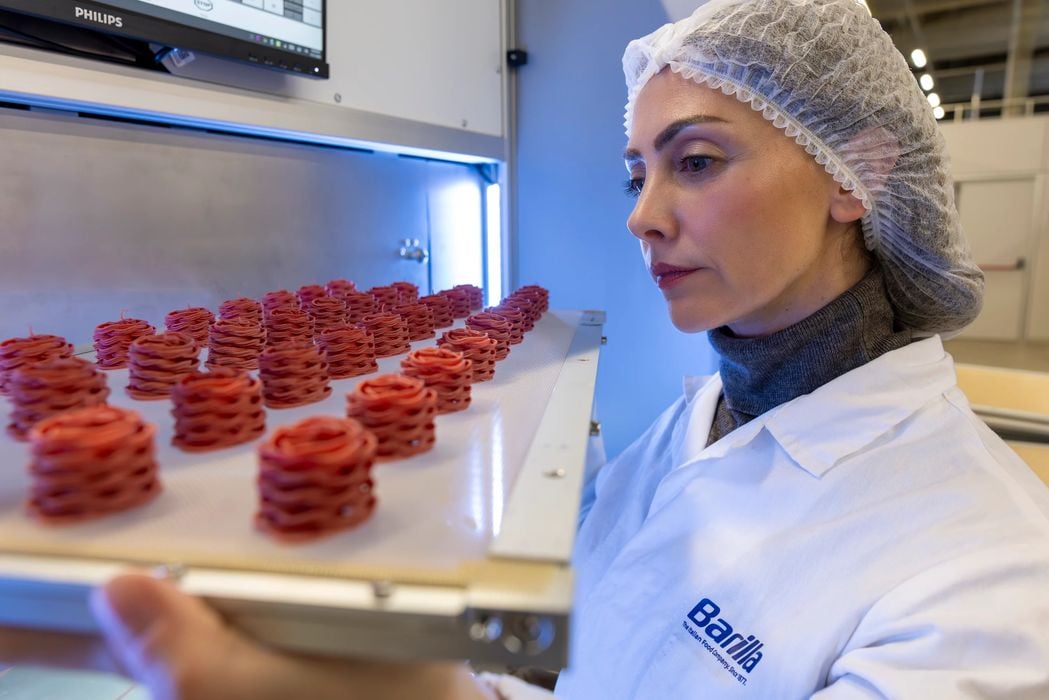
According to Barilla-linked reports, the 3D printed pasta is produced using durum wheat semolina and water, but fabricated layer by layer using custom food-printing systems.
Right now, Barilla’s 3D printed pasta production appears to remain centered in Parma, Italy, where the company’s innovation and R&D activities are concentrated.
In late 2025, Barilla opened its BITE innovation center in Parma, integrating advanced technologies including AI-driven sensors, digital design systems, and 3D printing.
The facility reportedly uses additive manufacturing both for product experimentation and for the development of entirely new pasta concepts.
That said, it would not be surprising if some technologies developed in Italy eventually migrate into North American manufacturing operations.
Food companies increasingly use pilot production systems to localize specialty products for regional markets. If Barilla sees growing demand for premium designer pasta in the United States, the Avon expansion could eventually support some type of specialty production.
Even if full-scale food 3D printers are not installed immediately, many adjacent technologies likely will be.
For example, modern food manufacturing plants frequently use:
- 3D printed tooling and machine components
- Digital twin simulation systems
- AI-assisted process control
- Predictive maintenance software
- Smart sensors and industrial IoT platforms
- Advanced robotics for packaging and logistics
So while consumers may not see robotic pasta printers running in New York tomorrow, additive manufacturing technologies could still play a role behind the scenes.
Why are traditional food extrusion and packaging workflows facing industrial bottlenecks?
Legacy food processing infrastructure struggles to adapt to modern supply chain constraints and shifting consumer demands due to rigid engineering limitations:
- Mechanical Die Constraints: Conventional pasta extrusion dies are geometrically restricted, preventing food engineers from fabricating intricate shapes designed for optimal sauce retention and uniform cooking performance.
- Manual Inspection Vulnerabilities: Traditional high-volume production lines lack automated quality assurance, resulting in higher product defect rates, packaging failures, and manual sanitation overhead.
- Inelastic Scaling Architecture: Fixed processing lines cannot quickly pivot to run low-volume specialty batches or accommodate localized ingredient volatility without expensive, lengthy facility retooling.
How does advanced manufacturing optimize commercial food production?
By blending traditional culinary processes with advanced digital fabrication and cyber-physical systems, food tech companies achieve heightened operational elasticity:
- Performance-Engineered Geometry: Additive food manufacturing platforms construct custom pasta shapes layer-by-layer using durum wheat semolina and water, achieving structural lattice configurations impossible to produce via subtractive methods.
- End-to-End Packaging Automation: Modern facility expansions deploy robotic case packing, machine vision inspection, automated palletizing, and real-time production analytics to stabilize logistics pipelines.
- Localized Digital Twin Prototyping: Utilizing 3D printed tooling and predictive maintenance simulation systems allows manufacturers to test new geometry or material tolerances behind the scenes before scaling to global operations.
Why This Expansion Matters for Pasta Lovers
For consumers, the most immediate impact is simple: more pasta production capacity means stronger supply chains and potentially more product variety.
Over the past several years, food manufacturers have dealt with logistics disruptions, ingredient volatility, and transportation bottlenecks. Expanding domestic production helps stabilize availability. The project also reinforces New York’s growing role as a food manufacturing hub.
Pasta demand remains remarkably resilient. Americans continue consuming billions of pounds of pasta annually, and premium pasta categories continue to grow.
Barilla’s investment signals confidence that consumers are still hungry for both traditional products and experimental offerings.
Food printing has often struggled to move beyond novelty demonstrations. But Barilla has approached it differently, treating 3D printing as both a culinary tool and a manufacturing platform.
Instead of simply printing gimmicky shapes, the company has focused on texture engineering, sauce interaction, cooking performance, and visual presentation.
The most successful 3D printing applications usually exploit geometries that are impossible to create conventionally. Barilla’s intricate pasta designs follow that philosophy.
Where Can You Eat 3D Printed Pasta?
Despite years of publicity surrounding Barilla’s BluRhapsody and Artisia initiatives, there is little public evidence that Barilla-branded 3D printed pasta is widely available in New York City restaurants.
However, New York City’s experimental dining scene is exactly the type of market where these products could eventually appear.
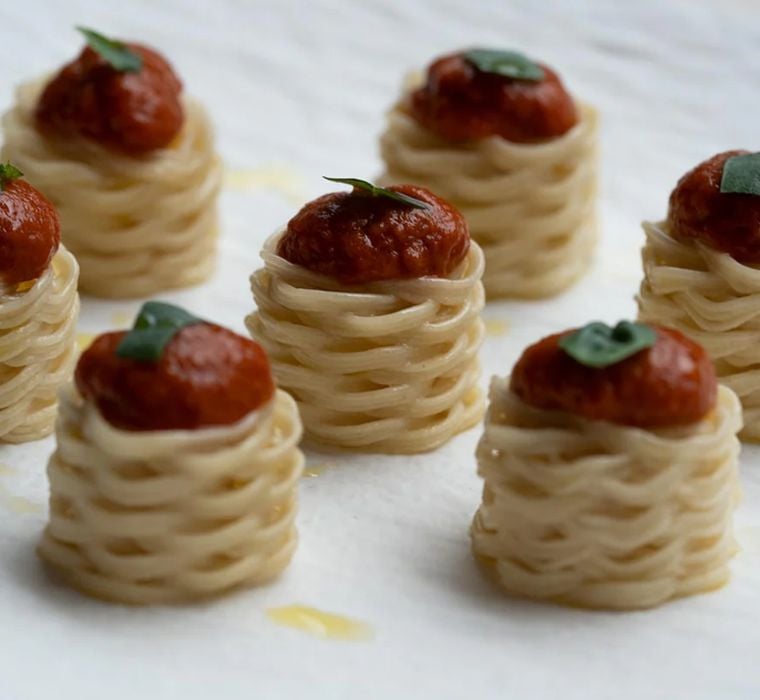
Restaurants focused on modernist cuisine, tasting menus, or culinary technology are natural fits for designer pasta shapes.
Several NYC Italian and experimental restaurants have explored visually sculptural pasta presentations, although not all publicly confirm the use of additive manufacturing.
One relevant example is the former Barilla Restaurants concept in Manhattan, which connected the company’s consumer brand with fast-casual Italian dining.
At the moment, though, 3D printed pasta remains more of a luxury culinary niche than a mainstream restaurant trend.
As food printing systems improve, production costs fall, and consumers become more comfortable with digitally fabricated foods, products like Artisia could become far more common.
How can advanced food-tech automation and 3D printed pasta optimization qualify for R&D tax credits?
Food equipment manufacturers and agribusinesses can claim the Section 41 R&D Tax Credit for Qualified Research Expenses (QREs) incurred during the design, engineering, and scaling of advanced automation systems, digital twin simulations, and additive food-printing technologies. To qualify for federal and state tax incentives, commercial food manufacturers must satisfy the IRS Four-Part Test by executing an iterative process of experimentation to resolve technological uncertainties regarding mechanical throughput, volumetric material extrusion, and computerized moisture management.
Barilla has earmarked 1 billion euros for a five-year global plan, dedicating substantial resources toward Industry 4.0 production upgrades and sustainable packaging.
How do automated food-tech developments qualify for R&D tax incentives?
Engineering, configuring, and testing automated food processing ecosystems involve systematic technological iterations that satisfy Section 41 criteria.
| Manufacturing Discipline | Eligible R&D Innovation Activity | Technological Impact |
| Additive Food Fabrication | Developing proprietary, layer-by-layer food-printing extrusion systems and evaluating slurry viscosity mechanics. | Overcomes geometric boundaries to optimize texture engineering and precise sauce retention. |
| Packaging Robotics Integration | Formulating algorithmic machine vision models and smart conveyor tracking to run variable product volumes. | Eliminates manual case-packing bottlenecks and minimizes material defects on high-speed lines. |
| Thermal & Moisture Engineering | Designing energy-efficient drying systems and AI-assisted climate control parameters for structural pasta setting. | Resolves material degradation and structural cracking uncertainties during high-throughput drying cycles. |
Food for Thought
Bringing Barilla to New York is a win-win for the iconic pasta company. With advancements in food 3D printing and Barilla’s dedication to innovation, pasta-lovers certainly have something to look forward to. Bon appetite!