
The Voron 3D printer design was NOT just patented by Chinese organizations.
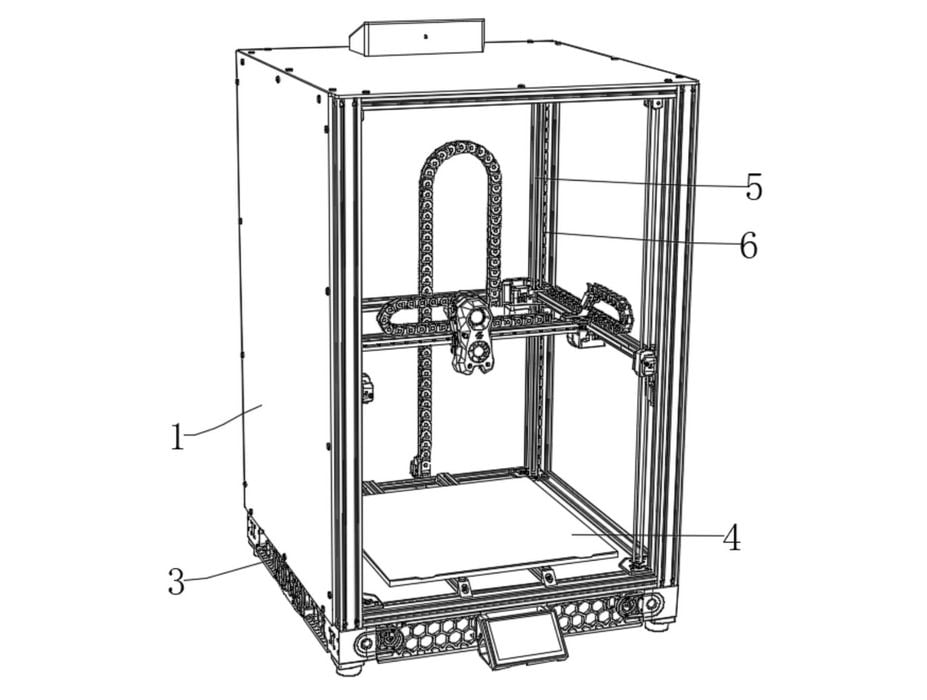
There has been some controversy over our story from last week about patent CN224323579U, assigned to Civil Affairs Vocational University and Tianjin Yiheng Technology Co., Ltd. Multiple reports and online discussions point out that the patent schematic diagram details a 3D printer that is suspiciously similar to the Voron Design 2.4, an open source design from a few years ago.
The concern seems to be that Chinese organizations should not be able to patent open source designs.
That’s not the best reading of this patent. Readers are not wrong to notice the visual resemblance; the mistake is assuming resemblance equals patent scope.
Let’s first separate three things: appearance, claimed invention, and prior art.
- A design patent is about appearance. It protects what something looks like.
- A method patent is about steps. It protects a way of doing something.
- A utility patent or utility model is about function and structure. It protects a useful technical arrangement.
This particular document is a Chinese utility model patent. That means it is not primarily about the appearance of the printer shown in the drawings. It is about the technical structure described in the Claims.
Those Claims describe a specific apparatus arrangement: a fixed build platform, moving lift assembly, horizontal moving section, printhead, four corner lift drives, synchronous belts, linear rails, and flexible rods forming a vibration absorbing constraint network.
The schematic diagrams are there to help clarify how those numbered parts relate to each other. Patent drawings are not always product drawings. They are often simplified or conceptual drawings intended to explain the claimed structure.
That does not mean the drawings are irrelevant, because they help explain the patent. But visible features in a diagram generally do not expand the patent beyond what is actually claimed in the text.
Sometimes patent diagrams resemble familiar machines because machines in this category are similar in design. Many enclosed CoreXY FFF machines share common elements: a cube frame, front door, fixed or semi fixed bed, belt paths, top gantry, and electronics in the base.
In fact, we wrote about a similar case a few months ago where a Bambu Lab patent appeared to reveal an unknown future machine in a diagram. That wasn’t the case at all. It was merely a conceptual diagram, again to help readers understand the written Claims.
It’s important to remember that the patent is driven by the Claims, not the diagram.
In fact, the patent itself says the drawings are schematics. Near the end, it states that the sizes and shapes shown in the drawings are not actual limitations and can be adjusted in implementation. In other words, the elements visible in the diagrams do not extend the scope of the patent beyond what is written in the claims.
It’s also important to know that patent claims are often written broadly enough to cover variations, but they still have to be supported by the written description and drawings. That means diagram details are secondary to the claims.
The claims in the patent appear to add up to a combination of a fixed platform, four corner belt and rail driven Z motion, and the flexible support / vibration absorbing network. The document repeatedly mentions reducing Z artifacts, avoiding platform instability, absorbing vibration, and improving print quality in tall parts.
That would indeed be a requirement when printing tall prosthetic or orthotic parts, which aligns with the prosthetic angle. This is about a machine concept that supposedly would be good to print that specific type of part.
One more thing: if the claimed technical arrangement was already disclosed by Voron or another open source project before filing, that could be a prior art issue. But that is not the same as “patenting Voron.”
So no, this patent does not appear to patent the Voron 2.4 design.
A better way to look at this patent is that it claims a particular machine arrangement for printing prosthetic and orthotic parts: fixed platform, moving gantry, four corner belt and rail Z motion, and flexible vibration absorbing supports.
That does not mean the patent is necessarily strong. If the same claimed arrangement was already publicly disclosed by Voron Design or elsewhere before the filing date, that would be a prior art question. If the drawings were copied from an existing source, that would be a separate attribution or copyright question.
But those are different issues. The claims define the scope of the patent; the diagrams are illustrative.
