
A new study examines how to make multiple FFF printheads build the same part without creating weak seams — a critical step toward “collective” printing.
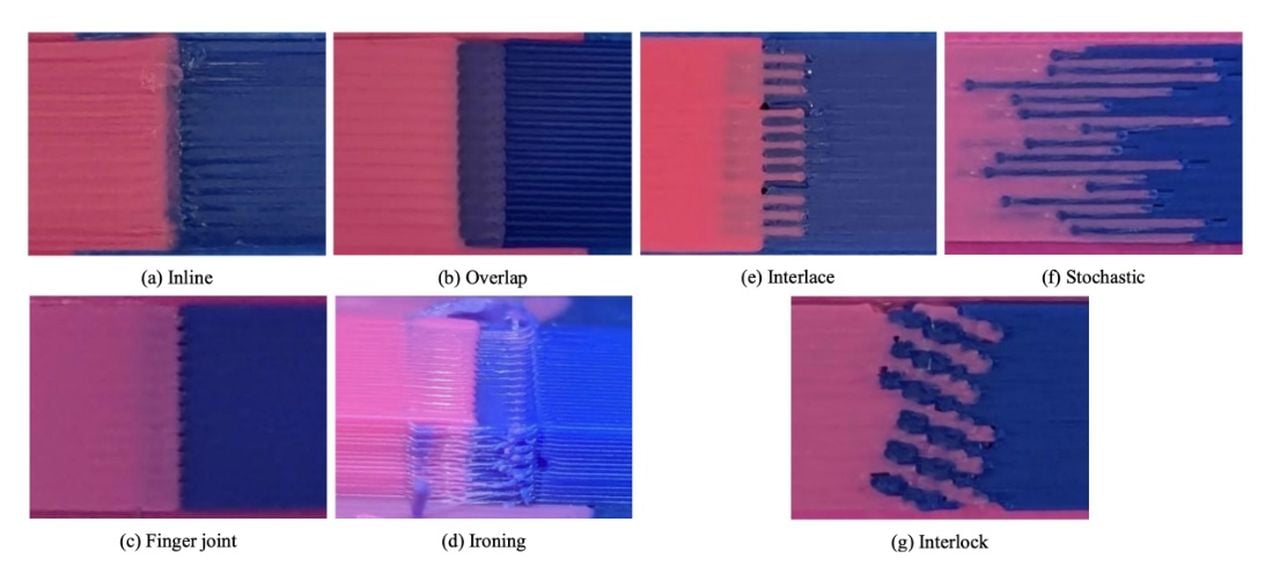
The paper, titled “Inter-Printhead Bonding Strategies for Same-Material Collective Additive Manufacturing in FDM 3D Printing,” focuses on a simple question: when two extruders meet on the same part, how do you guarantee a strong, uniform bond? For the FFF process, that is where most parallelization attempts fail miserably.
Collective additive manufacturing tries to split a single job across multiple tools to reduce print durations. We have seen versions of this in multi-laser metal powder bed systems, where careful hatch overlap and scan strategies maintain mechanical continuity. Translating that idea to the polymer world is harder. In FFF there is no melt pool to stitch; strength depends on extrusion line bonds that must still be hot enough to coalesce.
Dual and independent dual extruder (IDEX) printers typically avoid shared regions on a single part for exactly this reason. They mirror, duplicate, or multi-material print, but rarely run heads side by side on the same contour. Large-format FFF — the kind used for tooling and patterns — would benefit most from parallel heads, yet weak merge lines, thermal gradients, and collision risks have kept the concept in research labs.
Bonding Where Toolpaths Meet
The core problem is timing and temperature. If Head A lays down an extrusion that cools below the glass transition before Head B arrives, inter-diffusion plummets and a seam forms. If both extrude simultaneously with no coordination, you get overfill, underfill, or swollen layers that compromise dimensional accuracy.
Solving this means somehow coordinating overlap regions, extrusion geometry, and local heat. In other experiments, common approaches include controlled overlap widths, staggered toolpaths that keep interface temperatures high, and localized reheat using hot air, IR, or a compact laser pointed just at the merge line. Some groups explore interlocking infill patterns at the handshake zone to mechanically key the interface without adding a second material.
The Procedia CIRP work focuses on same-material bonding, which rules out adhesives or solvent assists and keeps the process compatible with standard filaments. If same-material seams can match strength within a small margin, multi-head FFF could finally become a common 3D printing technique.
What Stronger Seams Could Unlock
If validated, this would be a notable advance for anyone who relies on polymer AM for large tools, jigs, or molding patterns. Parallel heads could reduce build times by a factor roughly proportional to head count — assuming the merge zones do not become the rate-limiting step. For print farms, consolidating multiple coordinated heads into one frame reduces operator labor, part handoffs, and especially floor space.
There are some challenges. Multi-head systems need very accurate positional measurements for X, Y, Z axes, and extrusion calibration, plus closed-loop temperature awareness at the interface. Software plays a major role, too: slicers must partition geometry, generate synchronized paths, and enforce thermal constraints in real time. Materials will behave differently; amorphous polymers may be more forgiving than semi-crystalline nylons and PEEK, where cooling rates drive crystallinity and residual stress. None of that is unsolvable, but it will require substantial engineering work yet.
Compared to speed-focused single-nozzle systems, multi-head collective printing moves the problem from motion control more into materials science and process control. The upside is linear-ish throughput scaling on very large geometries where single-nozzle acceleration runs out of runway. But the downside is a new failure mode — the seam — that users must be able to trust.
This sounds quite promising, but going from a research paper concept to true production requires firmware, slicers, and a lot of thermal mapping. If someone can get all that done, we just might see those multi-head 3D printing systems we’ve all imagined.
Via Procedia CIRP
