
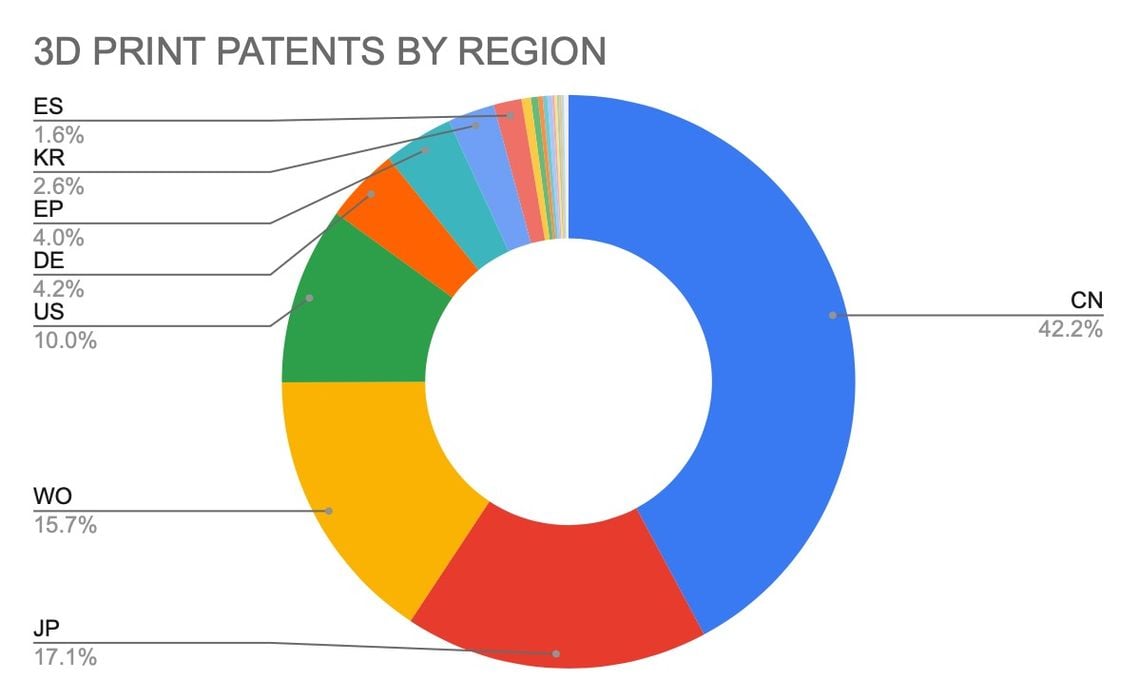
I did some analysis on 3D print patents to understand where innovation seems to be occurring.
Patents are a frequent topic these days on Fabbaloo, simply because they provide a glimpse into what the future might be in 3D printing. Each week there are many innovations being patented, and I’ll select a few that are interesting for readers.
I’ve been reviewing patents in detail for many months now, and have built up a rather long list of 3D print-related patents over that period. The vast majority of them have not been reported on Fabbaloo, but we can still do some analysis.
Our database now includes 759 patents from last October, about eight months’ worth of data. That’s about 21 new patents per week. That’s a lot of patents, so who is generating all these new 3D print ideas?
Patents 101
First, let’s look at how patents are identified. They always start with a two-letter abbreviation, usually corresponding to the country where the patent was filed. For example, “US” would be a US patent.
However, there are some special codes. One is “EP”, meaning a “European patent”. Another is “WO”, meaning worldwide.
WO deserves some explanation. Patents are issued ONLY by a country’s patent authority, an example being the USPTO. That patent would then protect the invention within that country only. There is no worldwide patent authority, so what is a “WO” patent? It’s a kind of registry, where someone could place an official record of an invention that everyone can see. Then later if someone attempts to patent the same invention in their country, the WO patent would serve as prior art and prevent that patent application from being approved.
However, for enforcement you still must have a patent in each country where business activity is expected; a WO patent doesn’t do that.
3D Print Patent Analysis
OK, with that all understood, let’s look at the frequency of patent codes for our list of 3D print innovations.
| PATENT COUNT | FILING AUTHORITY |
| 320 | CN — China |
| 130 | JP — Japan |
| 119 | WO — World Intellectual Property Organization / WIPO international publication |
| 76 | US — United States |
| 32 | DE — Germany |
| 30 | EP — European Patent Office / European patent publication |
| 20 | KR — South Korea |
| 12 | ES — Spain |
| 4 | AU — Australia |
| 3 | DK — Denmark |
| 2 | FR — France |
| 2 | CZ — Czech Republic |
| 2 | PL — Poland |
| 1 | ZA — South Africa |
| 1 | LU — Luxembourg |
| 1 | CH — Switzerland |
| 1 | IE — Ireland |
| 1 | FI — Finland |
| 1 | GB — United Kingdom / Great Britain |
| 1 | SK — Slovakia |
One note here: if you add up all the EU countries and EP patents, you get 88 for Europe, placing them ahead of the US.
The news here is that China is clearly where all the action is taking place. That country has registered nearly 3X the number of 3D print patents than the next country (Japan).
What does this really mean? Are these totals indicative of the amount of 3D print innovation in each country?
Not really. A company from, say, Argentina, might want to sell their product in the US. They might then apply for a US patent to protect their invention in that country. So the country of filing doesn’t always indicate the source location of the innovation. Patent geography is not the same thing as invention geography.
There’s something else to know: filing patents is a tedious and sometimes expensive process. It typically costs money to have specialists write up the details, present the application, and deal with the patent examiners, who ultimately may approve the patent. Because it is expensive, a company may apply for patents only in the areas they really feel it would be worthwhile.
For example, you might not need patent protection in South Africa because you don’t do business there. You apply for patents only where needed and financially justified.
The analysis does tell us something quite interesting, however. Based on all the above, it would seem that China is the region of the most competition. The number of patents in China is high because:
- There are likely many Chinese 3D print companies.
- These companies expect competition in China and require protection.
If a company was selling their product worldwide, would you expect them to get patents from many countries? We don’t see that from the Chinese companies. Most of the patents observed were only for China, and few were WO.
The analysis shows that China appears to be the most fiercely contested 3D printing market at the moment. If Chinese organizations are filing large numbers of China-only patents, the likely explanation is that they are not merely protecting export products for global sale. They are protecting themselves against other parties operating in the same domestic market.
For the rest of the world, this is something to monitor closely. A highly competitive Chinese domestic market can produce rapid iteration, aggressive pricing, and unexpected technical approaches. Many of those ideas and inventions would remain inside China. But others may eventually emerge as products, processes, or companies that compete globally.
This patent analysis cannot tell us exactly where every 3D printing invention began, but it does point to where the pressure seems highest.
Right now, that seems to be China.
