
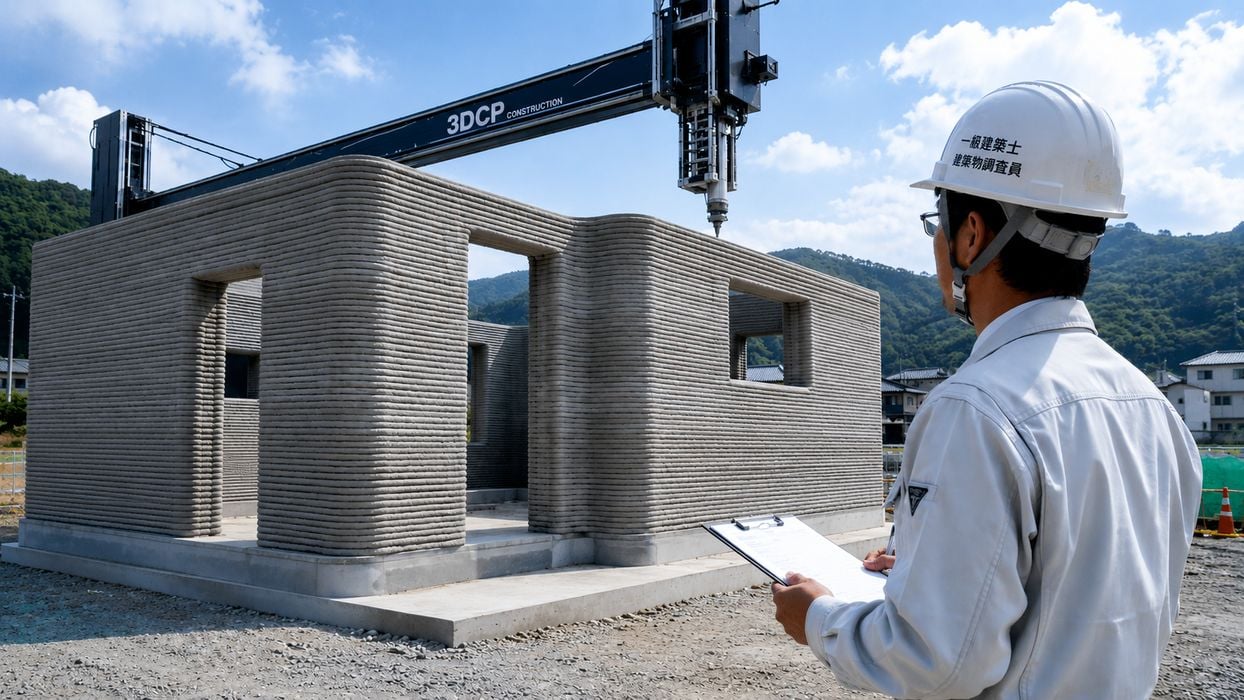
Building regulations are definitely slowing the progress of 3DCP technology.
Every jurisdiction has building codes, and they are there for a very good reason: safety. People live and work in buildings, and they should be safe.
But those building codes were designed many years ago with then-current building technologies in mind. Nowadays, we have a new technology that is slowly growing in momentum: 3DCP. Construction 3D printing is able to quickly print concrete portions of some building projects.
That technology is increasingly accessible, as we now see 3DCP being adopted by countless local building operations, both existing and new startup ventures. The promise is to build structures faster, at least the concrete portions, anyway. Whether the costs are truly lower as claimed is another story.
Nevertheless, these 3DCP operations often run into building code problems. Inspectors have usually never seen these 3D-printed structures and can be at a loss in how to evaluate them.
Another case was recently highlighted in Japan News, where a 3DCP firm, Tokyo-based Onocom Co., was building a cylindrical white building using a “construction 3D printer”.
But there was a regulatory problem. Japan News writes:
“The printing process was completed in 10 days, but under the current Building Standards Law, structures made solely of mortar require certification procedures. To comply with this, reinforced concrete was partially incorporated into the walls, extending the construction period to about six months.”
This is not to say that the concrete portion of the work took six months, but the entire project took six months. Nevertheless, that’s a delay, and delays cost money. This is a perfect example of how a regulation can reduce or even eliminate a potential advantage for the new technology of 3DCP.
In a world where housing shortages are real and everywhere, a solution that can make new homes faster should be welcomed. But here, and likely in many other areas, it’s an alien technology in the view of the building codes.
The solution, obviously, is to update building codes to accommodate 3DCP technology and practices. The problem is that building code updates tend to be extraordinarily lengthy bureaucratic processes, followed by education and training requirements for all involved. It’s not going to be fast.
Even worse, building codes are usually local. This means that such a transformation will have to occur over and over, repeatedly, in almost all areas.
This is going to take a very long time.
Via Japan News
