
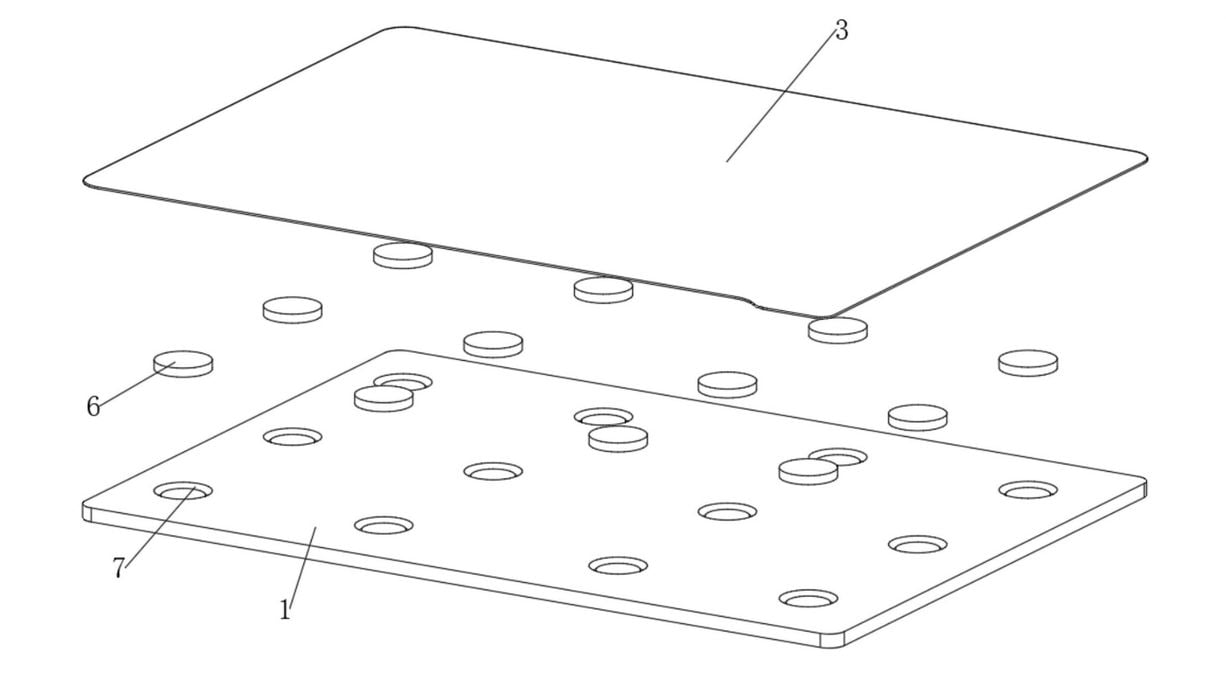
A Chinese utility model patent attempts to claim a magnetic flexible print platform — a feature that has been common in desktop FFF machines for many years.
The patent is CN224391932U, assigned to Shenzhen Xinbin Electronic Technology Co., Ltd. It describes a 3D printer print platform made from a fixed plate, a magnetic assembly, and a flexible support sheet that can be removed and bent to release the finished print.
That will sound very familiar to anyone who has used a modern desktop FFF 3D printer.
Their idea is simple: instead of printing directly onto a rigid build plate, the machine uses a removable steel sheet held in place by magnets. After printing, the 3D printer operator removes the sheet and flexes it slightly. The part pops off without a scraper, or at least with much less persuasion.
In other words, this is exactly the same general workflow seen on countless machines from Prusa, Bambu Lab, Creality, Anycubic, Elegoo, Raise3D, FlashForge, and many others. It has been a standard convenience feature in desktop FFF for well over a decade.
What The Patent Claims
The document describes a fixed platform containing a rectangular array of magnets. A flexible support plate, described as an steel plate, is magnetically attached to that platform and serves as the print surface.
There are a few implementation details. The magnets sit in mounting grooves, are flush with the fixed platform surface, and may be held with structural adhesive. The flexible sheet includes an extended tab that protrudes beyond the fixed platform, making it easier to lift. The patent also notes smoothed edges on the sheet.
None of this seems any different than what is already implemented on countless desktop FFF 3D printers.
The stated benefit is easier model removal. The patent says the operator can bend the flexible support plate to achieve “non destructive demolding”, avoiding masking tape and reducing residue on print surfaces. It also claims removal time can drop from three to five minutes to less than 30 seconds.
That is indeed a very real benefit, but it is not at all a new one. We’ve all done this with our existing machines, perhaps even today.
Magnetic flexible print plates became popular precisely because scraping rigid beds was annoying, risky, and slow. They also helped reduce consumables such as blue tape, masking tape, glue sticks, and other bed surface trickery. The feature became so common that many buyers now expect it even on inexpensive desktop machines.
The strange part is that this patent appears to be trying to protect something that the market has already completely normalized.
Only In China
This is also a Chinese utility model patent, not a global patent and not a product announcement. A utility model can be easier and faster to obtain than a full invention patent, and protection is territorial. This document does not automatically affect machines sold outside China. To do so Xinbin would have to apply for patents in other regions, like the US and Europe. However, it’s unlikely the patent would be awarded due to the long use of this technology.
But there’s one more issue: China is the center of gravity for a huge amount of desktop 3D printer manufacturing.
If the patent were asserted aggressively inside China (where it can legally be applied), it could theoretically create problems for manufacturers, suppliers, or distributors operating there, especially if their machines use a similar fixed magnetic base and removable flexible steel sheet. That could touch a very large number of existing printer designs.
Could it be overturned? Quite possibly, if challenged with strong prior art.
The prior art question seems obvious here. Removable magnetic spring steel build plates have been used and publicly sold for many years before the 2025 filing date. If earlier products, manuals, videos, store listings, or patents show substantially the same arrangement, that could weaken or invalidate the claim. The question would be whether the specific claimed combination — magnets embedded in a fixed platform, a flexible iron sheet, an extension tab, flush mounting, adhesive grooves, and related details — is considered sufficiently novel under Chinese utility model rules.
That is for patent attorneys and Chinese patent examiners to sort out.
If this remains an unasserted paper patent, it may mean very little. If it becomes a licensing or enforcement tool, it could collide with one of the most common hardware patterns in desktop FFF.
The strange thing here is seeing such a familiar 3D printing feature appear as a newly granted patent in 2026.
Via Espacenet
