Charles R. Goulding and Preeti Sulibhavi make a compelling case for how El Segundo represents a new generation of Southern California innovation, that resonates nationally.
A recent Los Angeles Times AI & Tech feature by David Nusbaum highlighted a major trend reshaping aerospace and defense manufacturing: the accelerating adoption of automation, artificial intelligence, and advanced production technologies. While automation has been a recurring theme in manufacturing for decades, a new generation of Southern California companies is demonstrating how digital manufacturing can fundamentally change the way critical aerospace and defense components are produced.
Among the most notable examples are Freeform and Machina Labs, two El Segundo-area innovators that are taking different but complementary approaches to advanced manufacturing. One relies on AI-driven metal additive manufacturing, while the other uses robotic metal forming. Together, they illustrate how the aerospace and defense industries are moving beyond conventional production methods toward highly automated, software-defined manufacturing systems.
These companies are hardware manufacturers, namely physical things, not software companies only, working with Bits.
Freeform’s Vision of Autonomous Metal Manufacturing
Freeform, founded by former SpaceX engineers and based in the South Bay aerospace corridor, has emerged as one of the most ambitious companies in metal additive manufacturing. The company was created around a simple but powerful observation: while metal 3D printing offers enormous design freedom, the technology has historically struggled to achieve the consistency, speed, and scalability required for large-scale industrial production.
Rather than merely developing another metal printer, Freeform has built an integrated manufacturing platform centered on artificial intelligence, advanced sensing, and real-time process control. The company describes its approach as “AI-native manufacturing,” using machine learning systems to monitor and adjust production parameters as parts are being built. This allows Freeform to generate digitally verified components while reducing the variability that has traditionally challenged metal additive manufacturing.
The company’s roots in SpaceX are particularly significant. CEO and co-founder Erik Palitsch spent years working on rocket engine development, where additive manufacturing became an important tool for rapidly producing complex components. That experience helped shape Freeform’s mission to bring production-scale metal printing to industries where performance, speed, and quality are essential.
Today, Freeform serves customers across aerospace, defense, energy, and industrial sectors. The company has attracted attention from major industry players, including Boeing, and has received investment support from NVIDIA’s venture arm as it expands its AI-driven manufacturing capabilities. The objective is not simply to print metal parts but to create autonomous factories capable of scaling production while maintaining rigorous quality standards.
This approach aligns closely with the needs of defense and aerospace manufacturers. Modern military and aerospace systems increasingly require complex geometries, lightweight structures, and rapid design iterations. Traditional manufacturing methods often require specialized tooling and lengthy production cycles. Additive manufacturing can dramatically shorten those timelines while enabling designs that would be difficult or impossible to produce through conventional machining.
For aerospace applications, this capability is especially valuable. Rocket engines, propulsion systems, heat exchangers, brackets, and structural components frequently benefit from the design freedom offered by metal additive manufacturing. Industry-wide, additive manufacturing continues to gain traction because it allows engineers to consolidate assemblies, reduce part counts, and improve performance while shortening development schedules.
Machina Labs Takes a Different Path
While Freeform is focused on adding material layer by layer, Machina Labs is transforming how metal sheet structures are formed.
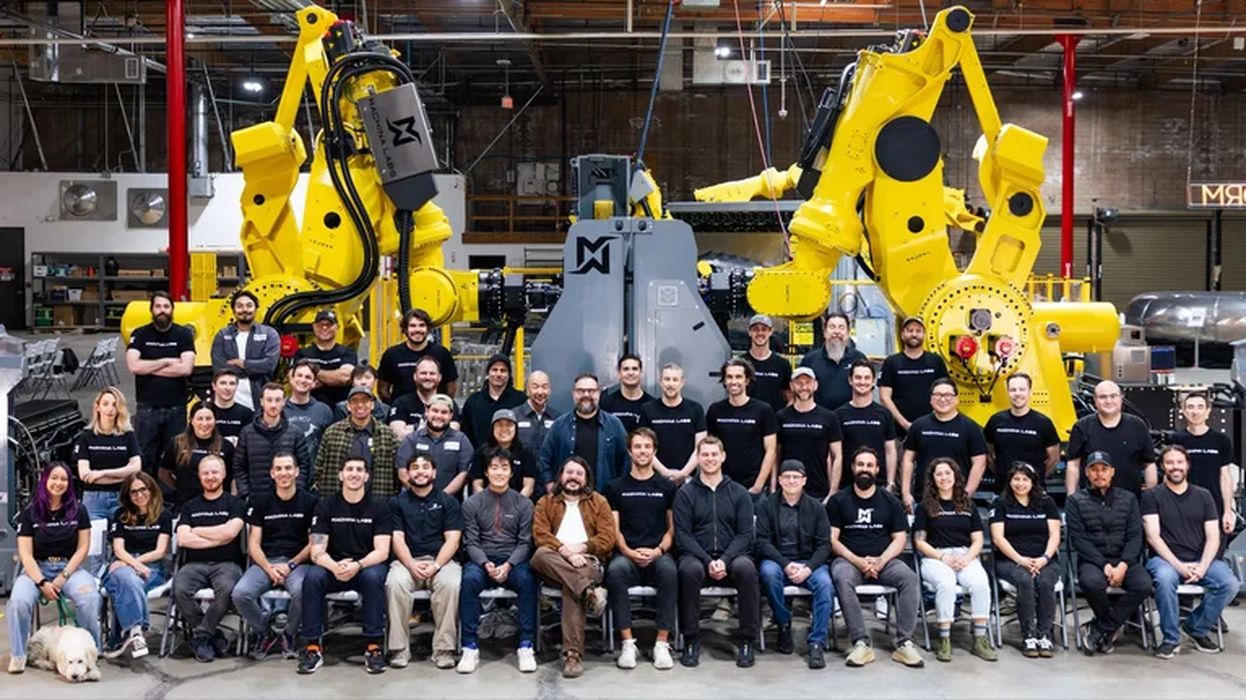
The Los Angeles-based company has developed an AI-enabled manufacturing platform built around advanced seven-axis robotic systems. Instead of relying on traditional stamping dies and dedicated tooling, Machina’s RoboCraftsman technology uses robotic arms to shape, trim, scan, and process metal components directly from digital designs.
This distinction is important. Machina Labs is not a 3D printer manufacturer. Rather, it represents a new category of digital fabrication in which robotic systems perform metal-forming operations that historically required expensive tooling, large presses, and lengthy setup times.
For aerospace and defense customers, the advantages are substantial. Aircraft structures, spacecraft components, and defense systems often require low-volume production runs with highly complex geometries. Conventional tooling can be expensive and time-consuming to create, particularly when designs are changing rapidly.
Machina’s robotic forming approach eliminates much of that friction. Engineers can move directly from digital design to production without waiting for custom dies to be manufactured. This dramatically shortens development cycles while increasing manufacturing flexibility.
The company has already attracted significant attention from defense organizations and aerospace manufacturers. According to recent reports, Machina Labs has worked with defense primes, the U.S. Air Force, and other advanced manufacturing customers while continuing to scale its intelligent factory concept. Its latest funding round is intended to expand deployment of these software-defined manufacturing systems.
A Shared Theme: Software-Defined Manufacturing
Although Freeform and Machina Labs employ very different technologies, they share a common philosophy.
Both companies are replacing hardware-centric manufacturing systems with software-defined production platforms. In traditional manufacturing environments, flexibility is often constrained by physical tooling, machine configurations, and fixed production processes. In contrast, these next-generation manufacturers rely on software, sensors, machine learning, and automation to adapt production in real time.
This shift has profound implications for aerospace and defense.
Global supply chains remain vulnerable to disruptions, and geopolitical tensions continue to increase demand for domestic manufacturing capacity. Defense agencies are increasingly interested in technologies that can accelerate production while reducing dependence on specialized suppliers. Automated manufacturing systems capable of producing mission-critical components from digital files provide an attractive solution.
The broader additive manufacturing sector is also benefiting from this trend. Across aerospace and defense, companies are investing heavily in advanced metal manufacturing technologies to support everything from hypersonic systems and missile programs to next-generation aircraft and space vehicles.
Freeform and Machina Labs are helping demonstrate that automation is no longer limited to repetitive factory tasks. Instead, it is becoming a core element of engineering, production planning, quality control, and manufacturing execution.
The Research and Development Tax Credit
The same automation and AI-driven manufacturing activities described above can also have tax implications. Companies building AI-driven additive manufacturing systems or software-defined production platforms may be able to support federal research credit claims under IRC Sec. 41 when their work involves domestic qualified research aimed at resolving technological uncertainty, developing new or improved business components, and using a process of experimentation. In practice, that can include iterative prototyping and testing of build parameters, closed-loop machine-learning process control, and integration of advanced sensing and digital verification into the production workflow—particularly where engineering and computer-science experimentation is directed at improving function, performance, reliability, or quality.
For platforms that combine robotics with manufacturing execution software, the qualifying narrative often centers on uncertainty and experimentation in robotic workflows—such as toolpath generation, scan-and-adjust routines, and automated forming or trimming sequences that must be validated against tolerance, repeatability, and material response. At the same time, the credit is fact-specific, and routine quality control, market research, routine data collection, or the evaluation and implementation of vendor software generally do not qualify. Qualifying costs may include wages for employees performing or directly supervising qualified research, supplies used in experimentation, computer-use costs, and certain contract research costs.
For startups, the credit can be especially meaningful because qualified small businesses may elect to apply up to US$500,000 of research credit against payroll taxes under IRC Sec. 41(h), subject to gross-receipts, controlled-group, timing, and filing limitations. For companies investing heavily in automation, AI-native production, and additive manufacturing, payroll tax offset can help support ongoing technical experimentation earlier in the company lifecycle. Documentation of the technical uncertainties, alternatives considered, tests performed, and results analyzed is critical.
Why El Segundo Matters
Perhaps the most important aspect of this story is where it is happening.
El Segundo and the surrounding South Bay region have quietly become one of the most dynamic aerospace manufacturing hubs in the United States. Long known for its aerospace heritage, the area is now home to an expanding ecosystem of space, defense, robotics, and advanced manufacturing companies.
Freeform, Machina Labs, SpaceX, and numerous other technology firms are creating a modern version of Southern California’s historic aerospace cluster. The region combines engineering talent, venture capital, manufacturing expertise, and close relationships with defense and aerospace customers.