
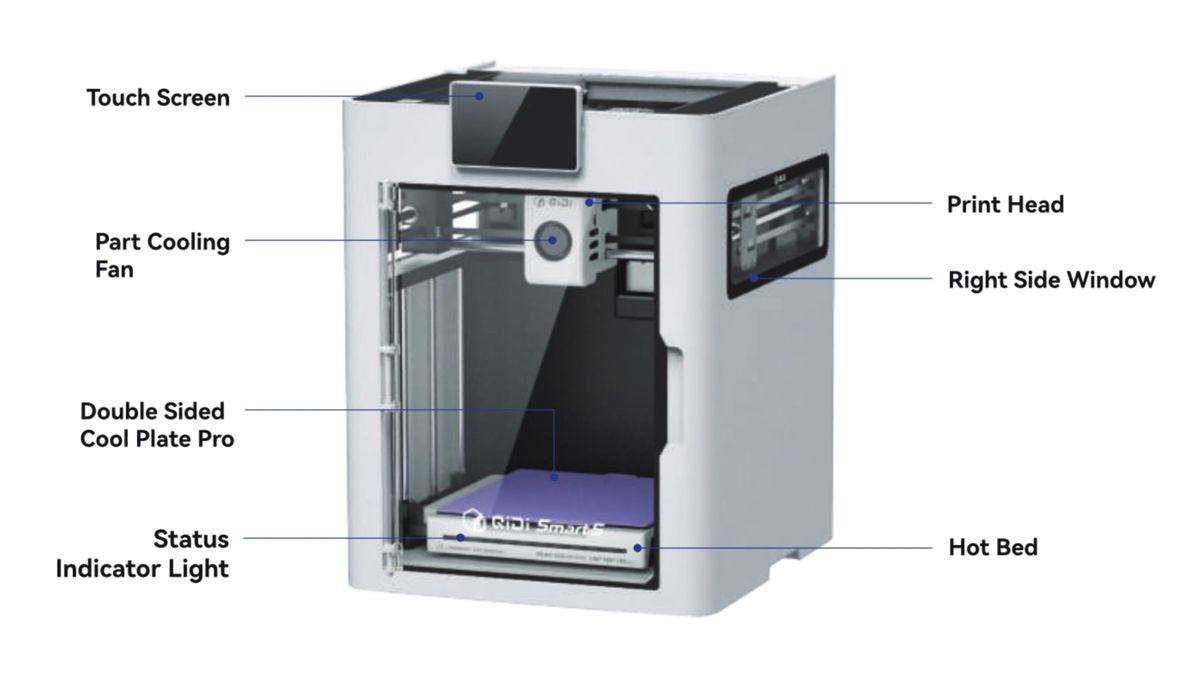
QIDI seems to have another machine on deck.
An FCC filing has surfaced for something called the SMART5, and while FCC documents are not product launches, they often reveal hardware just before a public debut. In this case the filing includes a user manual, which is enough to sketch out what QIDI is planning and, more interestingly, where it may fit in their lineup.
The SMART5 appears to be a compact enclosed FFF machine with a rather small 180 x 180 x 180 mm build volume, automatic bed leveling, a touchscreen interface, camera support, Wi-Fi, and what looks like a fairly conventional single-nozzle toolhead. The manual also describes remote control through QIDI’s usual software environment, along with the usual modern features like power-loss recovery and filament runout detection.
None of that is shocking by itself. Plenty of desktop machines now offer a package with those or similar features.
What caught my attention is that QIDI seems to be shaping this as a more approachable enclosed machine, rather than another high temperature flagship machine. The company has lately been associated with more capable engineering-oriented systems, particularly enclosed printers able to handle tougher materials. The SMART5, at least from the manual, looks a bit more like a general-purpose platform intended to bring some of that enclosed-printer experience into a simpler product.
That could be a smart move.
There’s a gap in the market between open-frame budget devices and the more serious enclosed systems that ask buyers to spend quite a bit more money, manage chamber heat, and think carefully about materials. A machine like the SMART5 could land in that middle zone: enclosed, cleaner looking, networked, but not obviously aimed at industrial polymers.
As far as I can tell from the manual, QIDI isn’t doing anything exotic here. I didn’t see signs of a toolchanger, IDEX configuration, pellet extrusion, or other unusual mechanics. That actually makes the filing more interesting, because it suggests QIDI may be refining a product segmentation instead of chasing higher end product segments.
If my reading is correct, then the SMART5 would differ from some of QIDI’s better-known equipment by being less ambitious. You’d buy it for reliable everyday printing in an enclosed format, not necessarily to chase the hottest nozzle temperatures or the most advanced material set.
What The Manual Suggests About Positioning
User manuals can be revealing. They show what a company thinks an operator will actually do.
In this case, the manual spends a lot of words on routine setup, touchscreen operation, connectivity, feeding filament, camera use, and everyday maintenance. That sounds like a machine meant for new users. If they are targeting schools, design offices, workshops, and hobbyists, that could make sense.
The enclosure is also interesting. For many buyers, an enclosure is about noise control, dust reduction, and keeping curious fingers away from hot moving parts. If QIDI can deliver that in a machine that is simpler to use than a more advanced engineering model, then the SMART5 could be viewed positively by a much wider audience.
I also suspect the naming is deliberate. “SMART5” sounds like a mainstream product family. That may indicate QIDI is trying to simplify its branding, which wouldn’t be a bad idea for a company with several overlapping enclosed models over the years.
What’s missing, of course, is the part buyers care about most: price and release timing. FCC filings won’t answer those questions. They only tell us the hardware is far enough along to need regulatory approval for wireless functions.
So I wouldn’t read the SMART5 as a breakthrough machine. QIDI may be preparing a cleaner, more mainstream enclosed printer for the growing group of buyers who want fewer compromises than a budget machine, but don’t need a miniature polymer lab on their desk.
That market is getting crowded, and that’s probably exactly why QIDI wants to be in it.
