
A newly granted Chinese utility model proposes combining material heating, mixing and forced feeding inside one compact 3D printer hopper.
Patent CN224510438U was assigned to Guangzhou Wenbo Intelligent Technology Co., Ltd. on 17 July 2026. It describes what is formally called a “consumable heating mechanism” for a 3D printer.
The terminology is somewhat vague, but the drawings and mechanism strongly suggest the system is intended for pellets, granules or powder rather than filament.
The main component is a cylindrical heating barrel with a removable threaded lid. Material enters through a pipe near the top and exits through another connection at the tapered bottom. Valves can isolate both ports, while a transparent glass window allows the operator to inspect the material level.
Inside the barrel is where the design becomes more interesting.
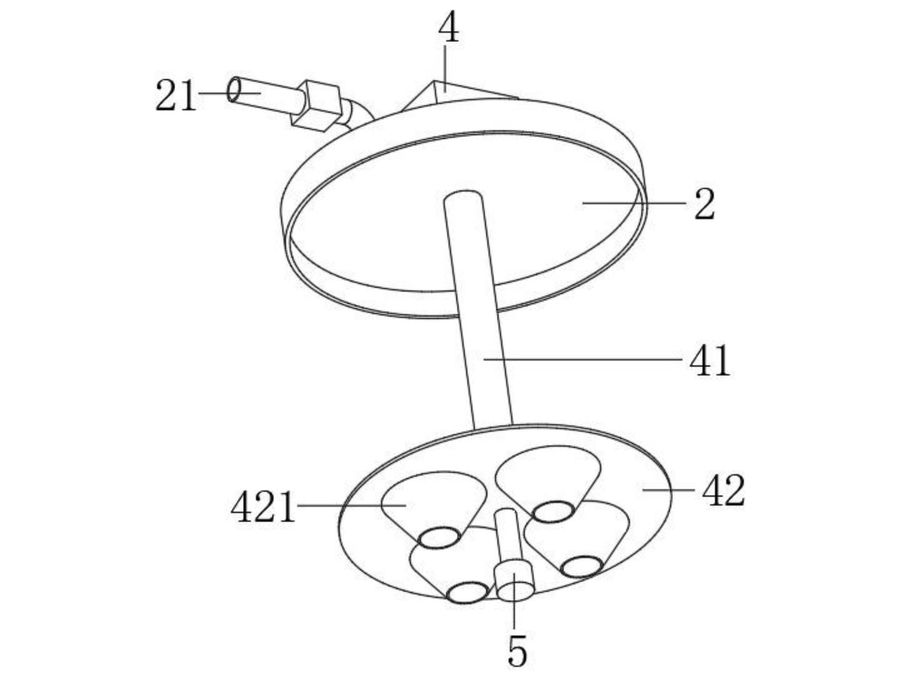
A controller mounted on the lid powers a circular metal heating plate suspended within the container. The plate includes four conical openings arranged around its surface. Incoming material lands on the heated plate and passes through these funnels, which are intended to divide the flow and expose it more evenly to heat.
A temperature sensor hangs beneath the plate and feeds measurements back to the controller.
In other words, the concept does not just wrap a heater around a hopper. It tries to control how material moves across the heated surface before reaching the lower chamber.
The bottom section contains a second mechanism driven by a servo motor. A vertical shaft carries both an agitator and a helical blade. The agitator mixes the heated material, while the screw section actively pushes it into the outlet pipe.
This is meant to address a likely problem: once some polymer feedstocks become warm, they can soften, stick together or bridge over an outlet. Gravity alone may then produce inconsistent flow or a complete blockage.
Combining agitation with an auger could make the output more reliable, particularly where the downstream process requires a steady supply of preheated material.
That could apply to pellet extrusion systems, large format additive manufacturing equipment or another printer architecture using bulk feedstock. Preheating material before it reaches the primary extrusion stage can reduce the thermal work required at the nozzle and potentially support higher throughput.
This setup could create maintenance challenges. Warm polymer residue collecting around the funnels, agitator and auger would likely require regular cleaning. The threaded lid makes the heater assembly removable, which should help, but access to the lower screw mechanism appears a lot less convenient.
Temperature uniformity is another question. A single sensor beneath the heating plate may not reveal hot or cold zones elsewhere in a larger material volume, and that was supposedly part of the concept.
Will this concept ever be used in a pellet/FGF system?
Via Espacenet
