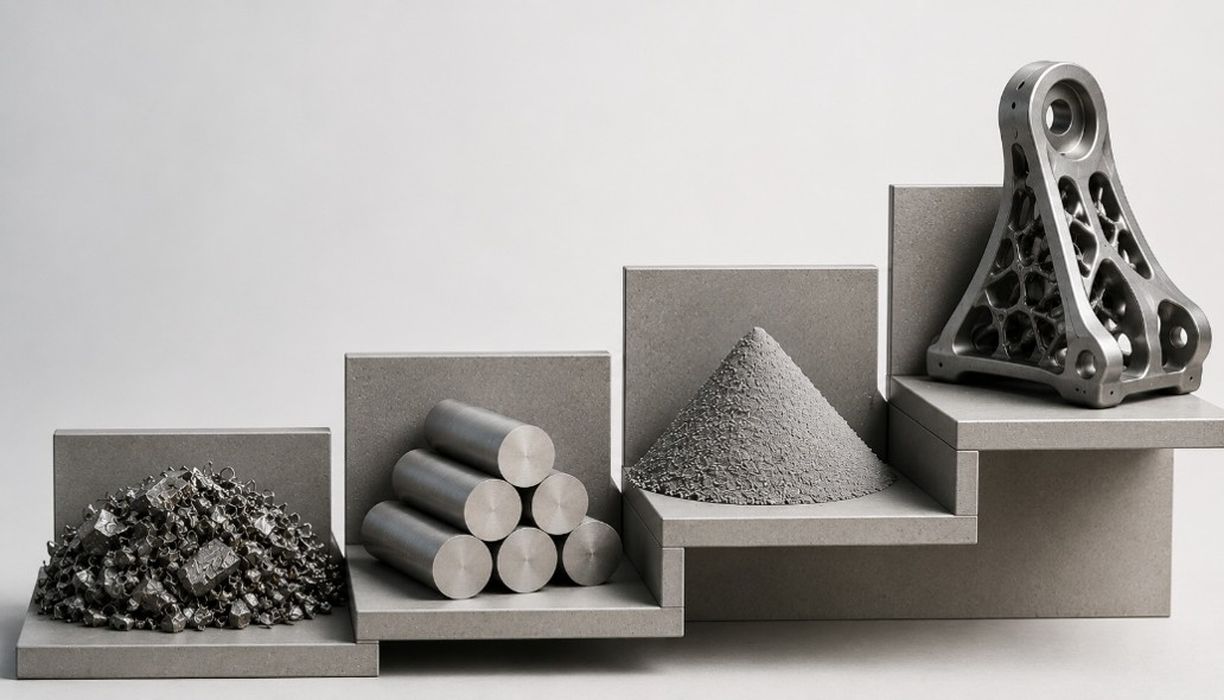
Charles G. Goulding highlights how advances in additive manufacturing, alloy traceability, and recycling technologies are redefining the future of sustainable aluminum production.
What Is Upcycling?
Metal recycling has traditionally focused on recovering metal itself, not preserving the highest value. Aircraft panels, automotive body panels, and beverage cans have all ended up in the same recycling streams, only to emerge as aluminum destined for less demanding products.
That is changing as manufacturers now pursue upcycling—recovering aluminum in ways that preserve the specific alloy that made it valuable in the first place. Instead of producing generic recycled metal, companies are trying to keep high-strength aerospace alloys, automotive sheet, and precision manufacturing scrap available for the next generation of advanced products.
The economics are compelling. Producing aluminum from recycled material requires only about 5% of the energy needed to make primary aluminum from bauxite ore. For companies facing rising electricity costs and governments seeking more resilient supply chains, every pound of high-quality aluminum already in circulation represents energy that does not have to be spent again.
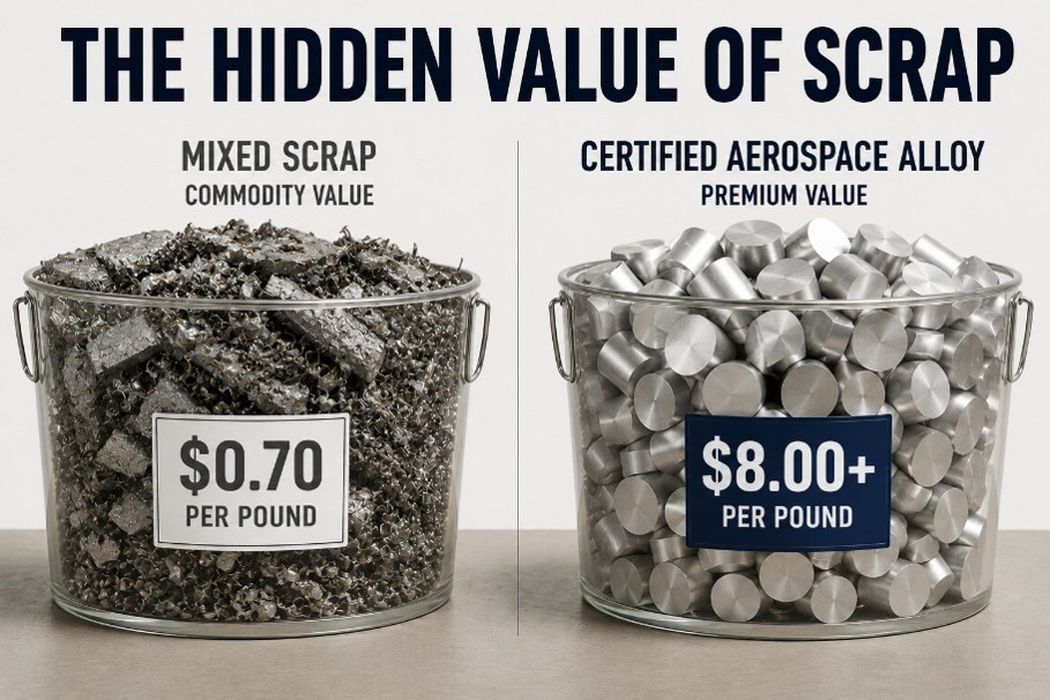
For decades, however, much of that value was lost. Mixing incompatible alloys often pushed premium aluminum into lower-value applications. Today, better process controls are making it possible to preserve much more of that value. Rather than asking whether aluminum can be recycled, manufacturers are increasingly asking whether it can return to equally demanding—or even more demanding—applications.
Aluminum Gaining Value
Aluminum has quietly become one of the defining materials of the modern economy. The shift can be seen almost everywhere. Ford Motor Company dramatically expanded its use of aluminum when it redesigned the Ford F-150 with an aluminum-intensive body to reduce weight while maintaining performance. Electric vehicle manufacturers including Tesla and Rivian rely heavily on aluminum because reducing vehicle weight can improve driving range.
Global Recycling Comparison: Steel vs. Aluminum
| Material | Approx. Annual Recycled Tonnage | Recycling Metric | Key Takeaway |
| Steel | ~630 million metric tons/year | ~35–40% of global steel production comes from recycled scrap. | Most recycled industrial material by tonnage; mature global recycling infrastructure. |
| Aluminum | ~35–40 million metric tons/year | ~33% of aluminum supply comes from recycled material; recycling uses about 5% of the energy of primary production. | Lower tonnage than steel but much higher value per ton when specialty alloys are preserved. |
The trend extends beyond automobiles. Airbus and Boeing continue to use aluminum extensively throughout commercial aircraft. Utilities are installing aluminum transmission conductors to expand electrical grids needed for AI data centers and renewable energy projects. AI infrastructure relies heavily on aluminum heat exchangers that remove enormous amounts of heat.
At the same time, producing primary aluminum remains one of the most electricity-intensive industrial processes in the world. As demand accelerates, countries are recognizing that the aluminum already embedded in existing products represents a strategic domestic resource. Rather than relying exclusively on new mining and smelting capacity, governments and manufacturers are looking for ways to keep aluminum circulating within their own economies. That strategy is even more attractive as new technologies increase the value of high-quality recycled metal.
Recycling Alone Isn’t Enough
Modern manufacturing depends on hundreds of specialized aluminum alloys engineered for specific purposes. Different applications require different alloys. Aerospace components, for example, demand exceptional fatigue resistance. Mixing these materials together may recover the metal, but it often destroys the precise chemistry that made each alloy valuable.
This challenge is driving investment in increasingly sophisticated sorting and recovery technologies. Advanced sorting systems can identify alloys before they are remelted. Manufacturers are also segregating machining chips and production offcuts directly on the factory floor, preserving alloy purity before contamination can occur.
Those improvements are creating opportunities that scarcely existed a generation ago. Companies such as Continuum Powders convert certified industrial scrap into high-performance metal powders for additive manufacturing, while 6K Additive uses advanced plasma processing to produce metal powders with an emphasis on sustainability.
Instead of treating recycled aluminum as a lower-grade commodity, these companies are helping transform carefully recovered alloys into materials suitable for some of manufacturing’s most demanding applications. The next challenge is turning those recovered alloys into components that conventional manufacturing often cannot produce.
How 3D Printing Changes the Economics of Aluminum
For decades, recycled aluminum usually moved down the value chain. A retired aircraft might become building products or beverage cans, but it rarely became another aerospace component. Once premium alloys were mixed with other grades, much of their engineering value was lost.
Additive manufacturing has created a new reason to preserve that value. Unlike conventional manufacturing, which typically starts with rolled sheet or extruded billet, most metal 3D printers require highly engineered aluminum powder. Producing that powder is expensive because every particle must meet demanding specifications for alloy chemistry, etc. As a result, manufacturers are willing to pay a premium for aluminum scrap that is carefully sorted and verified before it is recycled.
The transformation begins before a printer starts building a part. High-quality scrap is separated by alloy, chemically verified, remelted, and converted into microscopic spherical powder. Because the powder itself is valuable, preserving alloy quality throughout the recycling process has become far more important than it was in the past.
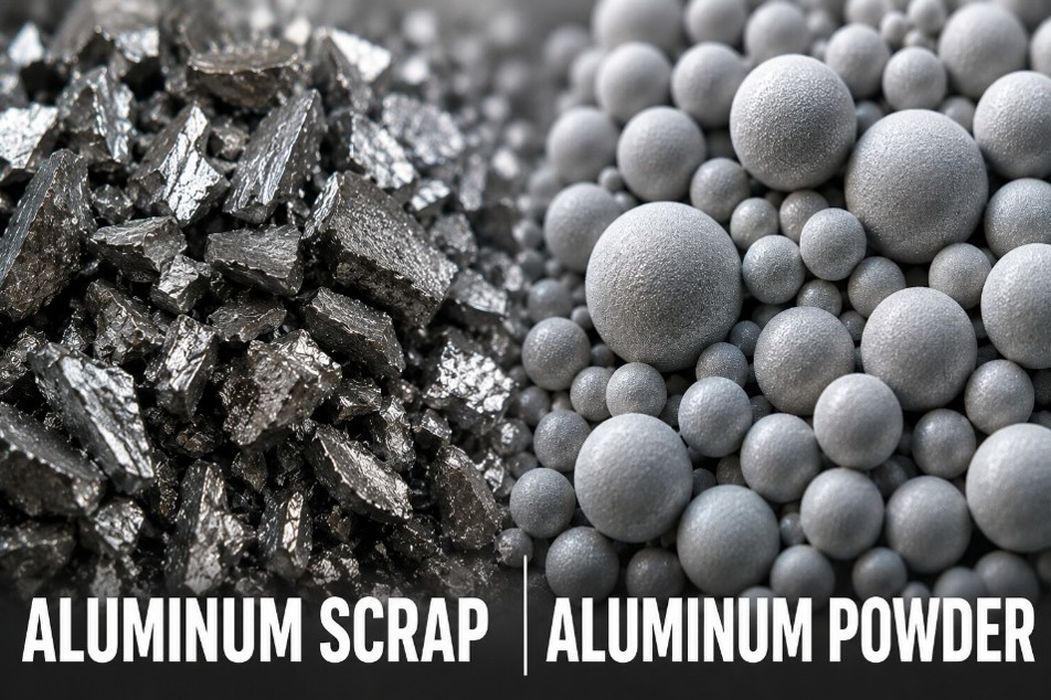
Companies are building businesses around that opportunity. Continuum Powders converts certified industrial scrap into additive manufacturing powder, while 6K Additive uses microwave plasma technology to manufacture premium powders. Those materials are then used on industrial systems produced by companies such as EOS, SLM Solutions, and Colibrium Additive to manufacture components that conventional machining often cannot produce efficiently.
The parts being produced are far more sophisticated than simple brackets. NASA has successfully hot-fire tested a 3D printed aluminum rocket engine nozzle manufactured using an advanced aluminum alloy developed by Elementum 3D. Airbus and its suppliers also use additive manufacturing for selected aircraft components, particularly where complex internal geometries reduce weight or improve cooling performance.
The result is a subtle but important shift. Additive manufacturing does not make aluminum recyclable; instead, it increases the value of recovered aluminum by creating demand for powder that can be used in premium applications.
Focus on Aerospace
Aerospace manufacturers produce bins of high-value machining chips while milling large structural components. Some companies are redesigning entire systems around keeping that aluminum in circulation. Novelis operates closed-loop recycling programs that collect automotive stamping scrap from vehicle manufacturers and return it as new aluminum sheet for the next generation of vehicles. Norsk Hydro has expanded recycled-content aluminum products. Constellium focuses on recovering valuable production scrap before alloys become mixed with lower-grade material.²¹
The goal is to preserve alloy quality well enough that yesterday’s manufacturing scrap can support tomorrow’s aircraft, vehicles, industrial equipment, and energy infrastructure.
Businesses Betting on Aluminum
| Company | Focus | Example |
| Novelis | Closed-loop automotive recycling | Returns stamping scrap directly into new automotive sheet. |
| Norsk Hydro | Recycled and low-carbon aluminum | Expanding products with high recycled content for industrial customers. |
| Constellium | Aerospace and automotive alloys | Recovers high-value manufacturing scrap for reuse. |
| Continuum Powders | Recycled metal powder | Converts certified industrial scrap into additive manufacturing powder. |
| 6K Additive | Sustainable powder production | Uses microwave plasma technology to manufacture premium metal powders. |
| Elementum 3D | Advanced printable alloys | Developed aluminum alloys used in NASA’s printed rocket engine testing. |
| EOS GmbH | Industrial metal printers | Powder-bed fusion systems for aluminum aerospace and industrial parts. |
| SLM Solutions | Large-format metal printing | Industrial aluminum additive manufacturing systems. |
| Airbus | Commercial aviation | Uses additive manufacturing to reduce weight and simplify aircraft assemblies. |
| NASA | Advanced aerospace applications | Demonstrated high-performance 3D printed aluminum rocket engine hardware. |
The shift toward aluminum upcycling is no longer confined to research laboratories. Companies are committing billions of dollars to expand primary production, secure recycled feedstocks, and build new manufacturing capacity that can support transportation, energy, and defense markets.
Perhaps the most striking example is Oklahoma’s effort to revive domestic aluminum smelting. At the request of the Oklahoma Department of Commerce, we first documented these efforts in February 2026 here at Fabbaloo. In 2026, Emirates Global Aluminum and Century Aluminum announced plans to develop a primary aluminum smelter in Inola, Oklahoma. Expected to produce 750,000 metric tons of aluminum annually, the facility would be the first new primary aluminum smelter built in the United States since 1980 and would more than double current U.S. primary aluminum production. The project illustrates how governments and manufacturers increasingly view aluminum as a strategic material rather than simply another industrial commodity.
Investment is accelerating overseas as well. In July 2026, Adani Group and Abu Dhabi-based International Holding Company announced an US$11.5 billion integrated aluminum complex in Odisha, India. The project will include an alumina refinery, a primary aluminum smelter, downstream manufacturing facilities, and supporting infrastructure. Once completed, it is expected to add 2 million metric tons of annual aluminum production capacity while creating one of the world’s largest integrated aluminum manufacturing hubs.
These investments may appear to run counter to the idea of upcycling; in fact they reinforce it. Aluminum demand is rising so rapidly that recycled material alone cannot satisfy future needs. Manufacturers are pursuing a dual strategy: expand primary production where necessary while recovering a much larger share of aluminum already circulating through the economy. Together, those investments reflect a broader shift in industrial thinking. Aluminum is no longer viewed simply as raw material. It is increasingly treated as strategic infrastructure that nations intend to produce, preserve, and reuse over multiple industrial lifecycles.
Certifying Alloy Quality
A modern aircraft may contain thousands of aluminum components, each expected to withstand years of repeated loading. Engineers cannot simply assume that recycled aluminum will perform like virgin material. They must demonstrate that its properties satisfy rigorous specifications. Every stage—from alloy sorting and remelting to powder production and final printing—must be carefully documented and repeatable. In many industries, certification of these processes—not recycling—is the greatest obstacle.
Digital manufacturing is making that process easier. Modern metal powder producers routinely analyze each element before a powder ever reaches a printer. During printing, machines monitor laser power, scan speed, melt-pool behavior, and build conditions, creating a digital record that follows each part through production. Non-destructive inspection methods such as computed tomography (CT) scanning can then verify that internal defects remain within acceptable limits.
This emphasis on traceability is changing the economics of recycled aluminum. Instead of treating scrap as an anonymous commodity, manufacturers increasingly preserve information alongside the material itself. Knowing exactly which alloy a machining chip came from allows that aluminum to compete for far more demanding applications than mixed scrap ever could. In the emerging upcycling economy, information travels alongside the aluminum, ensuring that valuable alloys retain not only their physical properties but also the trust required to put them back into service.
The Research & Development Tax Credit
Enacted in 1981, the now permanent Federal Research and Development (R&D) Tax Credit allows a credit that typically ranges from 4%-7% of eligible spending for new and improved products and processes.
Qualified research must meet the following four criteria:
- Must be technological in nature
- Must be a component of the taxpayer’s business
- Must represent R&D in the experimental sense and generally includes all such costs related to the development or improvement of a product or process
- Must eliminate uncertainty through a process of experimentation that considers one or more alternatives
Eligible costs include U.S. employee wages, cost of supplies consumed in the R&D process, cost of pre-production testing, U.S. contract research expenses, and certain costs associated with developing a patent.
On December 18, 2015, President Obama signed the PATH Act, making the R&D Tax Credit permanent. Since 2016, the R&D credit has been used to offset Alternative Minimum Tax for companies with revenue below US$50 million. And, pre-profitable, pre-revenue startup businesses can also obtain up to US$500,000 per year in payroll tax offsets and cash rebates for up to five years.
Eligibility and tax treatment are fact-specific, so manufacturers should maintain project and expense documentation and consult qualified tax advisers.
Conclusion
Once recycled aluminum became capable of supporting premium manufacturing, scrap itself became strategically important. The European Union has proposed policies to retain more aluminum scrap for domestic industry rather than exporting it overseas. In the United States, manufacturers have argued that exporting millions of tons of aluminum scrap also exports future economic value. Similar debates are emerging around the world as demand accelerates for aluminum in electric vehicles, aircraft, AI data centers, transmission infrastructure, and defense production.
Aluminum may be only the beginning of how countries think about “scrap.” For more than a century, industrial success depended largely on extracting raw materials. Upcycling changes that model. Instead of allowing valuable alloys to drift into lower-value uses, countries and manufacturers now seek to preserve engineering performance through multiple generations of products.
Additive manufacturing strengthens that strategy because it rewards high-quality recycled materials with applications that were difficult or impossible to produce using conventional manufacturing.
The same ideas are already spreading beyond aluminum into titanium, nickel superalloys, copper, and other high-value engineering metals. In the future, countries may increasingly depend on getting more value from materials already in circulation.
Charles G. Goulding is a practicing attorney.