
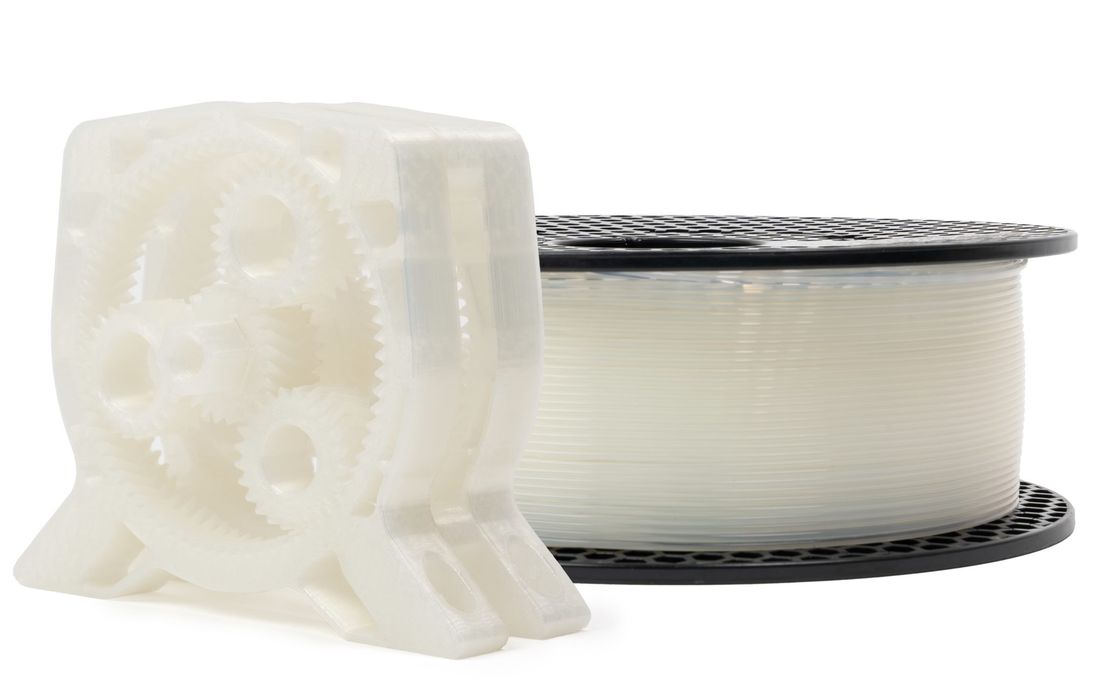
Prusa Research has added a “pure” PA11 Prusament filament for printing tougher, lower-friction functional parts.
The new material is called Prusament PA11 Natural. The key point is that this is not their previously released PA11 Carbon Fiber, but an unreinforced “natural” PA11 that offers different mechanical and thermal properties: maximize interlayer bonding and sliding behavior. In other words, Prusa is positioning it as a better choice for parts that move, rub, flex, or take repeated impacts.
Why introduce this material now when they’ve been making the CF version for a while? Back in 2022, Prusa says it did not have enclosed printers with sufficient heating to support pure polyamides without a high failure rate. Today it has the Prusa CORE One+, CORE One L, and the Prusa Pro HT90, all having higher chamber temperatures and a draft-free environment, which is critical because nylons are notorious for warping.
PA11 itself is a semicrystalline polyamide made from castor oil, and Prusa notes its impact resistance, wear resistance, UV resistance, and chemical resistance. Those traits make it ideal for outdoor and mechanical assemblies where PLA or even PETG can wear quickly, crack under repeated stress, deform in a warm environment or degrade in the sunlight. Their example applications include hose connectors and reduction gears, which are exactly the kinds of prints that benefit from low friction and overall toughness.
Why “Pure” PA11 Matters For Mechanics
The big difference between PA11 Carbon Fiber and PA11 Natural is the tradeoff between stiffness and bonding. Carbon-filled nylons typically gain rigidity and heat resistance, but can lose some layer-to-layer adhesion and become more abrasive: those tiny carbon fibers don’t adhere to the polymer, and they are very rigid. Prusa says PA11 Natural emphasizes “perfect layer-to-layer adhesion” and “excellent sliding properties,” which perfect for functional FFF parts like gears, bushings, hinges, and linkages.
For 3D printer operators, the message from Prusa Research is simply this: this is a nylon that is meant to survive real-world knocks.
Printing Requirements And The Real-World Tradeoffs
As with most polyamides, moisture management is essential. Nylons slurp up moisture from the air faster than you can breathe. Prusa recommends drying the new PA11 at 90C for six to eight hours before printing to reduce stringing and other defects, and then storing it in a dry box to slow re-absorption. It would also be advisable to keep it in the dryer actively during printing if you have that capability. That adds a bit more work compared to printing plain old PLA, but it is also the price you pay to get parts from a higher-performing polymer.
Bed adhesion is another known problem with nylon materials. Prusa says small PA11 parts can work on the standard sheet with a large brim, but it strongly recommends using their specialized PA Nylon sheet for larger prints. Interestingly, they suggest applying a thin glue stick layer as a separation layer for big, mostly solid prints where adhesion may become too aggressive.
Thermal performance comes with a little catch. Prusa reports a heat deflection temperature under load of about 58.7C as printed, but up to 122.5C after annealing. Its proposed annealing cycle ramps to 110C at 1.5C per minute, holds six to eight hours, then cools at the same rate. That sounds really good, but you will need an oven or dryer that can safely hold temperature for hours, and one that can gradually ramp temperatures up and down. A basic filament dryer, for example, might not work.
Prusament PA11 Natural is launching in a single translucent yellowish-white “Natural” color, with more colors “in the pipeline.” Pricing is listed at US$122 for an 800g spool (US152/kg), which obviously makes this a premium material.
While pricey, this material does transform a 3D printer into one that can produce truly functional parts.
Via Original Prusa
