
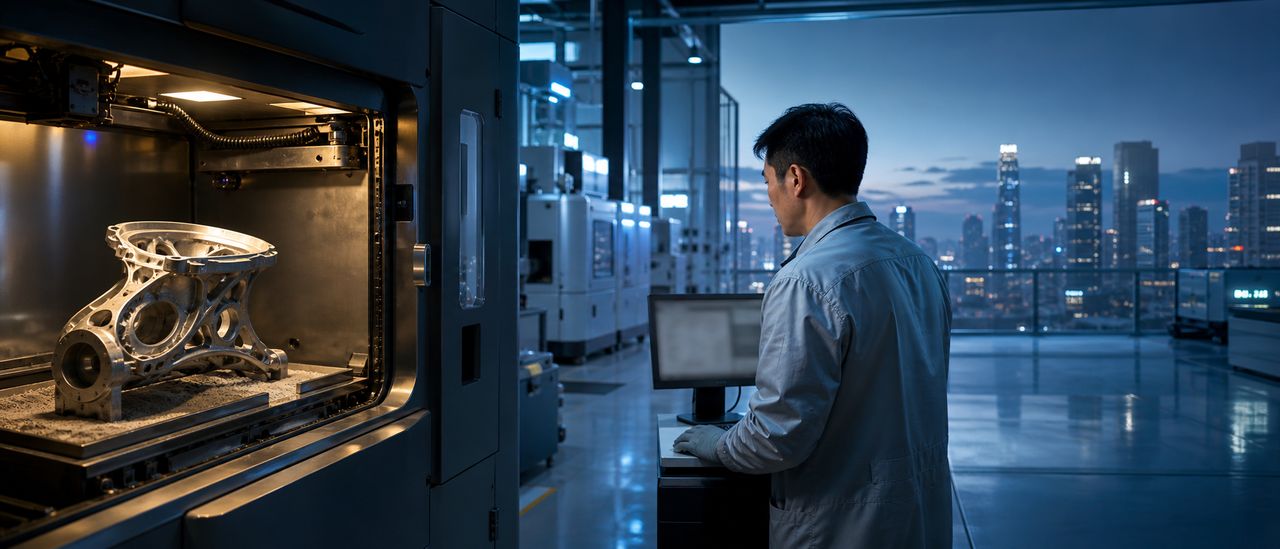
EOS is pursuing Chinese patent protection for additive manufacturing preflight software
This is a notable move by a major Western industrial 3D printing company in a huge Asian market that is highly competitive.
The publication, CN122471620A, appeared on 28 July 2026 through China’s National Intellectual Property Administration. EOS GmbH Electro Optical Systems is the applicant and follows a 2016 international filing.
EOS is seeking protection for a method and system that checks whether a digital part model falls within the reliable manufacturing limits of a specific layer-by-layer AM process.
Why pursue this in China?
China is now home to a large and growing ecosystem of metal laser powder bed fusion, polymer powder bed fusion, and industrial AM equipment vendors. A workflow patent covering machine-specific manufacturability checks could be strategically useful if EOS intends to sell software, integrated production workflows, or tightly controlled machine-and-material packages in China. The fact that EOS spent the effort to obtain this patent strongly suggests they intend on doing much business in China.
The patent describes comparing parameters in a CAD or STL-derived model with stored limits for a particular machine, material, process, and layer configuration. If the design exceeds a limit, the system can flag the issue to the designer or automatically adjust the model parameter.
The checks could include minimum wall thickness, hole diameter, slot width or depth, minimum feature resolution, stair stepping on angled surfaces, and maximum wall thickness. The patent uses EOS P390 equipment as one example and refers to powder-based AM processes including selective laser sintering and laser melting.
In other words, EOS is describing a more formal version of the AM design review that experienced machine operators already do themselves. Before the job reaches the build queue, the software determines whether the geometry is suitable for a stable process on the selected equipment.
“Printable” is not a universal thing. A feature that works on one polymer SLS system or metal LPBF machine might be risky on another because of recoater behavior, thermal effects, scan parameters, powder condition, feature orientation, and post-processing requirements.
The patent also suggests adapting the design to fit the process. For example, the system could alter a parameter to reduce weight or optimize stiffness, tensile strength, fatigue behavior, or other mechanical characteristics. It may use finite-element analysis to guide those changes.
This could be of interest to Chinese manufacturers looking to reduce manual design review while scaling production. It could also help EOS defend the value of its accumulated process knowledge. Hardware can be copied or competed against; reliable process data and the software logic that applies it are harder to replicate quickly.
EOS appears to see China as important enough to protect not only its machines and materials, but also the software intelligence surrounding their use. That is likely where much of the industrial AM competitive battle will happen.
Via Espacenet
