
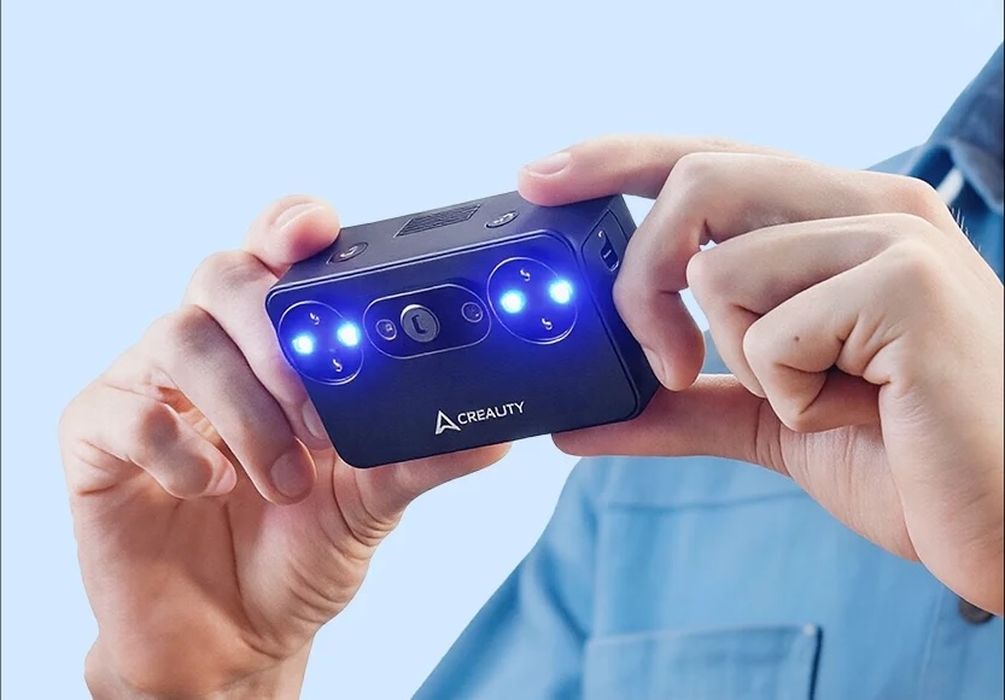
Creality introduced a very different kind of 3D scanner.
Handheld 3D scanners have been around for decades, and I recall buying one many years ago for US$65,000. Times have changed significantly since then, as three things have happened:
- Devices have become more powerful (faster, more resolution)
- Devices have become far less expensive
- Devices have become smaller
All of those factors seem to be how Creality’s new Pika 3D scanner was created. It is quite powerful, inexpensive, and it is extremely small.
How small? It’s literally the size of a thick-ish smartphone. You can slide it into your pocket and take it anywhere you like.
The Pika weighs only 260 g and has dimensions of 100 x 60 x 35 mm, making it one of the smallest handheld 3D scanners ever seen. But is it truly mobile? In spite of their multiple videos and images showing the device being operated standalone without any cabling, the product FAQ states:
“Pika needs to be connected to a phone, tablet, or computer during use. This allows it to leverage the connected device’s computing power for faster, more efficient scan processing and model generation.”
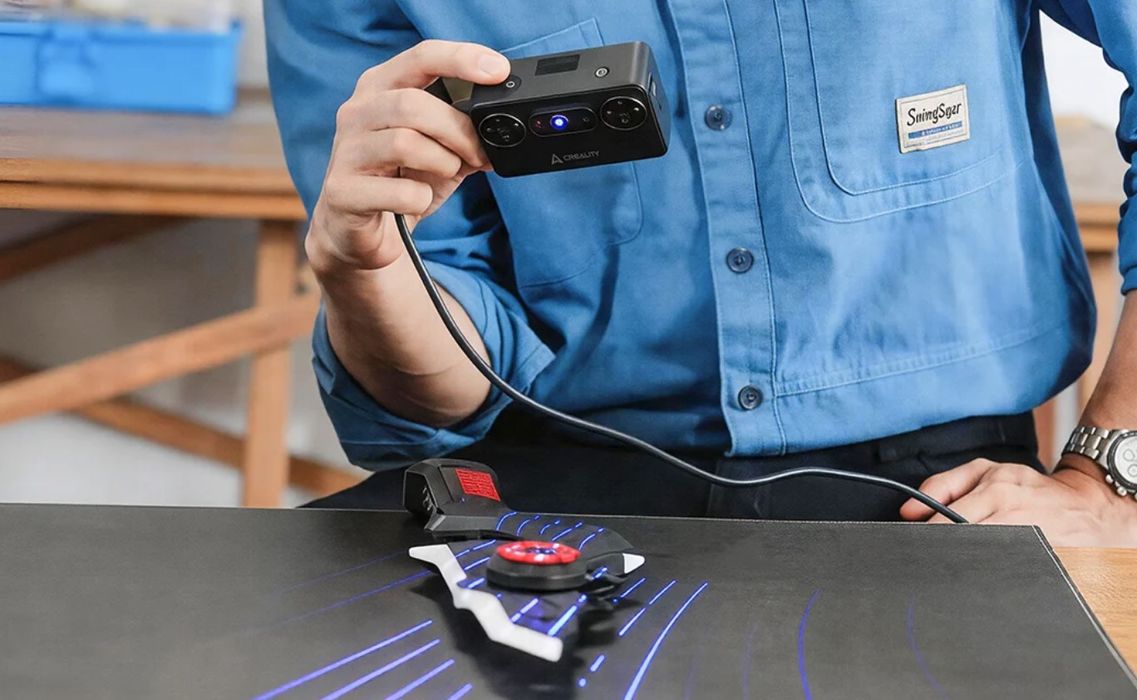
That makes the device a bit less impressive, but it is understandable given the low price and need for beefy hardware to perform the massive amount of computations required during high-frame-rate captures.
The technology inside the Pika is quite impressive. The main feature is that it is among the first 3D scanners to use Gaussian Splatting technology. This is a volume rendering technique that uses neural radiance fields to imply 3D geometry, and it often has far better results, especially with less-than-optimal input images. Gaussian Splatting also tends to produce much more vibrant colors in resulting scans, but this is less important for 3D printing applications. In addition, it is also able to handle pathological situations like reflections, thin hair, and dark surfaces far better than pure hardware scanning or photogrammetry.
I’ve seen this technique previously, but here it’s bundled directly into a hardware device.
Some other tidbits about the Pika:
- It can capture up to 110 fps, which is quite fast and should make it easy to capture objects on the fly.
- No markers are absolutely required when 3D scanning, but some are included to assist with challenging subjects.
- An IR filter allows use in direct sunlight.
- It is battery-operated, so it’s easy to swap batteries when one runs out; two are provided.
- Batteries are expected to last for up to 70 minutes of 3D scanning.
- Seven parallel blue lasers are used for detail capture.
- Near infrared is an alternate scanning mode; pick the right mode for the situation.
- Capture envelope ranges from 10 mm³ to 2000 mm³ — you can capture an entire person, unless they are a large basketball player.
The associated CrealityScan software can export the resulting scan as STL, OBJ, PLY, or ASC formats. STL can be used directly for 3D printing, and the OBJ and PLY formats can be converted into colour 3D models using the appropriate tools. There’s even an AI feature to automatically fill any holes in the scan, so you should receive printable watertight 3D models.
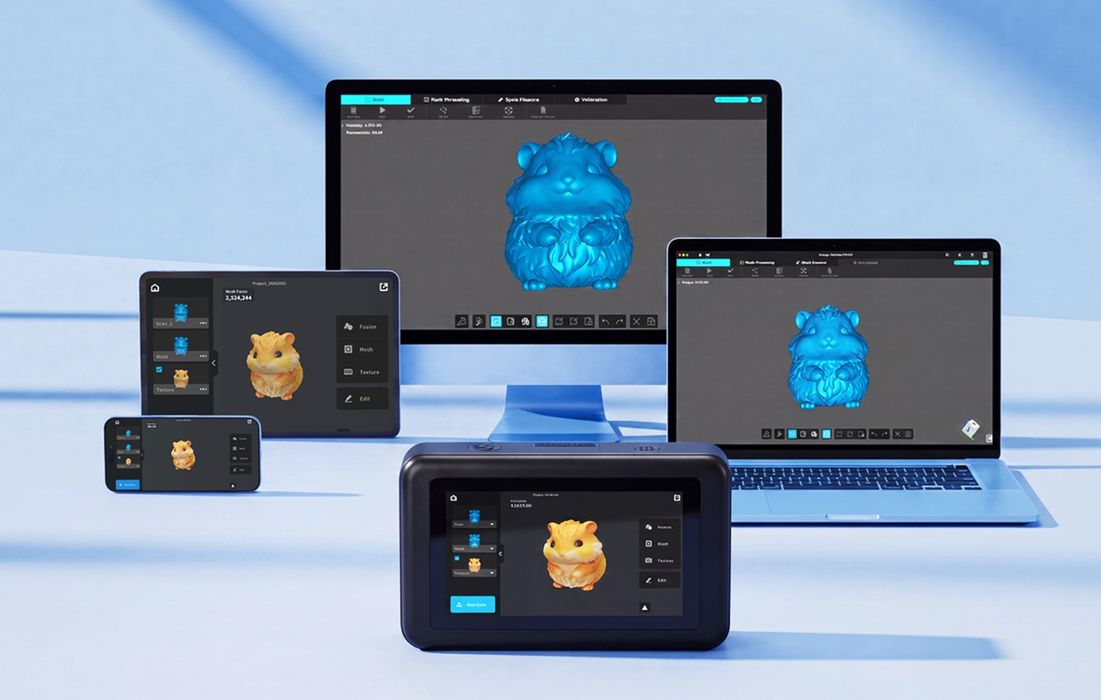
Creality has positioned the Pika as a device primarily to capture 3D scans for visual applications, rather than 3D printing. In other words, you can capture subjects for use in games, videos, etc. Does this mean you cannot 3D print from Pika scans? Certainly not; you can do so.
The catch is that the Pika isn’t as accurate as might be required for 3D scanning and reproducing dimensional parts. The resolution on the Pika is said to be something under 2mm, which isn’t good if, say, you are scanning a nut and bolt.
On the other hand, scanning organic objects like sculptures, people, architecture, or plants will work just fine because the accuracy required is achievable by the Pika.
The Pika is available now and is priced at a modest US$699. Note — there is a 10% discount offered by Creality for the first 20 days after launch.
Via Creality
