
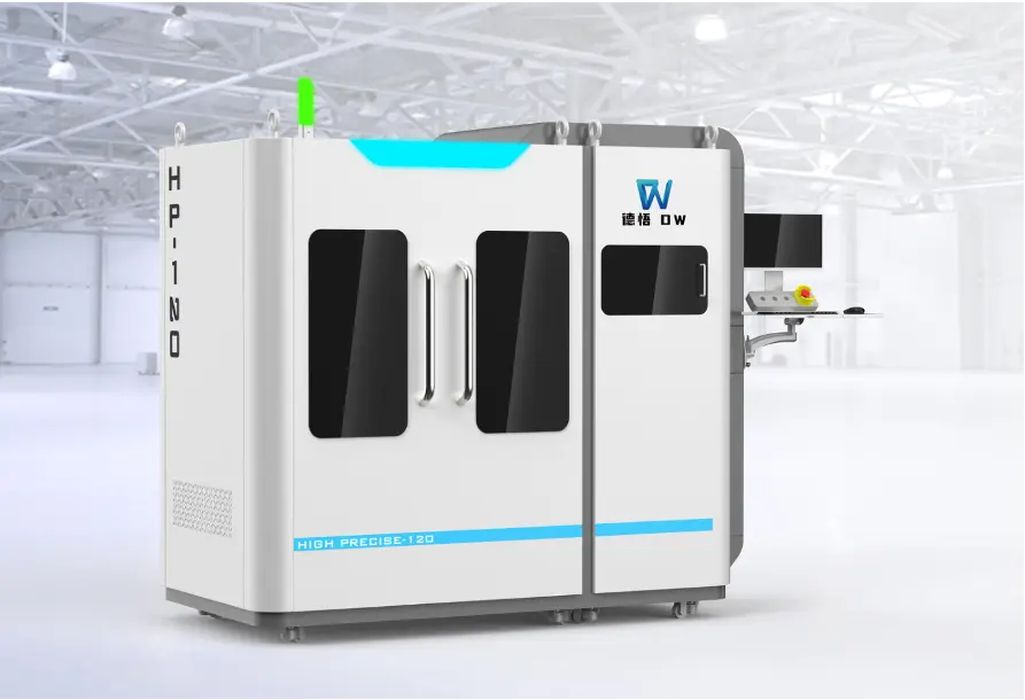
A Chinese company has figured out a way to lower the cost of 3D printing metal parts.
Traditional metal 3D printing with the LPBF process has been quite expensive. The highly reactive metal powders must be carefully contained and protected from oxygen and moisture exposure, requiring complex equipment and facilities.
But even after completing a metal 3D print, the job is not done: post-process is almost always required to complete the part. Metal parts are printed on thick metal plates, requiring them to be detached, and surfaces must be smoothed to specified tolerances. Most of the time, the post-processing steps cost a lot more than the actual printing itself.
In the end, the parts made in this way tend to be quite expensive, and that constrains the applications: unless your application is able to charge a lot for the part, it won’t make financial sense. That’s why we see a lot of aerospace, defence, and healthcare applications for metal 3D printing: those are markets where parts are already expensive.
But that may be changing.
In a fascinating story by 36Kr, we learn that Dewu Technology has a new approach to the cost problem. This involves a number of changes, not the least of which is a smaller and tighter laser spot.
Dewu was founded only a few years ago but has developed a form of LPBF that can achieve far higher resolution than most other systems. Their technology can reliably print walls only 0.03mm thick, and surface roughness is only 0.001mm (Ra).
The concept here is that if you print metal parts with their system, they will be much farther along the post-processing route than traditional LPBF parts. They require less post-processing — and that was the expensive part of the process, remember?
In an interview with 36Kr, Dewu founder Wang Zhou explained that typically post-processing is about 70% of the cost, but with Dewu’s process, it is reduced to about 10-20%.
However, Dewu’s systems are a bit more expensive than traditional LPBF options. This means you would pay a bit more for the printing, but save big on the post-processing. In total, they estimate savings of about 45%.
That’s a very significant change to the metal 3D printing equation, and if true, it would open up all kinds of new applications that could suddenly afford to use the process.
This potential has been noticed by investors, who just plowed “tens of millions of yuan” into the company. That’s a bit vague but could represent US$3-6M. Also note that this was a “pre-A Round”, meaning that it’s before a much larger raise.
It seems to me that Dewu is a company that might be one disrupting the metal 3D print market in a relatively short time.
