
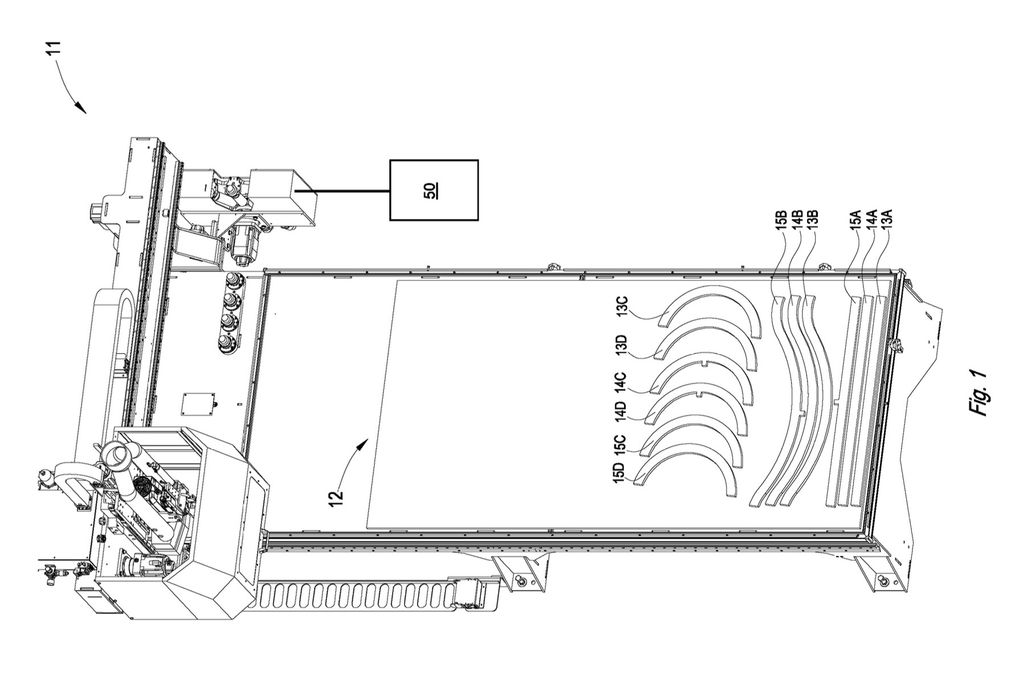
Thermwood has patented an interesting way to strengthen large hollow tooling made from stacked, machined layers.
The concept appears in international patent WO2025071893A1, “Methods and Systems for Support Structures in Cut Parts,” published in April 2025. The applicant is Thermwood Corporation, best known in additive manufacturing for its large (and I mean really large) scale additive manufacturing systems.
But this patent isn’t really about conventional extrusion 3D printing. Instead, Thermwood is looking at another way to build very large molds and tools: cutting individual layers from sheet material, stacking them together, and then machining the assembled structure to final dimensions.
Think of it as additive manufacturing where the “layers” arrive as sheets rather than extrusions.
Thermwood suggests those layers could be made from materials such as medium density fiberboard or aluminum. A CNC router or similar cutting system could produce nested layer segments from larger sheets, which would then be joined with interlocking shapes, fasteners, dowels, adhesive or combinations of these methods.
That approach could reduce the amount of material that has to be machined away compared with starting from a large solid block. It could also simplify fabrication of internal channels that might otherwise be extremely difficult to machine.
There’s one issue: hollow structures need support.
Adding Internal Structure
With a large format 3D printed tool, internal walls, ribs or other structures can simply be printed along with the exterior shell. With cut layer manufacturing, however, individual sheets don’t naturally provide convenient attachment locations for internal reinforcement.
Thermwood’s solution is to create “anchor points” on selected layers. These protrude into the hollow interior of the assembled tool.
Support members — rods, beams or other structures — can then span between these anchor points. They could reinforce a single layer, connect different layers, or cross the interior of the finished part.
Interestingly, the internal support material does not have to match the surrounding tooling material. Thermwood specifically contemplates supports with different properties, potentially making them stronger, stiffer, lighter or otherwise better suited for reinforcement.
In some situations the supports themselves could even be 3D printed.
That could allow a mostly hollow tool to obtain useful stiffness without filling its interior with expensive material. For very large molds, where material volumes become enormous, that could significantly affect both cost and weight.
Automating The Reinforcement
Thermwood describes a controller that could ask an operator whether internal reinforcement should be added, identify suitable layers for anchor points, and determine their locations. More advanced implementations could automatically place anchor points after analyzing the part geometry.
The system could even identify regions expected to require greater stiffness or reinforcement and generate support structures accordingly.
In other words, reinforcement could eventually become part of the tool generation workflow rather than something manually designed afterward.
Large scale additive tooling usually tries to improve extrusion speed, materials or machining efficiency. Thermwood is instead exploring whether some very large “printed” structures might be better made from preexisting sheets — while borrowing internal structural concepts from 3D printing.
If automated effectively, that could give Thermwood another manufacturing approach for large molds where printing the entire shell simply isn’t the most economical option. It’s just not a 3D printing technology.
Via Espacenet
