
Construction 3D printing is usually sold on these benefits: fewer workers, faster construction, less waste and the ability to produce unusual geometries.
But what if the reason you want fewer workers on site is because the site itself is dangerous?
That’s the angle taken by a Ukrainian publication titled “Construction in Conditions of Security Threats: Additive Technologies and Autonomous Systems.” It looks at automated construction not simply as a productivity tool, but as a possible way to reduce human exposure in hazardous environments. It’s not surprising this research comes from Ukraine, where it can indeed be dangerous to be outside at times.
That puts a very different spin on 3DCP.
If people can stand safely beside a machine all day, reducing labor is mostly an economic question. If the worksite is exposed to security threats, moving even a few people away from repetitive outdoor tasks could have considerably more value.
The Printer Is Only Part of the Problem
There’s an obvious problem here, though: A construction 3D printer can print walls, but a building is a lot more than just walls.
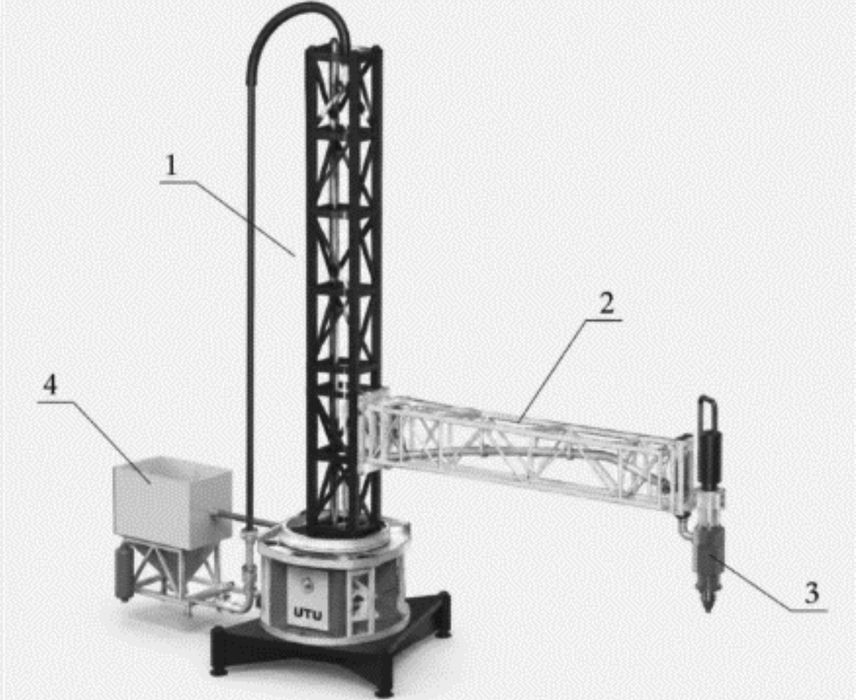
Most 3DCP systems use a gantry or robotic arm to extrude some form of cementitious material. That can automate a significant portion of shell construction, but somebody still has to supply material, prepare the mix, deal with reinforcement, install plumbing, HVAC and electrical systems, place flooring, windows and doors, inspect the work and handle all the other logistics around the project.
In a hazardous environment, automating only the extrusion step therefore doesn’t solve the whole problem.
The more interesting idea is to think of the printer as one member of a collection of autonomous or remotely supervised machines.
Ground vehicles, for example, might move materials or components around a site. Drones could handle mapping and inspection. Smaller robotic systems could perform localized deposition or placement jobs where a giant construction gantry would be impractical.
Put those pieces together and you begin to get something quite different from the usual image of a concrete printer slowly tracing the walls of a house.
Instead, the goal becomes reducing how often people have to physically enter the work area.
That could make sense for repairs, temporary facilities, protective structures or other infrastructure that needs to be established quickly under difficult conditions.
Now Make It Work in the Real World
Of course, construction 3D printing is already difficult enough on a perfectly ordinary building site.
Printable cement mixtures have to remain within fairly narrow operating conditions. Pumping has to be reliable. Material has to leave the nozzle consistently, hold its shape after deposition and cure predictably.
Now add uneven ground, debris, bad weather, unreliable electrical power and disrupted communications. And, in Ukraine, possible attacks.
Automation suddenly becomes a much tougher proposition.
Remote operation doesn’t eliminate human involvement either. Someone still has to determine whether the site is suitable, watch material behaviour, detect nozzle or pumping problems and decide what to do when a print goes wrong.
And if the result is intended to become a permanent structure, none of this makes reinforcement requirements, inspections or building codes disappear.
Printing a successful wall in controlled conditions is one thing. Running a partially autonomous construction operation when personnel, supplies, power and communications are all uncertain is something else entirely.
Most vendors talk about extrusion speed, reduced labor and architectural freedom. In a hazardous environment, however, perhaps a more important metric is simply how long the system can keep doing useful work without requiring someone to walk into the danger zone.
For this application, uptime — and how rarely a human has to intervene — may ultimately matter far more than how many metres of concrete the printer can extrude per hour.
Via OpenAlex
