
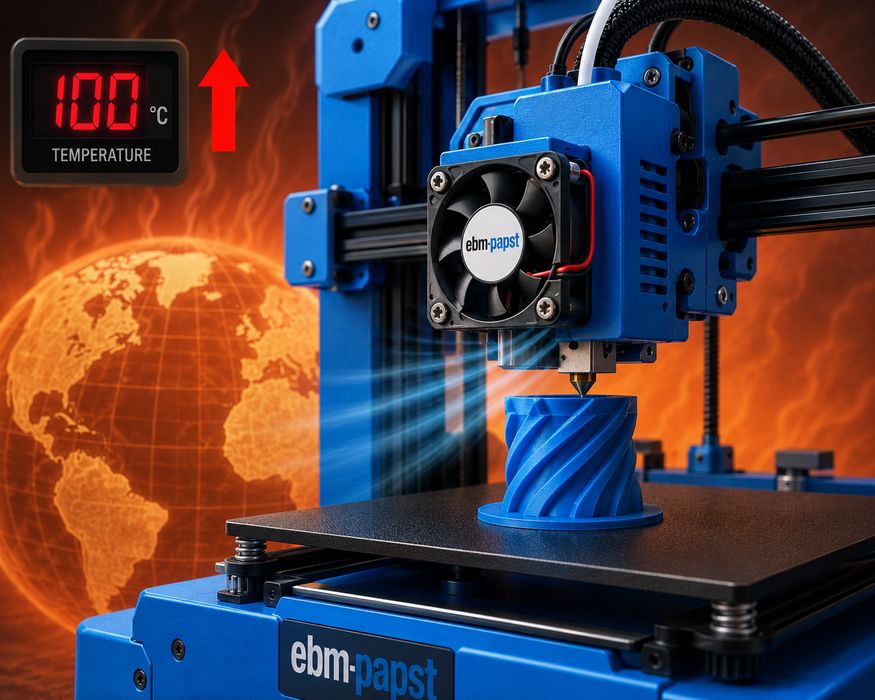
Charles R. Goulding and Preeti Sulibhavi look at the surprising 3D printing connections behind Madison Air’s acquisition of German fan giant ebm-papst.
Madison Air Solutions is making another major move in the HVAC industry, agreeing to acquire German fan and airflow technology company ebm-papst for approximately US$5.4 billion, including debt. The transaction, announced August 17, is expected to significantly expand Madison Air’s technology portfolio and international reach, particularly in data center cooling.
For Fabbaloo readers, however, there is another important reason to pay attention: ebm-papst already has a significant connection to 3D printing, both as a supplier of fans used inside 3D printers and as a user of additive manufacturing in its own product development.
That makes this acquisition particularly relevant at a time when HVAC companies are increasingly adopting 3D printing.
A fan company with a 3D printing connection
ebm-papst is a German manufacturer headquartered in Mulfingen that specializes in fans, motors, electronics and air-moving technology. Founded in 1963, the company describes itself as a global leader in fans and motors, serving markets ranging from HVAC and refrigeration to data centers, industrial equipment, medical technology and electronics cooling.
Its scale is substantial. In fiscal 2025/26, ebm-papst reported €2.236 billion in sales, approximately US$2.6 billion at current exchange rates, and employed 13,055 people worldwide. It operates 30 production sites and approximately 50 sales offices. The company also spent €142.7 million on R&D during the year.
One particularly interesting segment is fans for 3D printers.
3D printers need carefully controlled airflow. In an FDM printer, for example, a compact fan cools the hot end while another fan can cool the freshly deposited plastic. Without adequate cooling, printed layers can deform, dimensional accuracy can suffer and print quality can deteriorate. ebm-papst specifically markets compact fans for these applications and has explained how airflow helps control the thermal balance inside a 3D printer.
This is an important connection between two industries that are increasingly converging. The same engineering disciplines that optimize airflow through a 3D printer are also being applied to HVAC systems, data centers and industrial cooling.
But ebm-papst doesn’t just supply fans to the 3D printing industry. It also uses 3D printing to develop fans.
At Formnext 2025, ebm-papst demonstrated its use of a Stratasys Neo800 SLA printer with Somos WaterShed Black resin to rapidly produce large-scale functional fan prototypes. The company uses these prototypes to evaluate axial and radial airflow performance, allowing engineers to iterate designs faster and at lower cost than with conventional approaches.
That is exactly the type of application where additive manufacturing can deliver value in HVAC: not necessarily replacing mass production, but allowing engineers to test increasingly complex geometries before committing to expensive tooling and production processes.
Madison Air’s IPO set the stage
The ebm-papst acquisition comes only months after Madison Air made headlines with its April 2026 IPO.
Madison Air priced its initial public offering at US$27 per share, selling more than 82.6 million shares. The offering generated approximately US$2.58 billion in net proceeds, which the company used in part to repay outstanding borrowings.
As we reported previously in “From Airflow to ROI: Why Madison Air’s IPO Matters for 3D Printing”, Madison Air’s emergence as a major publicly traded industrial company was significant because it demonstrated the financial importance of HVAC, indoor air quality, energy efficiency and data center cooling.
The company generated approximately US$3.3 billion in 2025 net sales and had more than 8,650 employees. On a pro forma basis, including AprilAire, 2025 sales were approximately US$3.5 billion. Madison Air also says it has committed more than US$300 million in capital since 2021 toward R&D, growth opportunities and upgraded manufacturing equipment.
Now Madison Air is using that financial platform to acquire a company with roughly US$2.24 billion in annual sales and more than 13,000 employees.
The result will be a considerably larger HVAC technology company with a much stronger international and engineering footprint.
Three examples of additive manufacturing in the Madison Air orbit
There are already several documented examples showing how 3D printing fits into this broader ecosystem.
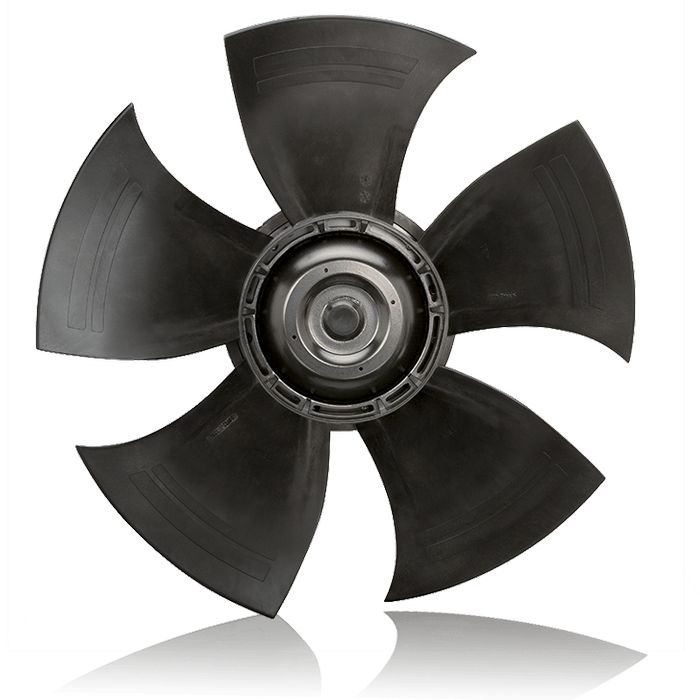
First, ebm-papst is using large-format SLA printing for functional fan prototypes. The Neo800 allows the company to produce large fan designs rapidly enough to perform airflow testing and iterate designs without waiting for conventional tooling. This is especially valuable for aerodynamic components, where even modest changes to blade or housing geometry can affect airflow, noise and energy consumption.
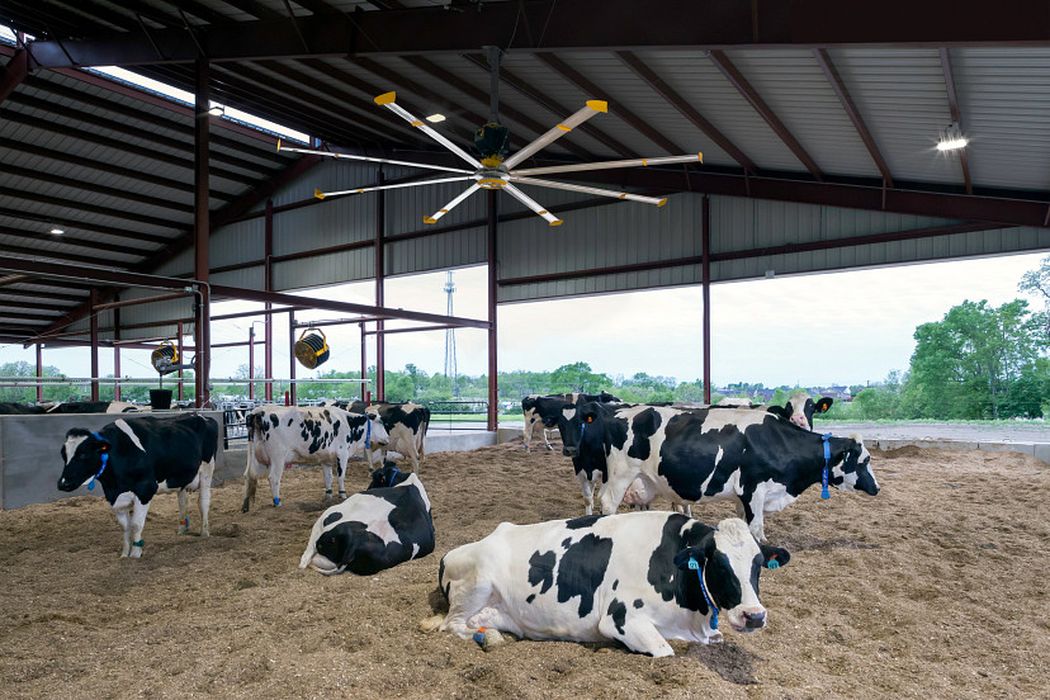
Second, Big Ass Fans, one of Madison Air’s brands, has used 3D printing extensively for fan prototyping. The company has used Raise3D Pro2 Plus printers to produce fan components for design evaluation and testing. According to Raise3D, each printer was being used for roughly 2,000 hours per year, and the printers supported product development by allowing engineers to produce and test multiple design variations internally.
Third, Big Ass Fans has used additive manufacturing for manufacturing aids as well as prototypes. Its 3D printing workflow has included jigs and fixtures, mold masters and occasional end-use parts. A later interview with the company’s engineering team confirmed that additive manufacturing was used extensively in prototyping and R&D, even though the company’s production airfoils were not being manufactured with additive processes. These examples illustrate an important point. HVAC companies don’t need to 3D print every component to benefit from additive manufacturing. Prototyping, tooling, fixtures and specialized low-volume parts can provide substantial value long before 3D printing becomes a mainstream production technology.
HVAC 3D printing is accelerating, especially in Maryland
This development also fits a broader trend we have been tracking at Fabbaloo.
In “Feeling the Heat: How Major HVAC Companies are Benefitting from Global Heat Waves”, we examined how major HVAC companies are responding to rising cooling demand. That article highlighted Daikin’s use of additive manufacturing for custom HVAC components and its research into advanced heat exchangers.
The trend is particularly visible in Maryland. The University of Maryland’s Center for Environmental Energy Engineering has developed an extensive HVAC-focused additive manufacturing program covering data center cooling, heat exchangers, desiccant systems and other energy technologies. As we reported in “University of Maryland’s Extensive HVAC 3D Printing Program Signals a Turning Point”, the work represents a shift from experimental 3D printed HVAC components toward practical energy infrastructure.
That means the use of 3D printing in HVAC is rapidly growing, particularly in Maryland, where university-industry research is helping connect additive manufacturing with real-world cooling and energy systems.
Our earlier article, “Revolutionizing Climate Control: The Role of 3D Printing and AI in HVAC Advancements”, also examined how 3D printing is being combined with AI and advanced cooling technologies as data center demand accelerates.
The Research and Development (R&D) Tax Credit
3D printing work often maps well to the IRC §41 four-part test (domestic §174A-type R&E, technological uncertainty, a new/improved business component, and a process of experimentation focused on function/performance/reliability/quality). ebm-papst supports the AM ecosystem by supplying fans used inside 3D printers, and it also uses additive manufacturing in product development. The article notes that inadequate cooling in FDM can deform layers and hurt dimensional accuracy and print quality – technical uncertainties that can drive iterative trials on airflow, geometry, and process settings.
For example, ebm-papst used SLA printing (Stratasys Neo800) and Somos WaterShed Black resin to build large-scale functional fan prototypes, then evaluated axial/radial airflow performance to iterate designs faster and at lower cost before committing to expensive tooling. Small aerodynamic geometry changes can materially affect airflow, noise, and energy use – ideal for design-model-test-refine experimentation. Big Ass Fans similarly used 3D printing extensively for prototyping, testing multiple design variations, and creating jigs/fixtures and mold masters.
Potential QREs can include qualifying wages, non-depreciable supplies used in prototypes/trials, certain computer-use costs, and generally 65% of eligible contract research. R&D Tax Savers has been helping companies navigate the complexities of R&D credit since its introduction into the code in 1981.
Why the timing matters
The Madison Air-ebm-papst transaction arrives at an important moment. AI is driving rapid growth in data center construction, while hotter global temperatures are increasing demand for cooling. At the same time, building owners are under pressure to reduce energy consumption.
That combination favors HVAC designs that are more efficient, lighter, quieter, easier to customize and faster to develop.
3D printing can help with all of those objectives.
The technology can produce complex airflow geometries that would be difficult to manufacture conventionally. It can shorten prototype cycles. It can eliminate tooling for low-volume components. It can also support customized parts and manufacturing aids without requiring an entire production line to be redesigned.
Madison Air’s acquisition of ebm-papst therefore looks like more than another industrial consolidation. It brings together a major HVAC platform with a company that already understands both sides of the additive manufacturing equation: fans that help 3D printers operate, and 3D printers that help engineers develop better fans.
As HVAC becomes more important to data centers, advanced manufacturing and energy efficiency, that connection will become increasingly valuable.
The conclusion is straightforward: this is the right time for the HVAC industry to integrate 3D printing. The technology has matured beyond simple prototyping, the industry’s engineering challenges increasingly favor complex and rapidly iterated designs, and the growth of data centers and energy-efficient buildings is creating exactly the market conditions in which additive manufacturing can deliver measurable value.