
EOS wants to make a laser powder bed fusion part with two different laser personalities.
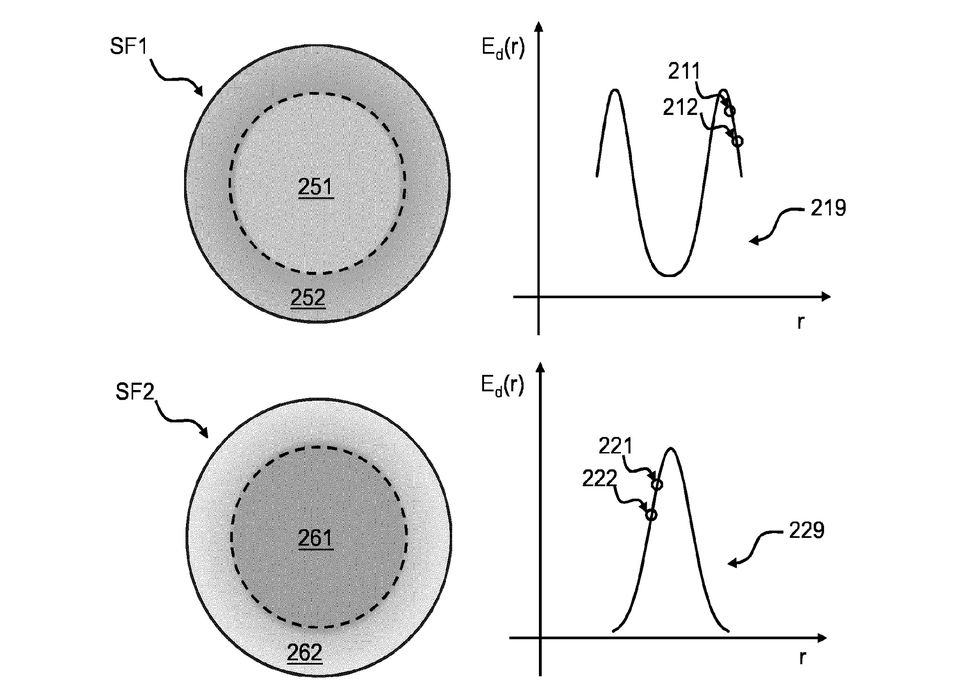
One laser profile is broad and modified, such as a ring or donut shape. The other is the usual Gaussian profile, concentrated toward the centre. The proposed software switches between them as the part is built, layer by layer.
Why do this? It turns out the answer is in its crystal structure.
In LPBF, a laser creates a small melt pool. As that pool cools, crystals grow along directions influenced by the local thermal gradient. A typical Gaussian shaped laser dot tends to produce a relatively homogeneous microstructure, which can help produce more consistent properties in different directions. The trade-off is a relatively small beam and limited productivity.
EOS says a modulated beam can be larger while still melting powder efficiently. Their patent application describes modified beam diameters in the range of roughly 120 to 600 micrometres, compared with approximately 40 to 120 micrometres for a typical Gaussian beam. A larger footprint can cover more material per scan, although it also changes the shape and depth of the melt pool.
That change is the whole problem. The patent says parts made with modulated beams can develop a more inhomogeneous microstructure and become less stable under certain loads, particularly loads across the build direction or torsional loads. The faster beam may therefore produce a part with more directional behaviour.
EOS’s answer, described in publication WO2026215064A1, is to mix the two approaches instead of choosing one for the whole job.
Their control software assigns one parameter set to the modified beam and another to the Gaussian beam. Those sets can specify beam diameter, energy distribution, power, scan speed and penetration depth. The printer then uses the first profile in some layers and the second in others. One preferred pattern is two layers with the modified beam followed by one Gaussian layer, although the claims cover other repeating sequences and even different patterns in different regions of the same part.
The second beam is supposed to melt deeply enough to reach into the layer produced by the first beam. In the patent’s terms, its penetration depth should be at least the first depth minus one solidified layer thickness, and preferably at least as deep. That is intended to prevent the later pass from merely sitting on top of a different microstructure. It partially remelts the earlier material and creates a transition between the two crystal populations.
The filing includes an example using a ring beam followed by a Gaussian beam. It also describes a third profile, another Gaussian beam with different dimensions, allowing the process to tune the microstructure and melt-pool geometry more gradually. A microscopic image in their application shows a more mixed and relatively homogeneous microstructure when the profiles are alternated.
For a printer operator, this would mostly appear as a new layer-planning option rather than added work. The machine would need beam-shaping hardware or multiple coordinated laser paths, plus software capable of assigning beam profiles to layers, sublayers or selected volumes, which, as far as I know, has not been announced by the company. EOS suggests that existing equipment could potentially be adapted through software or firmware, but the described hardware options include diffractive optical elements, fibre arrangements, liquid-crystal arrays and separate lasers.
This all sounds fairly complicated. Beam switching, calibration and melt-pool validation would all become more important. I also suspect it will depend heavily on the specific alloy, layer thickness and part geometry. The patent is, of course, not claiming that one three-layer recipe solves every mechanical-property problem.
What EOS is really proposing is a slicer that controls material microstructure as deliberately as it controls contours and scan paths.
That is a more interesting use of beam shaping than just making the laser spot bigger.
Via Espacenet