
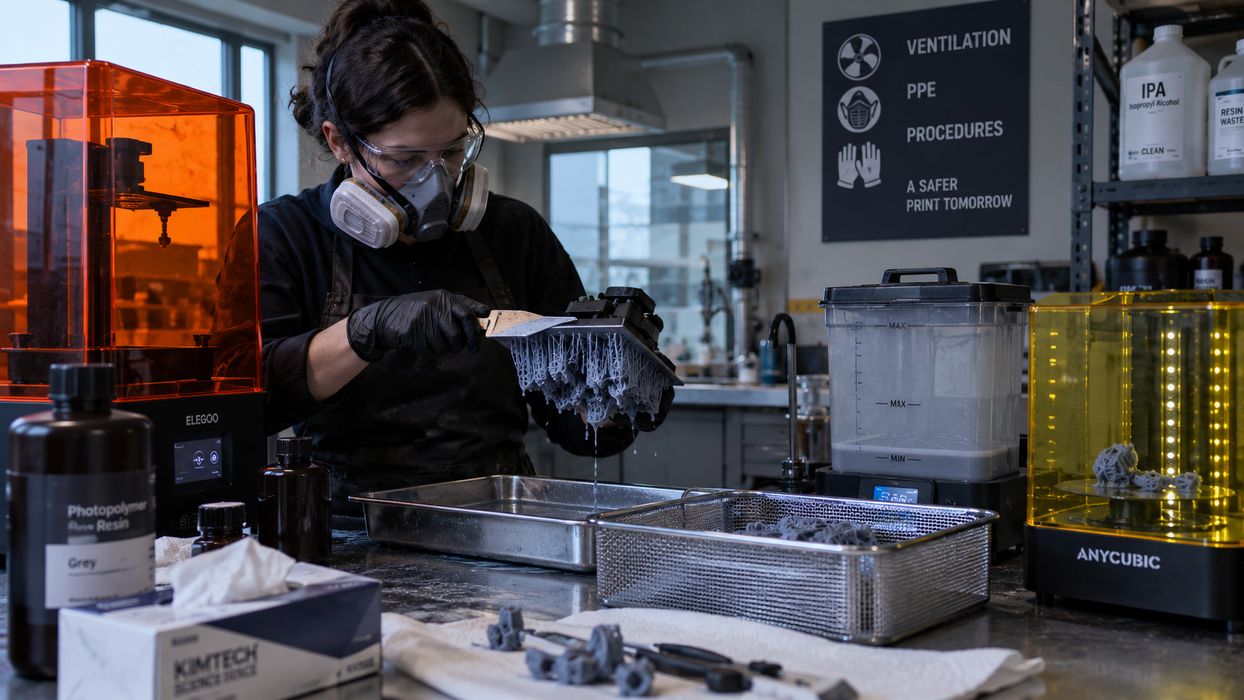
Here’s an uncomfortable thought for resin 3D printing shops: the printer may not be the only thing worth worrying about.
A new scoping review, Occupational Exposure to Airborne Emissions from Resin Based -Three Dimensional Printing: A Scoping Review, looks at what is known about airborne emissions from resin-based 3D printing. More specifically, it asks what operators may be breathing while they run the machines, remove parts, wash them, cure them and clean up afterwards.
That’s a more wholistic way to look at the safety issues with 3D printing.
Resin printer safety is frequently mentioned as though the entire problem sits inside the machine. Close the lid, use the filter, read the material safety data sheet and carry on. That may be fine as a starting point, but it doesn’t describe a real resin workflow very well.
A resin print is not finished when the 3D printer says so.
The Messy Part Comes After Printing
MSLA, DLP and similar vat photopolymer systems use liquid resins that harden when exposed to light. These formulations can include reactive monomers, oligomers, photoinitiators, pigments, additives and other ingredients that are usually proprietary. From an air-quality standpoint, the obvious things to watch are volatile organic compounds, or VOCs, along with particulate emissions.
For a hobbyist with a small desktop resin 3D printer, the usual advice is straightforward: ventilate the room, wear gloves and don’t get uncured resin on your skin. In a workplace, things get more complicated very quickly.
A dental lab, service bureau, factory or hospital may run several machines for long periods. Staff may be loading resin, opening lids, removing wet build platforms, transferring parts into wash stations, handling solvent, scraping supports, curing parts and cleaning equipment over and over again.
Each of those steps is a possible exposure event.
That’s the part that can be missed if the measurement stops at “printer operating normally with the lid closed.” The moment someone opens the machine and starts moving wet parts around, the situation changes. The wash station may have its own emissions. The curing unit may add heat. Solvent handling introduces yet another variable. Just carrying a wet part from station to station emits toxicity into the surrounding air.
Anyone who has spent time near a busy resin setup knows this intuitively. The smell is not always coming from one box.
Measuring The Workflow, Not Just The Machine
This scoping review does not declare one magic safe number. It does not certify one printer as good and another as bad. Instead, it gathers what researchers have actually studied, how they measured it and where the evidence is still thin.
That can be quite valuable, because resin printing has moved faster than the occupational exposure research around it.
For printer makers, the awkward question is whether their safety advice covers the full workflow. A carbon filter in a compact machine may help with odors or certain emissions during printing, but it does not automatically deal with open-tank handling, resin spills, solvent washing or cleaning routines.
For facilities, the answer may not be a single fix. General room ventilation might be enough in one case, but local exhaust ventilation may be needed in another. Closed wash systems, better storage, cleaner handling procedures and staff training may matter just as much as the printer itself.
Resins are constantly being tuned for speed, accuracy, toughness, temperature resistance, dental applications or biocompatibility. But the person choosing that resin may not have much independent information about what it gives off during printing and post-processing.
Companies are now selling resin systems into dental offices, medical settings, schools and small manufacturing operations. Those customers are not simply buying a printer. They are buying an entire chemical process that has to fit into a room, a ventilation plan, staff routines and workplace safety rules.
Better measurement standards would help. They would make it easier to compare systems and decide whether a setup needs simple ventilation, source capture or something more carefully engineered. They would also make it harder to pretend that a consumer-style desktop arrangement automatically scales into a production cell.
The point is not that resin 3D printing should be avoided. It’s that resin work should be treated as a connected, wholistic industrial process, even if it is just a printer sitting on a table.
Via OSF
