
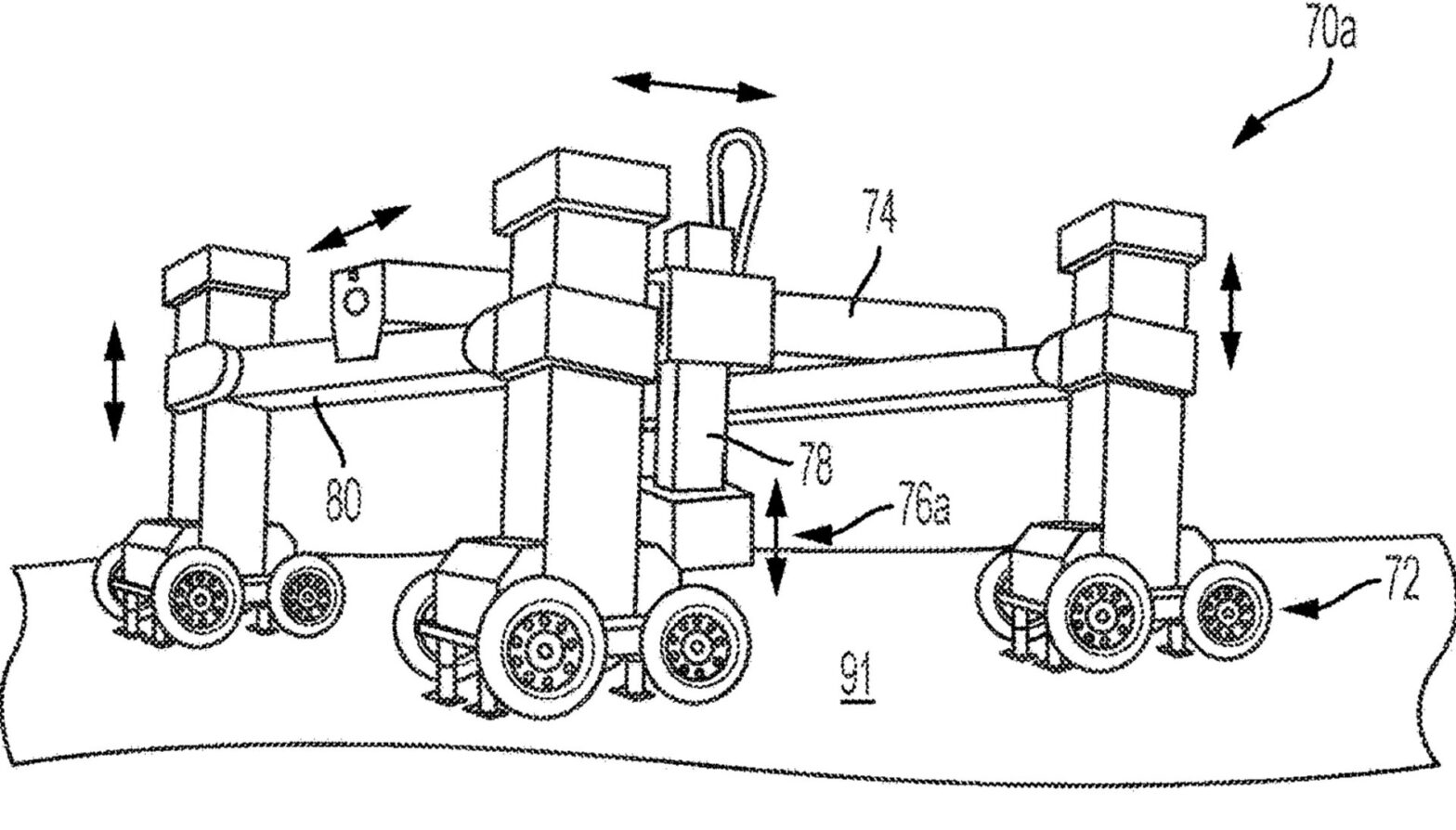
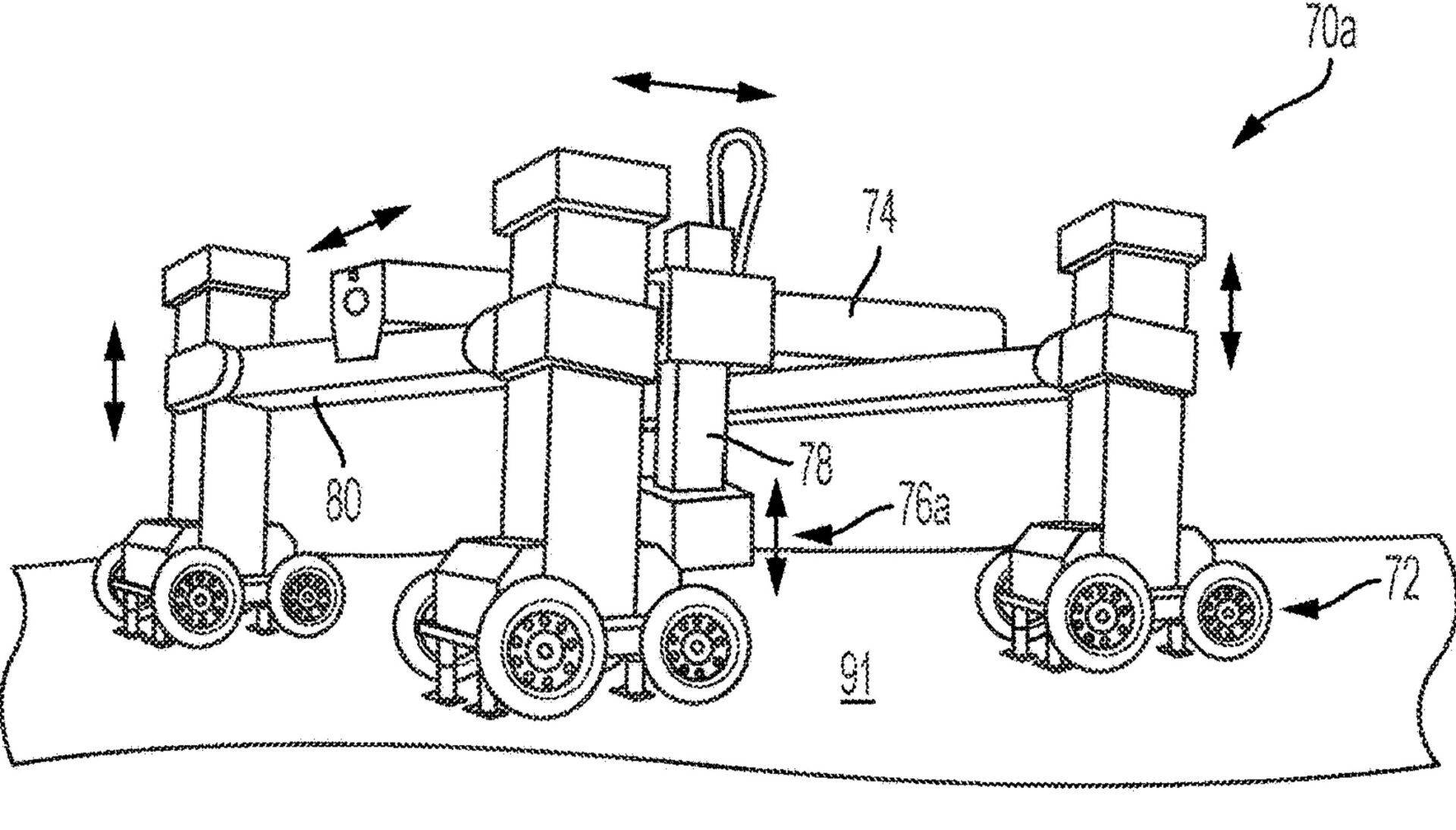
What if the 3D printer had to drive to the job site because the job site was another planet?
That is the seemingly crazy idea in ICON’s US20260316387A1 patent application, titled “System and Method for Deploying, Harvesting, and In-Situ Printing of Three-Dimensional Structures in an Extraterrestrial Environment.” The applicant and assignee is ICON Technology, Inc. of Austin, Texas, who have been in the news for their frequent large-scale building projects. The company has also been known for working with NASA on experimental off-Earth building technologies.
The patent filing describes a complete system for landing additive manufacturing equipment on an extraterrestrial surface, collecting local material, conditioning it, and printing a structure from it. The printer is not just dumped into the build site. It is actually part of a mobile platform that can travel across the surface while carrying the deposition hardware (see image at top).
That changes the engineering problem a whole lot. On Earth, a large construction printer usually has a very carefully prepared site, a stable power supply, and a separate material delivery system. Here, the machine has to survive launch, deployment, navigation, uneven ground, remote control, and the absence of a conventional material supply chain. And because it is mobile, it is even more challenging to register its printing location in 3D space.
The patent proposes collecting regolith (lunar dust and gravel) or other handy materials, then using heat, a furnace, binders, extrusion, sintering, melting, or others methods to turn that material into a printable substance. The patent abstract describes a printhead with a collector, a conditioner for heating and sintering the collected material, and an extruder with a slip-form opening. Material is deposited across the surface and consolidated into a solid extrusion.
A slip form could help contain and shape the freshly deposited material as the platform moves, allowing the machine to build walls, berms, landing infrastructure, or other structures without requiring a build chamber.
The drawings are particularly interesting because ICON does not commit to one specific mobile machine. They show a wheeled rover, a gantry, a tower, a robotic arm, a flying delta-style platform, and other deployable configurations. Some machines appear to carry the deposition head directly. Others use cables, rails, or articulated structures to position it.
That flexibility is reflected in the claims, which cover launching and deploying a mobility platform, moving it over an extraterrestrial surface, collecting material, conditioning it, and depositing it to form a structure. Their platform can apparently be configured for different terrain, print geometries, and material-processing methods.
One drawing shows a collecting vehicle that resembles a shallow mobile hopper or conveyor. It gathers loose surface material and carries it toward the processing equipment. Another set of drawings explores extruders with hoppers, screws, heaters, and material-flow controls. The objective is to avoid shipping every kilogram of construction material from Earth, which is, of course, incredibly expensive to do.
That sounds obvious until you consider the material they’re using. Regolith is not a consistent pelletized polymer. Its particle size, mineral composition, abrasiveness, moisture content, and thermal behavior could vary quite a lot from one location to another. The conditioner and extruder would therefore need to tolerate input material that is way more inconsistent than a standard concrete mix or plastic pellets.
ICON also includes remote communication, navigation and guidance, environmental sensing, power management, and lander configuration in the system. In other words, the patent is not protecting just a nozzle. It is describing an autonomous or remotely supervised construction operation in which the printer, vehicle, material processor, and mission hardware are one machine. It’s a complete system.
I suspect the mobile aspect may be more important than the choice of extruder. A fixed printer can be designed around one build envelope. A rover has to keep its tool stable while its wheels encounter terrain bumps, and it must know where the previously deposited material is located. Every metre of movement creates a very difficult print-control problem.
Their approach treats the lunar surface as both the factory floor and the raw-material source, while allowing the machine to relocate as construction expands. If ICON or another organization can make the conditioning process reliable, the result could be infrastructure built from local material rather than carried from Earth, which would potentially be a lot more economical.
The complication is that this would be an entire industrial plant on wheels, delivered by rocket and expected to operate remotely. That would be a very formidable machine, even on Earth. But for off-Earth construction, eliminating imported bulk material may justify exactly that kind of complexity.
Another consideration here is timing. This all sounds like science fiction stuff from the distant future. But here we have a proper company actually going to the effort of developing and patenting a highly complex process to achieve this capability. It’s as if they are really intending on doing it.
Do they know something we don’t know?
And when are they going to deploy a complete system like this on Earth?
Via Espacenet