
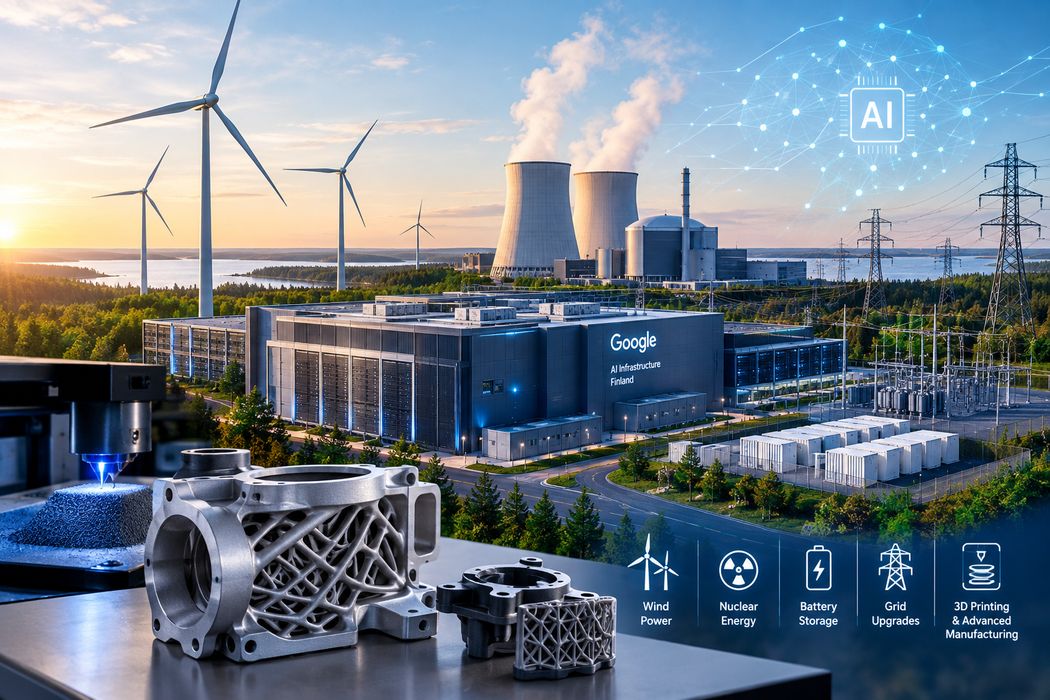
Charles R. Goulding and Preeti Sulibhavi explain how Google’s planned Finnish AI infrastructure expansion will require new sources of electricity and supporting energy infrastructure, creating potential applications for additive manufacturing.
Google’s decision to invest roughly US$15 billion in artificial intelligence infrastructure in Finland is about much more than building data centers. The company is simultaneously assembling an energy strategy designed to support those facilities, including new renewable generation, grid flexibility, battery storage and nuclear power.
That combination could create an overlooked opportunity for 3D printing.
The investment, announced September 9, calls for at least €13 billion in spending over 2027 and 2028. Google plans to expand data center infrastructure in Hamina, Kajaani, Muhos and Vaala while working with Finnish energy companies and grid operators to increase the availability and reliability of low-carbon electricity. Google says the initiative will include new onshore wind capacity, a 94-megawatt battery system and a long-term agreement connected to the life extension of Fortum’s Loviisa nuclear power plant.
The Wall Street Journal also reported on the investment on September 10, highlighting the enormous infrastructure requirements behind Europe’s rapidly expanding AI industry. The energy arrangements are particularly significant because data centers require electricity continuously, making access to dependable generation and a resilient grid just as important as the buildings and computing equipment themselves.
Nuclear Power Is Part of the Strategy
The nuclear element of the agreement is real, and it is more substantial than simply buying electricity from an existing plant.
Fortum and Google have signed a 22-year power purchase agreement covering up to 50% of the capacity of the Loviisa nuclear power plant. The agreement provides Fortum with greater financial certainty for investments intended to extend the plant’s operating life and upgrade its capacity through 2050.
Google and Fortum have also signed a memorandum of understanding covering potential future cooperation on new nuclear generation, renewable capacity and flexibility solutions. The companies specifically say they will investigate business models that could improve the commercial viability of potential new nuclear reactors at Loviisa.
That makes this more than a renewable-energy procurement story. Google is effectively helping create an energy ecosystem around its Finnish AI infrastructure, with nuclear providing dependable generation, wind supplying additional renewable electricity and batteries helping balance the system.
For additive manufacturing, nuclear is particularly interesting.
As we discussed in “3D Printing the Nuclear Renaissance: How Additive Manufacturing Fuels the AI Power Grid and R&D Credits”, the rapid growth of AI data centers is creating new pressure to build and maintain reliable power infrastructure. Nuclear plants contain thousands of highly engineered components, many of which must remain operational for decades. Additive manufacturing can provide an alternative when conventional suppliers disappear, tooling becomes obsolete or replacement parts have long lead times.
Finland already provides a particularly relevant example.
Fortum Has Already Tested 3D Printing for Nuclear Applications
Fortum is not a newcomer to additive manufacturing.
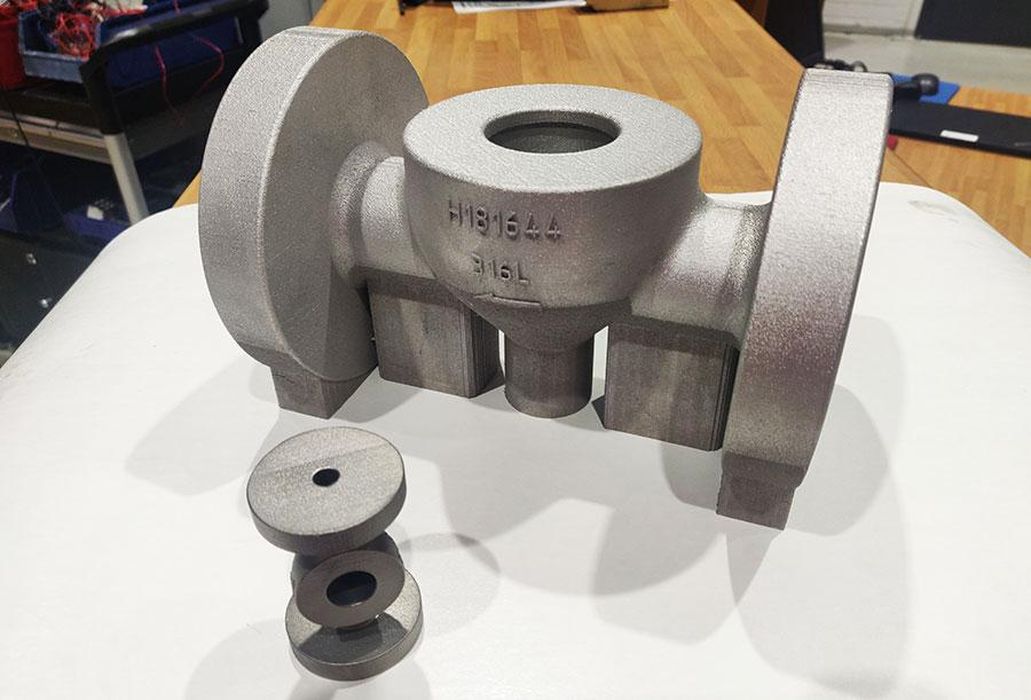
In 2021, Fortum and Teollisuuden Voima tested a valve with a 3D printed housing at the Olkiluoto nuclear power plant. The housing was produced by Neles Finland, while the valve itself was a conventional stainless-steel ball valve. Fortum said at the time that additive manufacturing could become particularly useful when nuclear components become difficult to source from traditional manufacturers.
The significance of the project goes beyond one valve. Fortum specifically identified the potential for 3D printing to manufacture safety-classified nuclear components and emphasized the possibility of shortening delivery times.
That is exactly the type of capability that could become valuable as Loviisa undergoes life-extension work.
Our previous Fabbaloo article, “From Parts to Power: Finland’s 3D Printing Revolution in Nuclear Energy”, examined this broader Finnish trend. The country has already demonstrated that additive manufacturing can play a role in keeping nuclear infrastructure operational, including through the use of 3D printed components at Olkiluoto.
The second Fortum example is outside nuclear power but is equally relevant to the sustainability story.
In 2020, Fortum developed a 3D printed hands-free door handle using its Circo recycled plastic, a material made from post-consumer plastic packaging collected in Finland. The company tested the product in Finnish retail environments as a practical example of turning waste material into a useful manufactured product.
Fortum had already gone further with the material itself. In 2019, it introduced Fortum Circo PP CF, a compound combining recycled plastic with natural cellulose fiber. Fortum said the material was suitable for 3D printing as well as injection molding and was fully recyclable.
These examples show two different possibilities for the Google project: additive manufacturing as a way to solve industrial supply-chain problems, and additive manufacturing as a way to use more sustainable materials.
Where 3D Printing Could Enter the Google-Fortum Buildout
The first opportunity is maintenance and replacement parts.
A large data center and its associated energy infrastructure contain pumps, valves, brackets, housings, cooling components, electrical infrastructure and specialized mechanical parts. Some will be standardized and mass-produced. Others may be unusual enough that maintaining a traditional inventory is expensive.
Digital inventories combined with additive manufacturing could allow certain qualified components to be produced closer to where they are needed.
The second opportunity is nuclear modernization.
If Loviisa receives significant upgrades as part of its life-extension program, engineers could evaluate additive manufacturing for selected components, tooling, fixtures and eventually more demanding nuclear applications as qualification and regulatory frameworks permit.
This does not mean that every nuclear component will suddenly be 3D printed. Nuclear manufacturing is highly regulated, and safety-critical parts require extensive qualification. But Fortum’s previous work demonstrates that the company already understands the technology and its potential.
The third opportunity is data center and energy infrastructure design.
AI data centers generate enormous quantities of heat. Cooling systems therefore become central to their efficiency. Additive manufacturing can create complex internal geometries for heat exchangers, manifolds and fluid-management components that would be difficult or expensive to manufacture conventionally.
This is also where sustainability-focused additive manufacturing becomes interesting.
Fabbaloo’s recent article, “Carbon-Capturing Materials and the Push for Sustainable Additive Manufacturing”, examined emerging materials that can incorporate carbon capture into construction and manufacturing systems. Such materials are still developing and should not be treated as an immediate solution for Google’s facilities. But the concept points toward a future in which the physical infrastructure surrounding data centers could be designed with lower embodied carbon and, potentially, carbon-sequestering materials.
Large-scale additive manufacturing could eventually become useful for non-critical infrastructure, architectural elements, equipment enclosures or other construction applications associated with these massive facilities.
A More Integrated Energy Strategy
Google’s Finnish strategy is notable because it recognizes that building AI infrastructure requires more than simply connecting a data center to the grid.
The company says its additional wind agreements with Valorem and Suomen Hyötytuuli bring the total new-to-grid onshore wind capacity supported by its Finnish PPAs to 629 MW. It is also contracting for a 94 MW battery system near Kajaani and working with Fingrid on grid balancing and demand-response opportunities.
At the same time, the Fortum agreement helps preserve an existing source of low-carbon, around-the-clock electricity.
That matters because Finland’s electricity system will have to accommodate both AI infrastructure and other industrial electrification. Google’s stated strategy is therefore not simply to consume more electricity, but to participate in adding generation and flexibility to the system.
There are still legitimate questions about the environmental impact of the buildout. Data centers consume substantial electricity and can put pressure on water supplies, land and other local resources. Communities around the world are increasingly asking whether the economic benefits of new AI facilities justify those demands.
Finland’s approach does not eliminate those concerns. But tying new computing capacity to additional clean-energy generation, grid improvements, battery storage and investment in existing nuclear infrastructure provides a more comprehensive answer than simply building another enormous electricity consumer.
The Research and Development (R&D) Tax Credit
Below is a table that presents the R&D expenses incurred by Google, or rather its parent company, Alphabet Inc., over recent years in comparison to its human capital.
| Fiscal year | Alphabet R&D expense | Human capital count | R&D expense / employee |
| 2025 | US$61.087 billion | 190,820 | US$320,129 |
| 2024 | US$49.326 billion | 183,323 | US$269,062 |
| 2023 | US$45.427 billion | 182,502 | US$248,913 |
| 2022 | US$39.500 billion | 190,234 | US$207,639 |
The 3D Printing Opportunity Should Not Be Overlooked
With all the media coverage and controversy surrounding AI data centers, Google’s Finnish strategy may ultimately prove to be a useful model.
Being a billion-dollar multinational technology giant gives Google access to capital, energy partnerships and vast overseas development opportunities that a smaller company simply cannot match. That scale also allows Google to influence the infrastructure surrounding its facilities rather than merely consuming what is already available.
The more interesting question is whether the clean-energy component can grow alongside the computing infrastructure.
The Loviisa nuclear agreement, new onshore wind capacity, grid investments and battery storage suggest an effort to build that relationship from the beginning. If those initiatives succeed, they could help offset some of the negative effects associated with data centers, particularly their enormous demands for electricity and, depending on their cooling systems and locations, water and other critical resources.
And the role of 3D printing should not be overlooked.
Fortum already has firsthand experience using additive manufacturing in nuclear applications and developing recycled materials suitable for 3D printing. As Finland builds out an increasingly sophisticated AI and energy infrastructure, additive manufacturing could help maintain aging power assets, shorten supply chains, create more efficient cooling and energy components, and eventually contribute to lower-carbon construction.
The real opportunity may therefore sit at the intersection of three industries: AI, clean energy and advanced manufacturing. Google’s investment puts billions of dollars behind the first two. Finland’s existing experience suggests that 3D printing could become an important part of the third.