
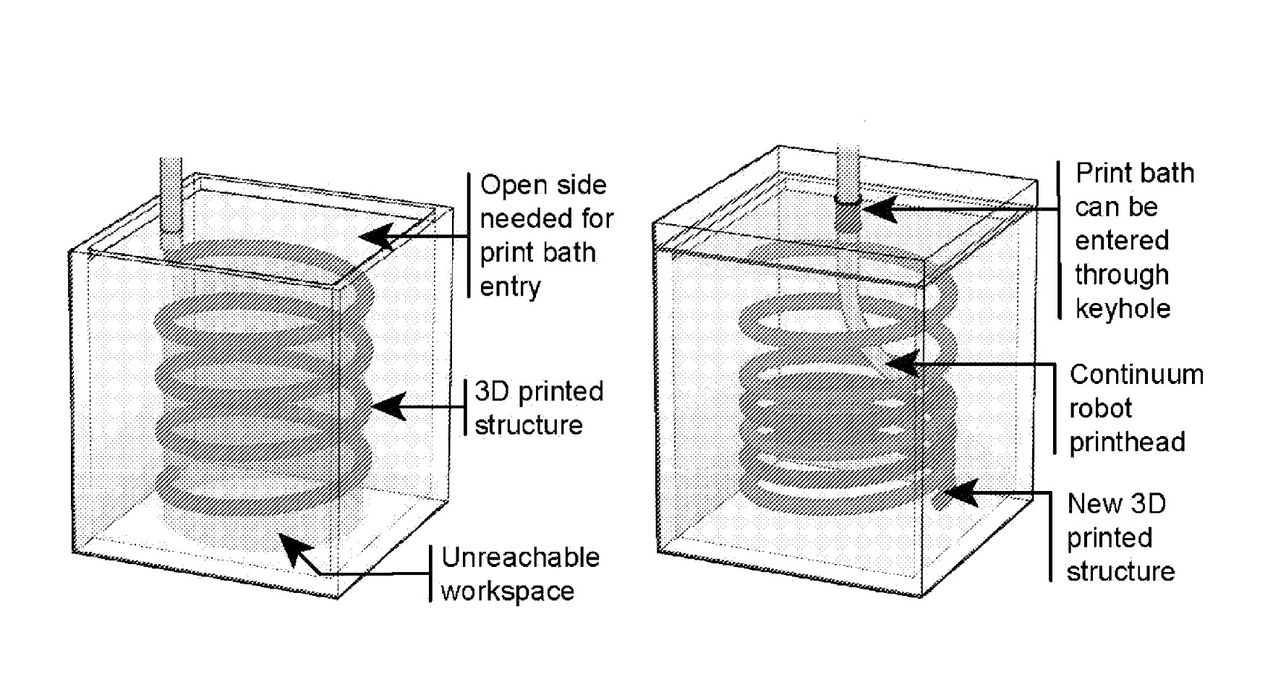
What if the printhead could snake its way into the build instead of hovering above it?
An unusual Stanford University patent describes a 3D printing system based on continuum robots — the long, slender, flexible robotic devices more commonly associated with minimally invasive surgery. The patent was filed internationally as WO2025179212 and has now appeared in China as CN122826105A.
The proposed printhead could enter a closed or mostly closed workspace through a small opening, then curve, rotate and extend to reach locations inside. Stanford calls this “keyhole” 3D printing.
Imagine a container filled with a viscoplastic support material used for embedded 3D printing. Normally, access to that build volume is limited by the mechanical arrangement of the printer. A conventional Cartesian toolhead needs room to move around above or beside the work.
The Stanford approach instead pushes a thin tubular robot through a port in the container.
Inside the tube is another pre-curved flexible tube, potentially made from a shape memory metal such as Nitinol. Sliding this inner tube outward changes how far the nozzle reaches from the central axis. Rotating the assembly moves it around that axis, while moving the entire assembly in and out controls the axial position.
The result is effectively a cylindrical motion system rather than the familiar X-Y-Z arrangement.
That opens up some strange possibilities.
A nozzle could potentially reach around existing structures inside a support bath. Several such robots could enter the same build chamber through different openings and print simultaneously. The patent even describes systems with multiple curved tubes emerging from one larger tube, creating something resembling a tiny cluster of robotic tentacles.
There’s also a multi-material version.
Several material channels can run through the same continuum robot and converge at the nozzle. Instead of physically changing toolheads, the printer could select another material channel, or potentially extrude multiple materials together.
The patent goes even further, proposing nested tubes, multiple nozzles and branching arrangements where one continuum robot contains several smaller ones.
At that point the printhead begins looking more like a robotic vascular network.
One especially interesting application would be printing inside an enclosed object. The patent specifically considers irregular build chambers and even injection molds. In principle, material could be deposited within spaces that a normal gantry-mounted nozzle simply couldn’t reach.
There are medical possibilities as well. Because continuum robots already make sense for navigating through confined anatomical spaces, the inventors describe possible in vivo printing applications.
But this is a patent, not a conventional research paper demonstrating a production-ready machine.
Most 3D printers are designed around the assumption that the machine surrounds the part. This system reverses that relationship: the printer could reach inside the environment containing the part.
That could make some previously inaccessible build spaces printable.
Via Espacenet
