
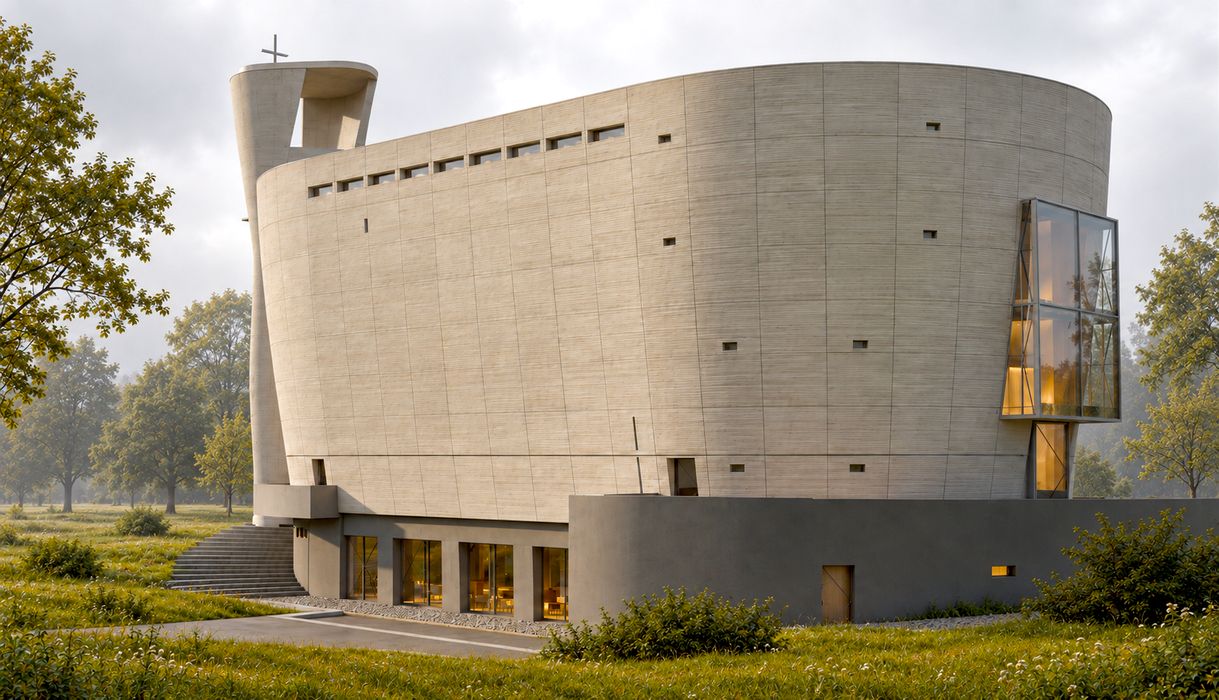
This week’s selection is the Holy Trinity Church and Cardinal Josef Beran Community Centre by architect Zdeněk Fránek.
For years, architects have shown us wildly curved, organic buildings that look as though they came from the future. Actually building them is another matter, because, you know, curves cost money.
That’s what makes the new Holy Trinity Church and Cardinal Josef Beran Community Centre in Neratovice, Czech Republic, especially interesting. Designed by architect Zdeněk Fránek, the unusual structure makes extensive use of concrete 3D printing (3DCP) to produce shapes that would be expensive to build using traditional building methods.
And this isn’t merely a decorative 3D printed wall attached to a normal building.
The project will apparently make use of hundreds of individually 3D printed concrete components. They will form the church tower and rectory, but most interestingly, both the inner and outer shells of the main nave.
In other words, 3D printing is being used to create a substantial portion of the architecture people will actually see. It’s a truly 3DCP structure.
We’ve seen plenty of experimental 3D printed structures over the years, and quite a few projects where the technology is essentially used as an alternative way to make pretty ordinary walls. These don’t really exploit the radical geometric possibilities of the 3DCP process.
The Neratovice church takes a different approach.
Fránek’s design is filled with flowing surfaces and continuously changing curves.
Concrete normally needs formwork. If you want a flat wall, that’s easy enough. But when the wall begins curving in several directions, the forms themselves become increasingly complicated. Setting up a curved formwork is way more challenging than a flat plane.
That’s where 3DCP turns into a real design tool rather than just another construction method.
HSF System CEO Tomáš Kosa explains that the architectural geometry can instead be prepared digitally and used to produce the required components directly, no formwork required at all!
3DCP has often been promoted on the basis of speed, reduced labour, or lower material use. Those may certainly be advantages, but there’s another possibility that I’ve been long waiting for: architects can begin drawing things they previously might not even have considered.
A 3DCP printer doesn’t care that a wall curves, but a crew building a curved formwork certainly would have a harder time.
Work on the church has already progressed through the first basement level, including foundations and part of the tower structure. The ceiling above that level and foundations for the rectory are also complete. The above-ground work will now begin revealing the unusual form of the church itself.
The project has attracted some attention in the Czech Republic. Czech President Petr Pavel and Archbishop of Prague Stanislav Přibyl visited the construction site in May 2026.
There’s still a long way between experimental construction printing and a world in which architects routinely specify almost arbitrary concrete geometry.
But buildings like this are showing us what that world could look like.
It is a lot less rectangular.
