
A recoater crash is one of the more expensive ways for a powder bed 3D printer to have a bad day.
A warped part, a curl of material, or an unexpected object can rise above the intended layer height. The recoater then arrives, hits it at speed, and may damage the part, the recoater, or something else in the machine.
Voxeljet’s patent application proposes a surprisingly simple warning system: shine light across the build surface and watch for an interruption before the recoater gets there.
The idea appears in international publication WO2026202739A1, titled “Crash Prediction Sensor For 3D Printing Devices, Devices Including A Crash Prediction Sensor, And Method Thereof.” The applicant is VOXELJET AG.
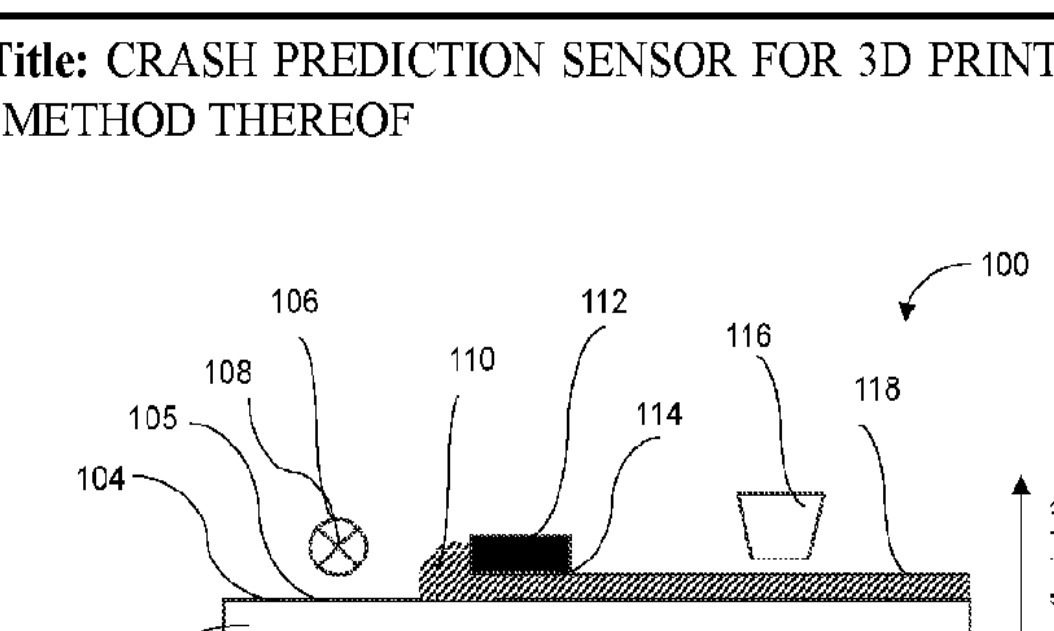
Here’s the setup: A particulate-material recoater moves across the construction field in one direction. A light source sits on one side of the field, while an optical sensor sits on the other, producing a beam that travels generally parallel to the build surface.
The sensor is positioned ahead of the recoater. As the sensor and recoater move together, the light beam scans the area that the leveling component is about to cross. If a raised feature blocks or changes the measured light, the controller can identify its position and stop the recoater before contact.
That is different from waiting until the end of a recoating pass to discover that too little material was deposited. By then, the defect has already passed under the machine’s working hardware. Voxeljet’s approach tries to find the problem in the few moments before the dangerous component reaches it.
The patent describes the sensor being close to the recoater’s leveling surface, with example vertical distances of 50 mm or less, 20 mm or less, 10 mm or less, and even 5 mm or less. It also gives example forward offsets from the recoater’s leading surface, including values from roughly 3 mm to 250 mm.
Those numbers suggest the system is intended to be a genuine crash predictor, not a general-purpose camera looking at the build from a distance. The closer the sensor is to the leveling component, the less time remains to react, but the more directly the measurement corresponds to what the recoater is about to encounter. It is simple, but it should work pretty well.
The controller could stop the recoater, stop a printhead, or change the process. The filing also mentions identifying the defect’s location, continuing to print unaffected parts, and changing the construction-field temperature to reduce curling. Those are broad possibilities in the claims, rather than evidence that every option has been demonstrated.
Voxeljet also proposes two optical sensors arranged in different directions. A single beam might detect that something is wrong along one axis, while two crossing measurements could help locate the defect in both X and Y. The light source could be an LED or a remote laser delivered through fiber optics.
There’s another feature that makes sense in a powder machine: the patent includes cleaning the optical source and sensor. Powder will eventually settle on anything exposed to the build chamber. The application suggests scheduled cleaning or cleaning triggered by a drop in measured light flux.
I like the idea here. It doesn’t require a full 3D inspection system to answer the critical question: is something sticking up into the path of the recoater?
Implementing this will be way cheaper than repairing a crashed recoater.
Via Espacenet