Prusa has patented a very unusual and possibly quite powerful hot end design.
That is the idea behind a new patent filing from Prusa Development A.S. They propose changing the internal shape of the melt channel several times as filament travels through the nozzle, with the idea of heating it more efficiently and pushing more material through the tip.
This is an area where several companies have been experimenting in recent years. The problem is this: a 3D printer operator wants a small nozzle opening for detail, but that small opening restricts flow. Push filament faster and the heater may no longer be able to melt it fast enough. Viscosity rises, extrusion force climbs, and the high-speed print fails.
Existing high-flow nozzles often deal with this by using several straight internal channels. More channel wall means more contact with the hot metal, but drilling straight holes puts a limit on what can be built. Other designs use an insert that divides the flow, although the insert also becomes an obstruction.
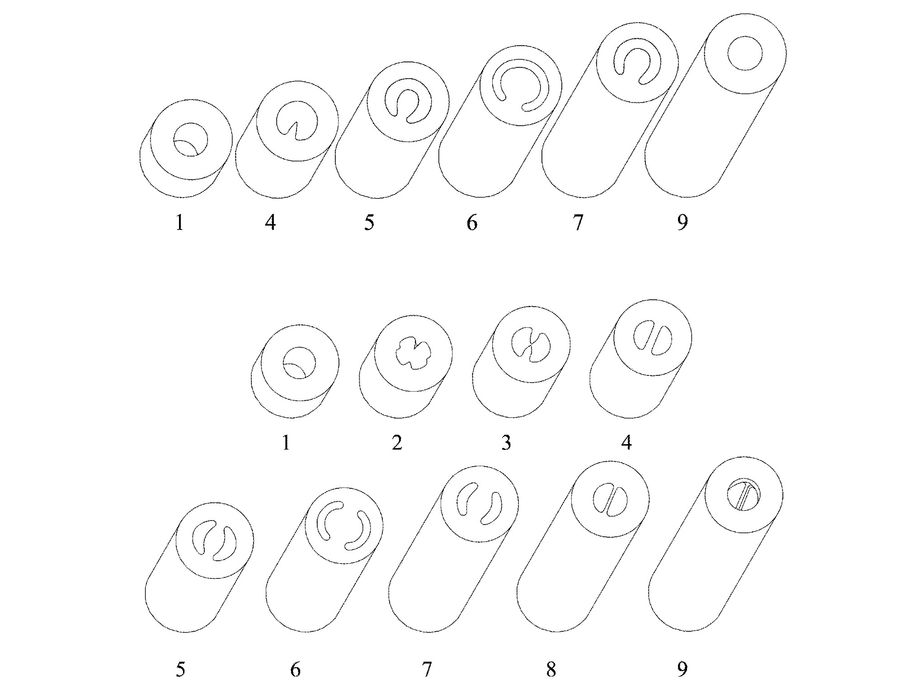
Prusa’s approach is more like reshaping a plumbing system while the material is moving through it. The inlet begins as an ordinary circular passage. It then changes into one or more channels shaped like circular sectors, passes through a transition region, and becomes an arc-shaped or almost closed C-shaped channel. The cross-sectional area is intended to remain broadly uniform, while the channel perimeter increases.
That extra perimeter is the important point here. For roughly the same amount of plastic in a slice of the channel, there is more hot metal surface touching it. The patent’s idea is that this improves heat transfer without imposing the same flow penalty as simply making the passage narrower. The channel then transitions back toward a circular outlet before the melt exits.
The two-channel example is particularly interesting. Incoming filament is first worked by ridges that stop it rotating, then split into two channels. Each channel is shaped like a half-disk before changing into an arc. Near the tip, the two streams merge again. It is a miniature manifold hidden inside a nozzle, but one designed around heating rather than merely routing material.
Why not make every channel C-shaped from the start? The gradual transitions appear intended to avoid abrupt changes that could disturb the melt or create excessive resistance. The patent also describes the changing geometry as matching the filament’s changing viscosity: colder and stiffer upstream, hotter and easier-flowing downstream.
The filing, published as WO2026201228A1, claims the sequence of inlet, sector-shaped primary segment, transition, higher-perimeter secondary segment, and downstream transition. Optional claims add multiple channels, splitting and recombining structures, anti-rotation ridges, and a secondary passage shaped like an almost closed C.
There is an important manufacturing outcome here. Prusa says the organic internal surfaces are difficult to produce by conventional drilling or CNC milling, and points instead to metal 3D printing. That seems pretty clear, as actually making this nozzle design seems to be a near impossible feat. The nozzle would therefore depend on additive manufacturing to create a component whose purpose is to make material extrusion faster.
The patent includes a comparison chart showing the proposed two-channel design reaching higher flow rates than the cited straight-channel and insert-based examples at comparable extrusion forces.
Instead of choosing between a tiny opening and a large, blunt high-flow nozzle, Prusa is trying to give the melt a larger heated perimeter on the way to the same small exit.
This is a very unique approach that could be quite important. Prusa is a company that seems to have less patent activity than some of its competitors, so a powerful concept like this, if it works, could be very valuable in the future.
Via Espacenet