Thermal resistance is often spoken of for 3D print materials, but I ran into an unusual scenario involving temperature.
Thermal resistance is a “hot” topic in the 3D print world because the higher the thermal resistance, the more potential applications can be accomplished: parts don’t fall apart at higher temperatures.
That’s what thermal resistance is all about: at what temperature does the material soften, thus compromising the geometry of the part?
3D print materials often appear listed with their glass transition temperature, the official temperature at which softening begins. PLA is notorious as having a relatively low glass transition temperature, around 50-60C.
This makes PLA an unattractive option for any warm environments. Even a car left in the sunshine will be sufficient to droop that phone holder you printed in black PLA.
Thus for such applications many 3D printer operators opt for materials with a higher thermal resistance, like ABS or PETG. Because of this, these “better” materials are often used routinely out of habit. PETG > PLA, right?
Wrong. That’s not always true, and let me tell you a story I heard recently.
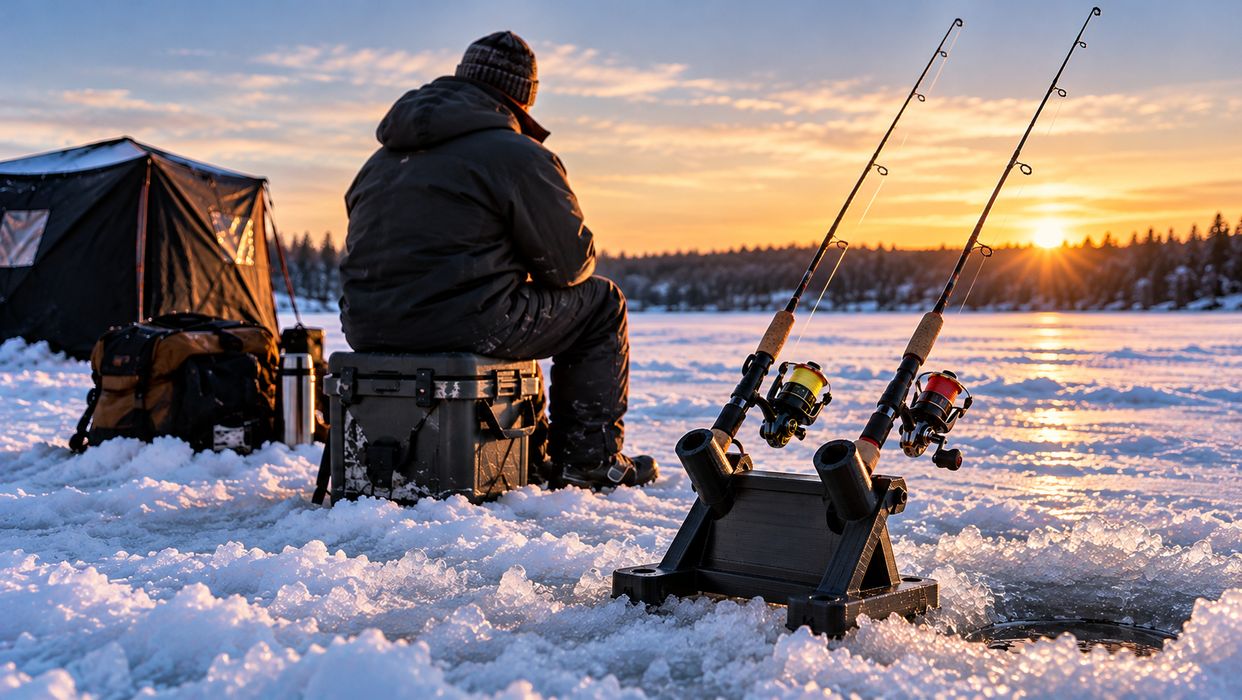
A 3D printer operator friend happens to also be an ice fisher. This is the sport of fishing through small holes cut in thick winter ice on lakes and rivers. It’s not something everyone is able to do, as there are not that many places in the world where seasonal ice is sufficiently thick to permit people and vehicles to cross the ice and set up an ice fishing shack.
Nevertheless, ice fishing IS fishing, and you know what that means: lots of waiting around for something to happen. You’ll be holding your fishing rod for a long time.
It turns out my inventive operator friend decided to do something about this by printing a 3D model to allow the ice fisher to mount poles in a holder. This relieves the need for manually holding the fishing rods, which, in winter, is not fun even with thick gloves on. Rods are stuck in the holder and the fisher awaits a “bite”.
However, my friend informs me that he’s had multiple instances where his 3D printed rod holder has broken. This was thought to be strange, since the PETG material used is normally pretty strong.
Then PLA was used instead of PETG. Incredibly, the “lesser” PLA material has not broken.
What’s going on here? Why is PLA stronger than PETG?
It turns out to be temperature. While PETG has a far higher softening temperature than PLA, it also turns out that PETG gets quite brittle when exposed to freezing temperatures. In these ice fishing scenarios, it is not uncommon to have temperatures of -10C or even -20C (+14F to -4F). At this range, PLA still retains a bit more give than the increasingly brittle PETG.
The moral of the story here is that materials have an effective functioning temperate range, both a high and a low. When printing a part, take into account both the high AND the low temperatures the part will be exposed to, and select the appropriate material.
Now, back to fishing.