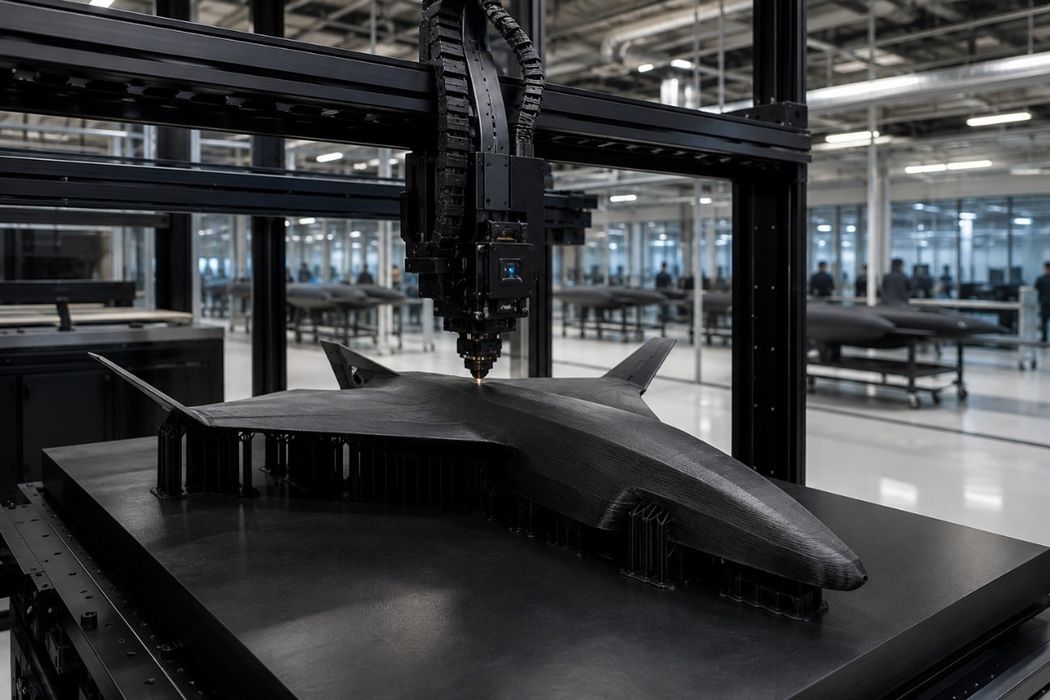
Charles Goulding and Ari Willick examine how Helsing’s expansion into West Virginia signals a broader shift toward mass production of drones powered by additive manufacturing.
The defense industry continues to explore how advanced manufacturing can support faster production, and the Munich, Germany-based defense technology company Helsing is the latest example of this shift. The company recently announced plans to establish its first U.S. manufacturing facility in West Virginia, where it will produce its HX-2 AI-enabled strike drone.
For the additive manufacturing industry, Helsing’s expansion is notable because the company has specifically discussed using 3D printing as part of its approach to producing large numbers of drones. This places Helsing among a growing group of aerospace and defense companies looking at additive manufacturing as a way to support more flexible, scalable production.
Helsing Selects West Virginia for U.S. Drone Production
Helsing plans to open its new facility in Martinsburg, West Virginia. The company has stated that the location was selected because of its skilled workforce, manufacturing background, and ability to support rapid industrial development. The facility is expected to initially focus on production of the HX-2 drone.
According to reports, Helsing plans an initial investment of US$50 million in the West Virginia site. The company has also discussed production goals that could eventually reach thousands of drones per month.
The move follows rapid growth for Helsing. Founded in 2021, the company originally focused on artificial intelligence software for defense applications before expanding into autonomous drones and other defense systems. In July 2026, Helsing raised US$1.8 billion in a funding round that valued the company at US$18 billion.
The HX-2 Drone and the Role of Additive Manufacturing
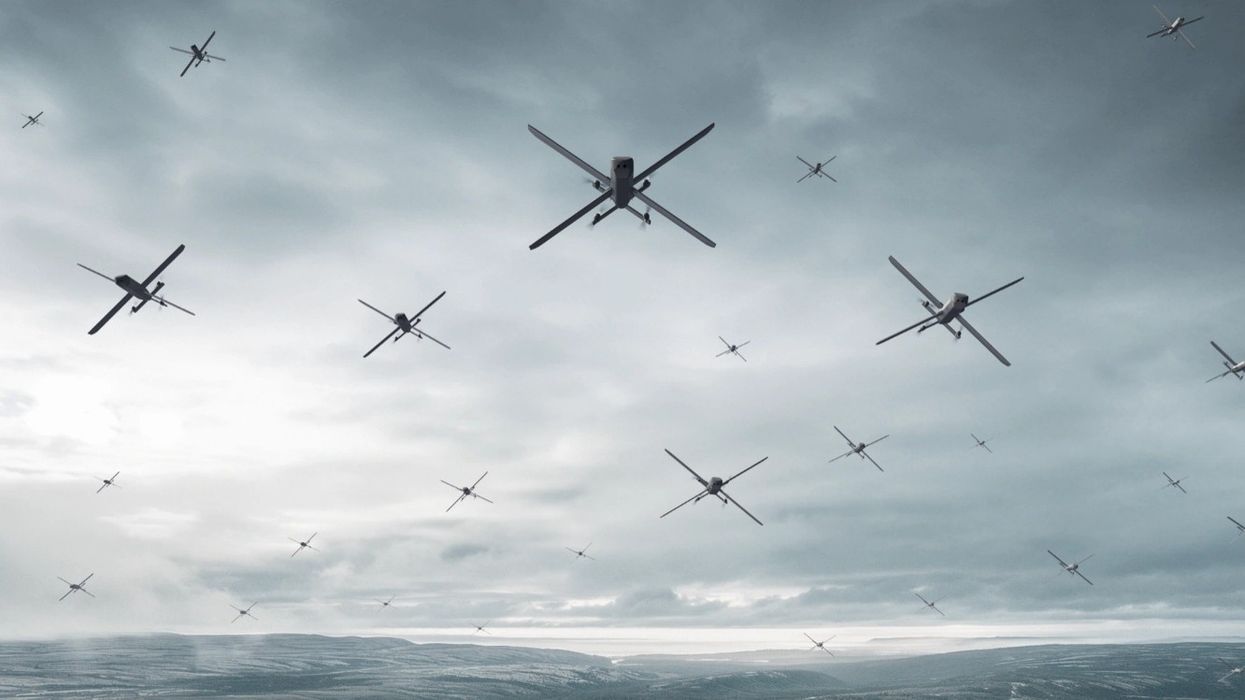
Helsing’s HX-2 is designed as an AI-enabled strike drone with an emphasis on software, autonomy, and scalable production. The company has promoted the platform as one that can be produced in large quantities compared with traditional defense systems.
One of the interesting manufacturing details is Helsing’s use of techniques such as 3D printing to help support production. Financial Times reported that Helsing highlighted advanced manufacturing approaches, including 3D printing, as part of its ability to produce drones at lower cost and higher volume.
This approach aligns with a broader trend in defense manufacturing. Additive manufacturing can help companies produce specialized components, iterate designs quickly, and reduce dependence on traditional tooling and long supply chains. These advantages are especially relevant for smaller unmanned systems, where design changes and production speed can be important factors.
3D Printing Is Already Supporting Drone Development
Helsing’s use of 3D printing is part of a wider pattern in the drone industry. In 2020, we examined how defense organizations and drone suppliers have adopted additive manufacturing for prototyping, replacement parts, and production support.
Since then, German defense company Rheinmetall has demonstrated a strikingly similar trajectory, showcasing how traditional European defense titans are pivoting toward additive manufacturing. As examined in our previous analysis of Rheinmetall’s growth into a global defense force, the firm has increasingly used additive manufacturing across its operations to streamline supply chains and produce critical components. More recently, we covered Rheinmetall’s strategic partnership with Virginia-based software provider Auterion, a collaboration that mirrors Helsing’s core strategy by combining AI flight control software with 3D printed, mass-producible drone hardware for autonomous swarming capabilities. Together, these companies highlight a shift in western defense strategy. Instead of relying on slow, traditional manufacturing, they are moving toward software-driven platforms where 3D printing delivers the speed, flexibility, and simplified production needed to supply modern conflict zones.
The connection between drones and additive manufacturing extends beyond military applications. Counter-drone systems, security technologies, and large-scale drone operations increasingly rely on quickly produced components and customized hardware. During the 2026 World Cup, we covered the relationship between counter-UAS technology and 3D printing in the context of major sporting events and security applications.

Locations with strong manufacturing ecosystems are also becoming important centers for drone development. Dallas, Texas, for example, has been highlighted as an area where aerospace activity and 3D printing capabilities intersect. For more, read our recent article.
How Helsing’s West Virginia Drone Manufacturing Qualifies for Section 41 Research and Development (R&D) Tax Credits
Helsing’s US$50 million facility in Martinsburg, West Virginia presents a primary application of IRC Section 41 Qualified Research Expenses (QREs) and IRC Section 174A software expense rules, which now allow for full expensing. Under current federal tax law, defense contractors, additive manufacturing firms, and autonomous system developers can claim federal and state tax credits for eligible wages, raw materials, and contract research expenses associated with scaling drone production. Core technological developments across additive airframe geometry, advanced polymers, and autonomous swarm algorithms qualify directly under federal tax statutes.
To qualify under Section 41, Helsing’s defense manufacturing operations satisfy the IRS Four-Part Test:
- Permitted Purpose: Developing a new or improved business component by utilizing 3D printing to achieve high-volume production of thousands of HX-2 autonomous strike drones per month while lowering manufacturing costs.
- Elimination of Uncertainty: Resolving technical uncertainties regarding structural airframe integrity, additive material performance under aerodynamic loads, rapid prototyping tolerances, and real-time AI autonomous flight software integration.
- Process of Experimentation: Evaluating alternative CAD geometries, testing advanced composite polymers and alloys for additive fabrication, and running iterative flight and stress simulations.
- Technological in Nature: Relying on fundamental principles of aerospace engineering, materials science, mechanical design, and computer software development.
Defense technology companies utilizing AI software engineering and physical additive manufacturing qualify for significant tax optimization opportunities. Internal engineering salaries, specialized 3D printing raw materials, prototype tooling costs, and cloud simulation infrastructure required for AI algorithms may directly constitute eligible QREs. By capturing these expenditures and by documenting the process with help from R&D Tax Savers, defense manufacturers expanding into regional hubs like West Virginia can offset federal corporate tax liabilities and preserve capital for ongoing technical expansion.
A Growing Connection Between AI, Drones, and Manufacturing
Helsing’s expansion demonstrates how modern defense companies are combining software development with physical production. While artificial intelligence is a major part of the company’s identity, manufacturing remains essential because autonomous systems still require reliable, repeatable hardware production.
For additive manufacturing companies, defense applications represent an area where speed and flexibility can provide measurable advantages. Drone platforms often require frequent design improvements, and 3D printing can allow manufacturers to adjust components without rebuilding expensive production tooling.
The West Virginia facility will provide Helsing with a U.S.-based manufacturing presence while adding another example of how advanced manufacturing is becoming integrated into aerospace and defense production. As drone technology continues to develop, companies like Helsing show how the future of manufacturing may involve a combination of software, artificial intelligence, automation, and additive manufacturing working together.