
Two-photon polymerization 3D printing has a throughput problem: the machine usually can print only one object at a time.
A patent application from the University of Arizona proposes making several focal points from the same laser, then using them to print several objects at the same time.
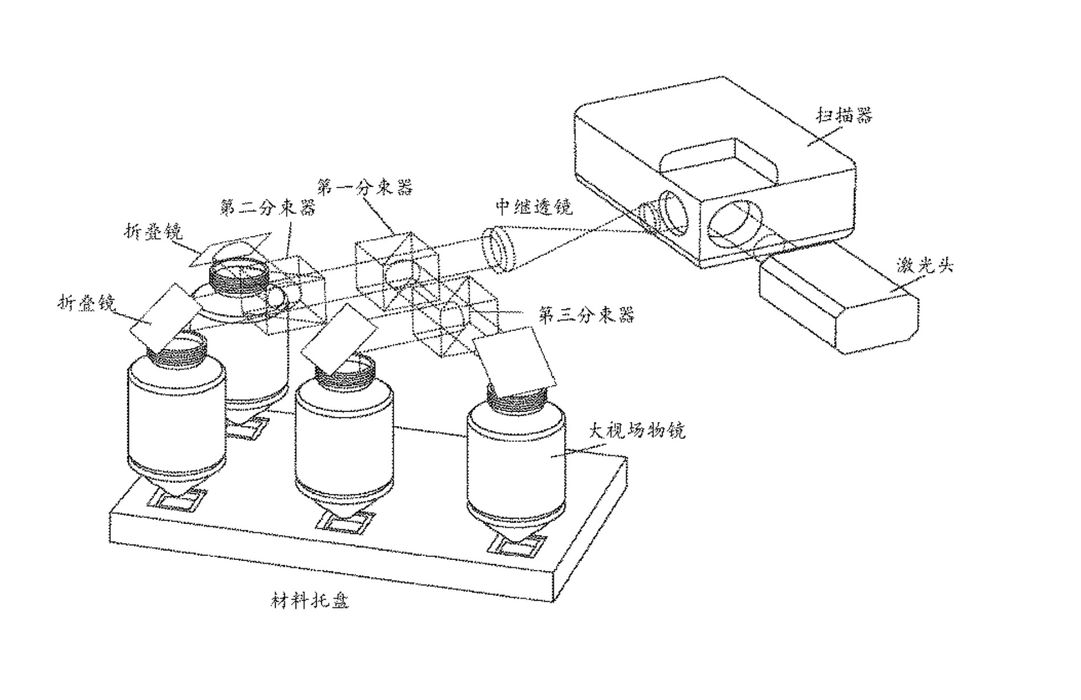
The application, CN122892763A, describes a high-throughput 3D printing system built around a straightforward optical trick. A beam splitter receives the laser and produces multiple beams. Each beam travels to its own objective lens, and the lenses are arranged so that all of the beams focus onto a shared focal plane.
That focal plane is positioned inside the 3D printing material. When the separate beams are focused into their respective positions, the system can create several printed objects simultaneously.
This is for at two-photon polymerization, also called 2PP. The process uses tightly focused light to solidify material in three dimensions, which is useful for extremely small (like microscopic) and intricate structures. The catch is that the writing process is incredibly serial: the focus has to be moved through the volume, one small region at a time.
The patent’s claims cover systems with four objectives and systems with eight. They also describe beam splitters configured to divide the incoming light evenly, allowing the separate objectives to receive approximately equal intensity. That configuration could produce several essentially identical objects in one exposure sequence: parallel 2PP!
There is another interesting option in the claims. At least one objective can have a different magnification from the others, allowing the system to produce objects of different sizes at the same time. That sounds like a flexible microfabrication platform.
The mechanical arrangement can vary. One version uses a single tray holding material for all of the objectives. Another uses multiple trays, with each tray supporting the material associated with one optical path. The material, or the trays, can move along the X, Y, or Z axes so the focal positions can be advanced through successive layers or volumes.
In operation, you could imagine several tiny parts being built side by side. The optical system exposes one layer of each part, shifts the material or focal arrangement, and repeats. Four parallel objectives would not necessarily make the machine four times faster, since laser power, scanning and exposure conditions still have to be balanced, but the architecture attacks the largest obvious source of idle time.
The patent also claims integration with a 2PP system using a laser scanner and relay optics. The relay system routes the scanner’s output into the multiple objectives, with the optical axes rotated by about 90 degrees relative to the scanner output. That detail suggests they are thinking about fitting the parallel optical head into an existing instrument rather than merely placing several lenses around a vat.
The difficult engineering question is alignment. Several objectives must focus on the same plane while remaining accurately positioned relative to one another. Beam splitting also divides the available optical power, so the laser and resin process must tolerate the resulting energy budget. Calibration, lens quality and thermal stability could become just as important as the basic idea.
Even with those complications, the proposal looks like a great idea. 2PP already offers incredibly impressive resolution, but its throughput is basically terrible. Printing four or eight small parts in parallel would change the economics quite a bit. We might see a new 2PP system emerge that could provide micro 3D printing at far better costs.
Finally, there’s one more really interesting twist to this story: this is a Chinese patent, opened by a US University. Evidently the University of Arizona wants to protect their intellectual property in China by blocking others from copying their concept. I guess they expect Chinese companies to build this out before any in the West do.
Via Espacenet