
Laser beam steering usually means moving something.
Galvo mirrors are the usual approach in metal and SLS 3D printing. example. They tilt rapidly to reflect a laser beam across the entire build surface, but they are still mechanical devices with moving parts and optical alignment challenges. VulcanForms has described a rather different concept in their latest patent: use an optical phased array to aim laser energy at a Risley prism assembly, then use the prism assembly to send it to the build surface.
The idea appears in US20260307171A1, a patent application assigned to VulcanForms Inc. Its title is “Additive Manufacturing Systems and Related Methods Utilizing Risley Prism Beam Steering.”
A Risley prism is made from wedge-shaped optical elements. Put two wedges together and rotate them relative to one another, and the outgoing beam can be moved through an angle. The beam does not need to bounce off a tilting mirror. It passes through the prisms and emerges in a different direction.
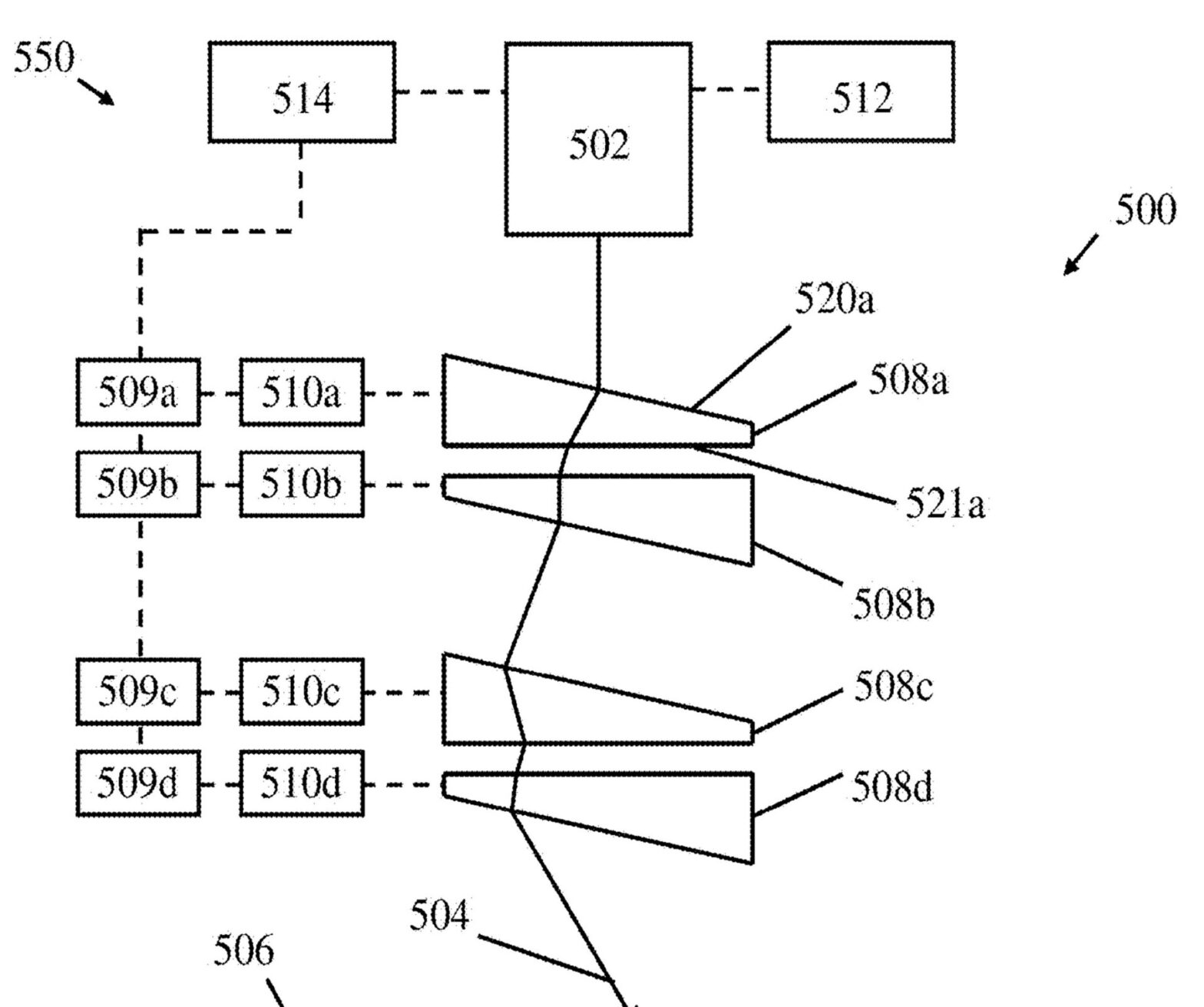
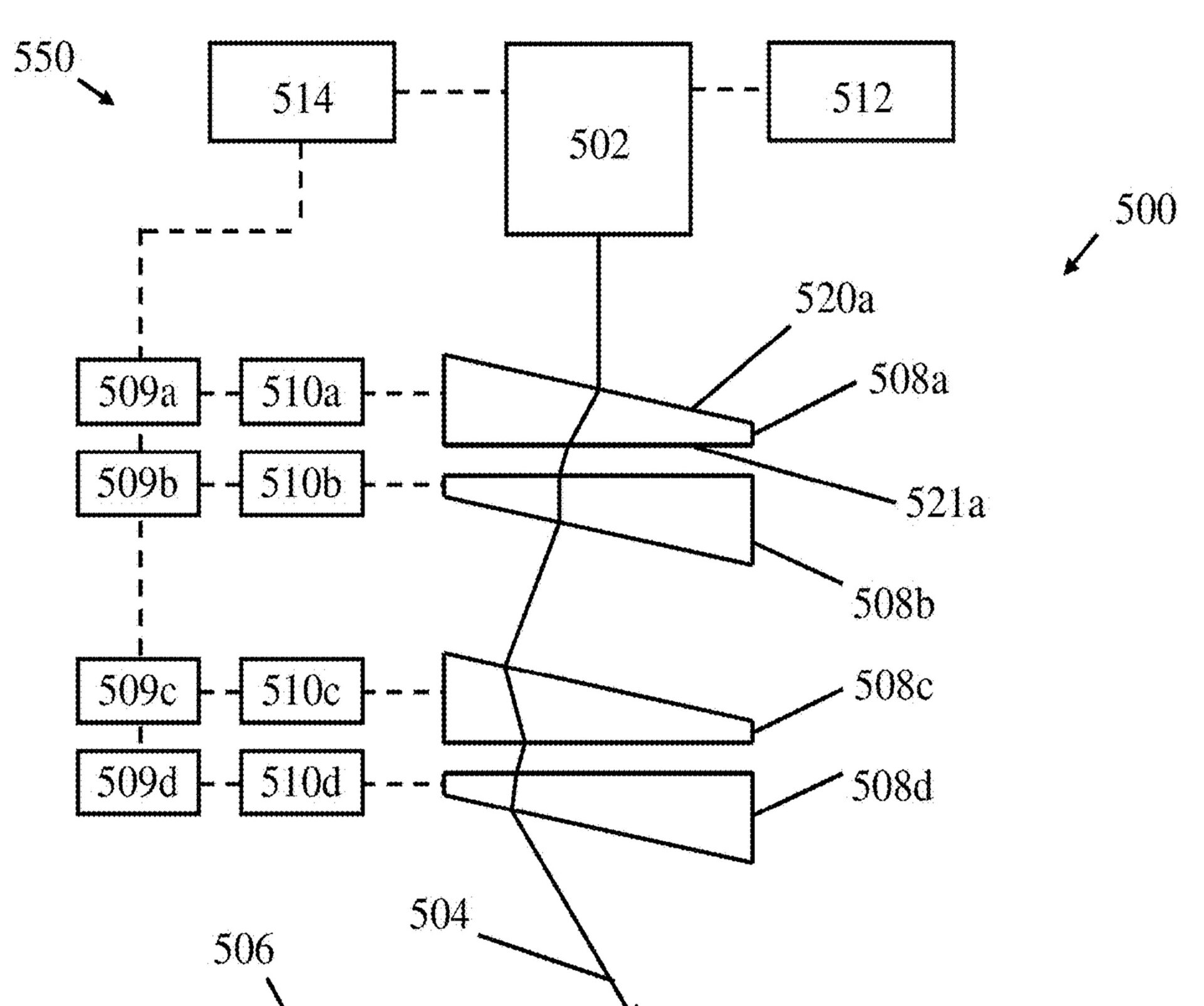
That sounds pretty straightforward until you look at the rest of the system. The patent places one or more laser sources behind an optical phased array. The array uses phase shifters to control the phase of portions of the laser energy, allowing the outgoing beam to be directed toward the Risley prism assembly. The prisms then provide another stage of steering toward the build surface.
Why use both?
It could be that VulcanForms is combining fine electronic or optical control with a larger-angle prism mechanism. The phased array can select and shape the direction of the incoming light without moving a large optical assembly. The prism pair can then redirect that light over the required working area.
The drawings show the concept scaling beyond a single beam. One system diagram includes multiple laser sources, multiple phased arrays and multiple Risley prism assemblies aimed at a common build surface. Another arrangement shows several optical channels working in parallel. That suggests a multi-beam laser powder bed fusion architecture, which would obviously benefit from print speed increases.
More beams could address different areas of the build surface, while the optical phased arrays could adjust the beam directions without waiting for a conventional scanning mechanism to move. In a production machine, even small reductions in scan overhead can accumulate across thousands of layers. In other words, shorter print jobs.
But prisms introduce their own engineering questions. The system would need precise control of wedge orientation, careful management of optical distortion and a way to keep the beam correctly focused as its angle changes. High-power laser processing is not a forgiving environment for alignment errors. The extra optical elements also have to survive heat, contamination and the demanding maintenance conditions around a powder bed.
Those who operate laser cutters know, for example, that the focusing lens must be repeatedly cleaned otherwise material accumulating on the lens would itself absorb passing energy and ultimately melt the lens. The same problem would probably be present in this setup.
There is another interesting detail here. The patent claims are not just about putting a Risley prism in front of a laser. They cover combinations involving the build surface, laser energy sources, phased arrays, phase shifters and prism assemblies, along with related methods of directing the energy. That gives VulcanForms room to pursue several machine configurations while keeping the main optical concept.
It’s not clear whether VulcanForms is using this method in a machine, but it sounds somewhat like the concept we’ve thought they’re using. Nevertheless, this is a very interesting approach to speeding up metal 3D printing.
Via Espacenet