
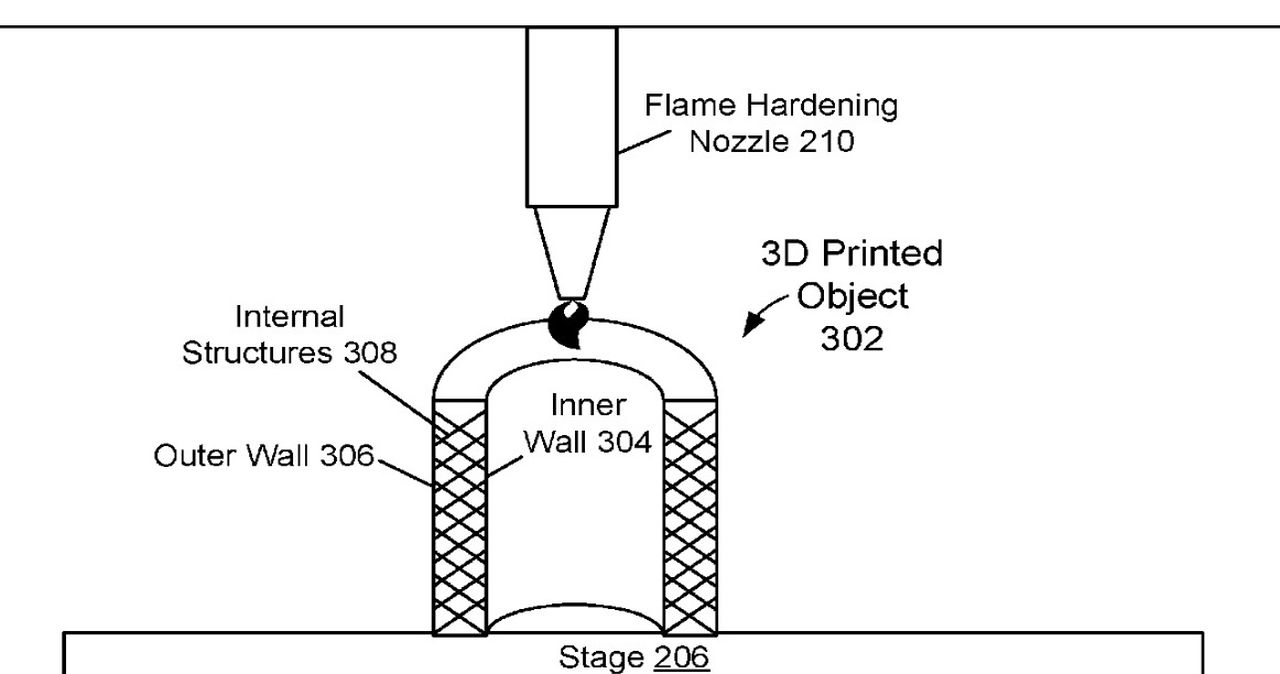
What if a 3D printer could heat treat the inside of a part before the part is completed?
That is the scary idea in IBM patent application US20260316380A1, titled “Flame Hardening in a Three-Dimensional Printing Process.” IBM proposes adding a “flame hardening nozzle” and a “quenching nozzle” to a 3D printing system, then using them while internal structures are still exposed.
Here’s how it would work. The printer deposits a layer with its normal 3D printing head. At this point, the object might contain a lattice, ribs, channels, or some other internal feature that will eventually be closed off by an outer wall.
Before that happens, the flame hardening nozzle moves over the exposed structure and heats it, hopefully without burning. A second nozzle then quenches the heated region, reducing its temperature. The printing head continues building, eventually enclosing the treated internal structure inside the finished object.
Why not simply heat treat the completed part? Because the interior is inaccessible. A flame or other treatment applied to the outside would have to work through the outer wall, and that could produce a very different result from treating the internal members directly.
The treatment is placed directly into the printing sequence, it’s just more printheads. Parameters determine how the flame-hardening operation is performed, and the drawings show the treatment head and quenching nozzle mounted alongside the printing head on a guided motion system.
This all means that different regions of a part could receive different thermal treatments. The printer could print an internal structure, harden it, cool it, and then carry on with the next layers. The filing also describes applying different flame-hardening parameters to successive layers, suggesting that the treatment need not be identical throughout the object.
This is not just a heated nozzle brushing across a plastic surface. Flame hardening normally involves rapid heating followed by rapid cooling, producing a change in material properties in the treated region. The actual result would depend heavily on the printed material, the flame, exposure time, distance, and quench conditions.
This approach also introduces a bunch of problems you wouldn’t see in a typical 3D printer. A flame inside a 3D printer creates heat, combustion products, shielding requirements, and a some kind of process controls. The quenching step adds another fluid-delivery system, while the motion system must keep both nozzles away from the part and the printing head.
I can see why IBM would focus on internal structures. Lattices and reinforcement can make a part lighter, but their properties are locked in during the build. Being able to selectively modify them before they are sealed could let the printer produce a part whose internal and external regions are engineered separately.
Whether that is worth installing a flame and quench system in a printer is another question. The concept is for certain interesting, but it will need tight control of many factors to actually work, and of course add considerable cost to the hardware.
Via Espacenet