
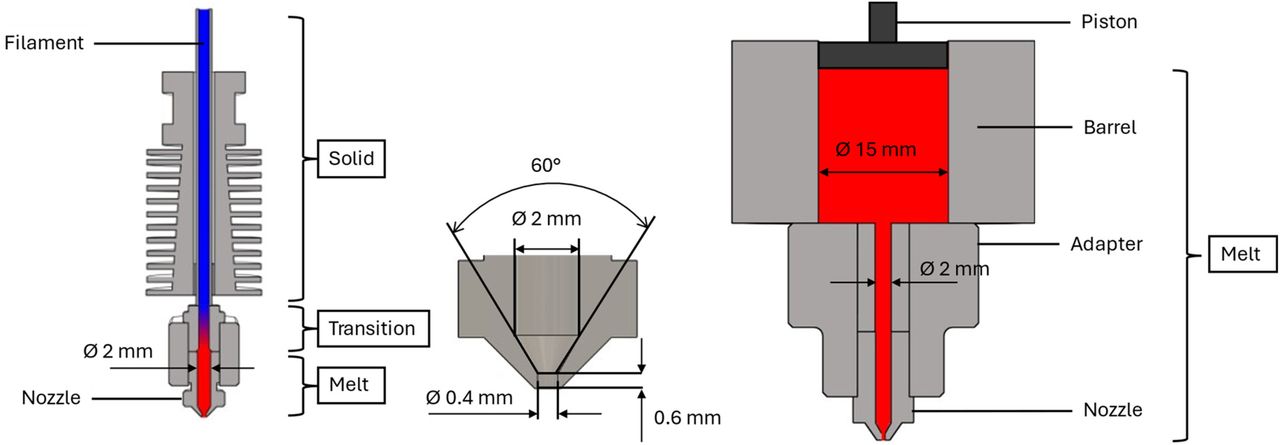
A force sensor at a material extrusion nozzle may be a way to dynamically measure viscosity during a print.
That is the concept explored in a new paper, “Friction-Corrected In-Situ Viscosity Measurement in Material Extrusion.” The researchers developed a force based measurement method and validated it against conventional rheometry (the science of how materials flow) using the same nozzle geometry.
For extrusion based 3D printing, polymer viscosity changes with temperature, shear rate, moisture, degradation, and even a slightly different batch of filament. The extrusion system has to deal with those changes in every print job.
Capillary rheometers are the normal method of measuring polymer melt flow. They push material through a fixed capillary and use pressure, flow rate, and geometry to figure out rheological properties. However, they are laboratory instruments, not something you would put inside a printhead.
The Force Signal Has More Than Melt Pressure
Material extrusion systems already monitor an important factor: the force required to drive material through the hot end. A desktop FFF machine may detect troubles from a stepper motor skipping, while larger pellet extrusion systems can use more direct pressure or force sensing. But raw extrusion force can be a sloppy measurement.
Part of that force comes from forcing molten polymer through the nozzle. Part comes from friction elsewhere in the feed path, including contact between solid filament and the guide system before it melts. If those other factors are included in the nozzle pressure measurement, the calculated viscosity will be wrong.
The paper’s main idea is the friction correction. Their method attempts to separate the force associated with material transport from the force associated with flow through the nozzle. In other words, it tries to turn an extrusion force measurement into a rheology measurement instead of a generic indication that the extruder is working harder.
A Potential Closed Loop Input
If the approach remains accurate across practical printing conditions, a material extrusion machine could monitor viscosity continuously instead of just using a static material profile from the slicer. Firmware control software might then be able to adjust nozzle temperature, feed rate, or print speed when the melt behavior drifts outside of some tolerance values.
That would be particularly important for pellet-fed FGF systems and production lines running long build jobs. These applications often are a bit cheaper to run by accepting more variable input materials, but that can cause inconsistent extrusions, poor layer bonds or even a jammed nozzle.
A force history tied to a viscosity model may provide better evidence of what happened during a job. It would not replace post-print inspections or strength testing, but it could identify suspicious sections of an expensive print.
Material extrusion machines have long generated process signals that are mostly used for fault detection after something goes wrong. A reliable viscosity estimate would let the machine interpret one of those signals before poor flow becomes a visible failed part.
Via Friction-Corrected In-Situ Viscosity Measurement in Material Extrusion