
Researchers have found an unusual 3D printable material that generates electricity in flowing water.
The researchers found that a porous ceramic structure in the spines of sea urchins had a very unusual property: when water flows over it, the structure “instantly” generates a small amount of electricity. Why would this happen? It turns out that sea urchins are able to “feel” flowing water, and this is their sensing apparatus.
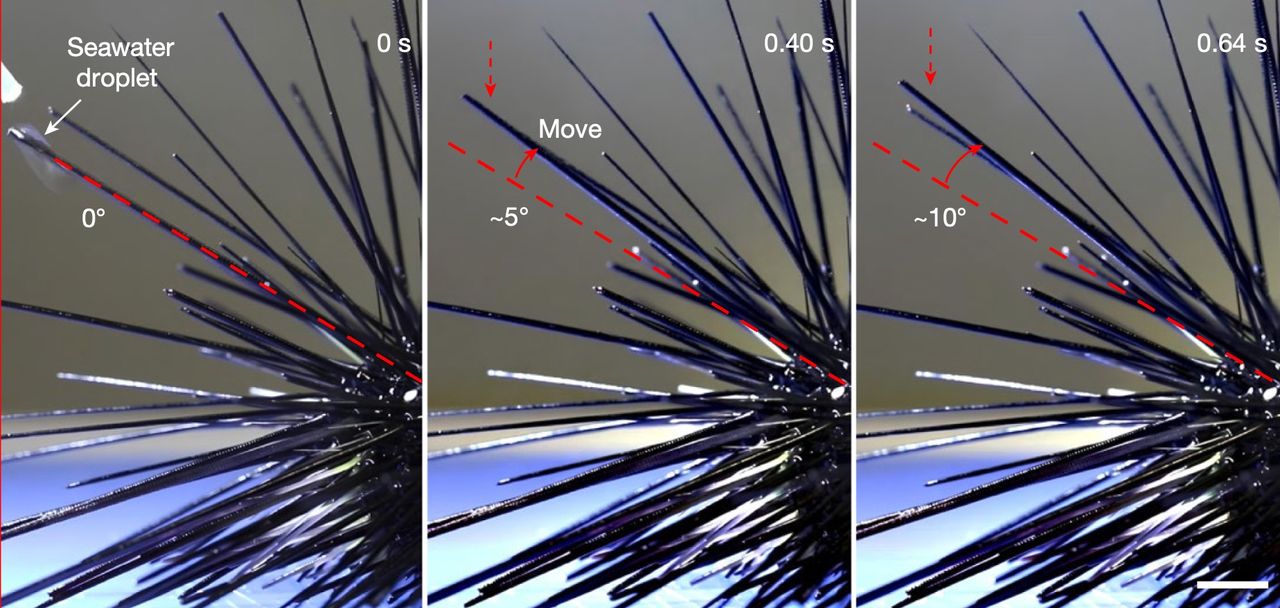
The work focuses on the long spines of the sea urchin Diadema setosum, which are usually thought of as defensive ceramics with a sophisticated cellular interior. However, in tests, a seawater droplet landing on a spine tip triggered a quick rotation of the spine within about a second, while neighboring spines did not respond, suggesting localized perception rather than a whole body reflex. The researchers then instrumented spines with electrodes at two positions along the length and measured a clear voltage signal when droplets struck the apex.
In air, the droplet stimulus produced a peak response around 116 mV, and underwater flow stimulation produced a smaller but still distinct response on the order of tens of millivolts. One of the more provocative details is that the electrical response under droplet stimulus showed little difference between living and dead spines, implying the effect does not require active tissue. That hinted that there was a technology here, separate from the biology and toward materials physics. Could this be used in additive manufacturing?
The spine contains a porous “stereom” network, a hollow internal channel, and a denser outer layer. The porosity and specific surface area rise toward the tip. In other words, it is a functionally graded cellular solid.
When liquid first contacts the solid, ions rearrange at the interface and form an electric double layer (EDL). Once the stereom is wetted, flowing liquid shears that EDL and separates charge, creating a voltage between two points along the structure. When flow stops, the separated charge relaxes and the voltage collapses. The researchers also measured that seawater’s higher ionic strength compresses the EDL and reduces charge mobility, which helps explain why seawater signals differ from deionized water in controlled tests.
How Does Additive Manufacturing Fit In?
The team designed a gradient triply periodic minimal surface (TPMS) lattice that mimics stereom-like solid/void distributions, then fabricated tapered, spine-like samples using a vat photopolymerization 3D printing system. They printed both polymer and ceramic versions and reported that both produced obvious voltage output during water injection, supporting the idea that geometry and surface interactions drive the effect more than any unique biology. They replicated the natural sea urchin mechanism with 3D printing tech.
Ceramics performed better than polymers because ceramic surfaces can present different ion adsorption and dissociation behavior than typical photopolymers. Compared with gradient-free controls, the printed “stereom gradient” sample showed about a three-fold increase in voltage output and an eight-fold higher amplitude differential.
From A Single Spine To A Metamaterial Array
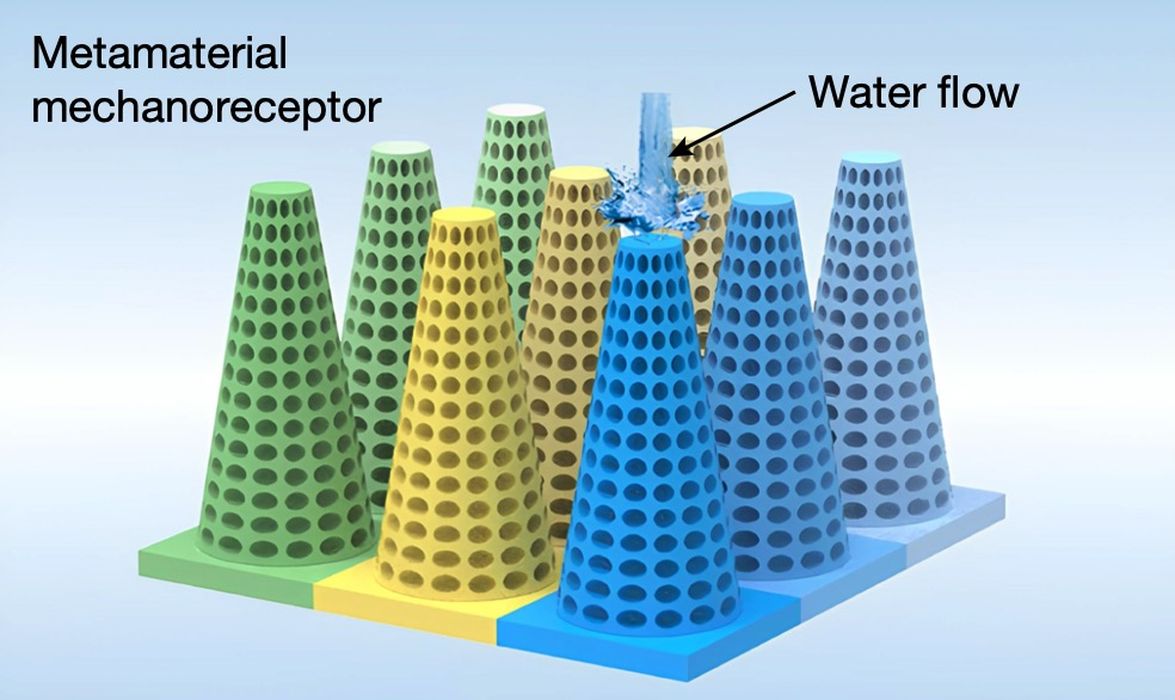
The made a 3 × 3 metamaterial mechanoreceptor array made of nine graded node units. Submerged in water, each node’s apex and base were wired into an external circuit so the array could output a time-resolved voltage pattern under water impact or flow. In effect, the array “maps” where the water hits and how that stimulus evolves over time, without needing conventional pressure transducers or external flow sensors embedded around it.
What This Needs Before It Becomes A Product
Could this work in practical applications? It depends on surface chemistry, fouling, ionic strength, and stable wetting behavior, all of which can drift in real seawater. The paper demonstrates repeatable voltage response in a controlled environment, but it does not provide long duration cycling in dirty environments, nor does it translate output into a calibrated flow rate over broad conditions. Another open issue is manufacturability at scale: TPMS lattices are printable, but tuning pore size gradients from micrometres to metres — as the authors suggest — could have problems with 3D print processes and equipment, resin shrinkage, ceramic debinding, and the surface finish inside complex pores.
Regardless, this is one of those rare bioinspired studies where the “inspiration” is not just a geometry, but is in fact a performance capability not seen previously: you can print a structure that produces an electrokinetic signal simply by its shape. If commercialized, we may have a new class of passive, self powered underwater sensors hiding inside what looks like ordinary lattice filler.
Via Nature and City University of Hong Kong
