
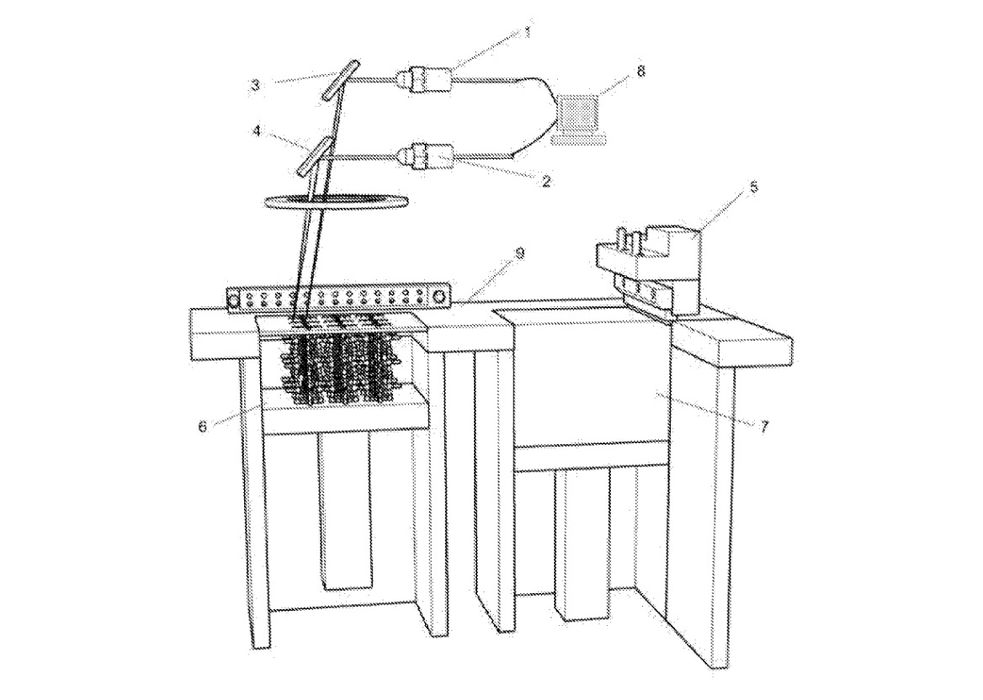
A new dual laser Laser Powder Bed Fusion (LPBF) concept proposes printing overhangs with micro spot precision while the bulk runs faster with a higher power beam.
Overhangs are one of LPBF’s biggest pain points, not because they are impossible, but because the physics get ugly fast. When a melt pool loses firm support from the previously solidified layer, gravity, recoil pressure, and surface tension effects can pull material downward into surrounding powder. The result is dross, rough skin, and a higher chance of porosity and geometric error, especially as overhang angles get more aggressive.
One straightforward answer is to add supports, but supports cost time, powder handling, removal labor, and sometimes surface damage. Another is to chase higher fidelity process windows with micro laser powder bed fusion (μ LPBF): smaller spot sizes, thinner layers, and finer powders to push minimum feature sizes below 50μm and reduce defects. The tradeoff is not great: throughput collapses, making μ LPBF hard to justify for anything beyond micro components or specialty geometries.
This patent stakes out a middle path by treating the part as two different manufacturing problems.
The disclosed system uses slicing software to split a target 3D model into an “overhang portion” and a “support portion,” then generates separate slice data for each. The build plate is also treated as two functional regions: a first forming sub area for the overhang portion and a second forming sub area for the support portion. A controller turns those two slice streams into print instructions and orchestrates powder spreading, beam selection, and scan strategies.
Hardware wise, it is a two laser, two galvanometer setup in a sealed chamber with inert gas protection, not terribly different than most of today’s LPBF systems.
Two Beams, Two Process Regimes
What is novel here is not simply “two lasers,” but two lasers that intentionally operate at very different resolutions and layer regimes for different sub regions of the same part. The first beam targets the overhang portion with a micro scale spot diameter of 10μm to 40μm, layer thickness H1 of 10μm to 15μm, and relatively low power P1 of 25W to 75W. Scan speeds are listed at 900mm/s to 1100mm/s with a 50μm hatch spacing, using an orthogonal scan strategy with 90 degree layer to layer rotation.
The second beam targets the support portion with a larger spot of 60μm to 100μm, much higher power P2 of 375W to 425W, and scan speeds of 700mm/s to 900mm/s at the same 50μm hatch spacing. Crucially, the support portion uses a thicker powder layer H2 that is an integer multiple of H1, with an example of H2 being three times H1 (30μm to 45μm). The workflow cycles through like this: print a layer of overhang at H1, then switch to the second laser to print one thicker layer at H2, and repeat until completion.
The process uses fine layer, fine spot, lower energy density control where surface quality and defect suppression matter most, then uses a blunt instrument to build the non critical mass faster. The patent also argues that the higher power, larger spot pass helps remelt and stabilize the connection region between overhang and support portions, improving adhesion and density at the interface.
Materials are not left totally open ended: the examples focus on an Al Mg Sc Zr alloy powder, with magnesium at 4.0 to 4.4wt.%, scandium at 0.38 to 0.43wt.%, zirconium at 0.15 to 0.21wt.%, balance aluminum, and powder particle sizes of 2μm to 20μm. The claimed target overhang bottom inclination angles are 10 to 40 degrees, suggesting the inventors are chasing the “support free” zone that is notoriously tricky in aluminum LPBF.
What should an AM workshop make of this? The promise is better down skin and fewer internal defects in overhang regions without forcing the whole build into μ LPBF mode. However, 2μm to 20μm powder distribution is demanding for handling and safety, and it is not clear how recoating stability holds at the transition between H1 and H2 processing. The approach also relies on correct part partitioning in software, and that segmentation step becomes a new failure mode if the geometry classification is wrong.
If this is implemented in a commercial machine, it could become a competitive lever for any LPBF vendor selling into micro structural components, lattice rich designs, or aluminum applications where surface and fatigue performance matter. But the patent is still just a patent idea with lab style parameter ranges; it does not provide build volume, cycle time benchmarks, measured roughness numbers, or statistical density and fatigue data.
Patented by Nanjing Univ Of Aeronautics And Astronautics, it is likely this technology could eventually find its way into Chinese metal 3D printers, and possibly beyond.
Via PATENTSCOPE
