

Researchers have developed a way to 3D print recyclable PCBs.
PCBs, or printed circuit boards, are everywhere. They are inside every smart object and lots of dumb objects, too. Once they’re made, however, they are hard to recycle. The components tend to be unrecoverable and the whole board usually ends up in the landfill.
The researchers devised a method of producing a functional PCB with materials and process that allows for full recycling.
Instead of traditional FR-4, the boards are printed in PVA filament, with conductive channels filled by EGaIn liquid metal and components bonded using a water-soluble PVA glue.
When no longer needed, the entire board dissolves in water, allowing near-total recovery of components and materials—tests showed over 99% of PVA and nearly 99% of EGaIn reclaimed. Performance metrics are surprisingly robust: traces carry 5 A continuous current without overheating, signal transmission holds cleanly up to 10 MHz, and conductivity is close to copper PCB standards for low-voltage circuits.
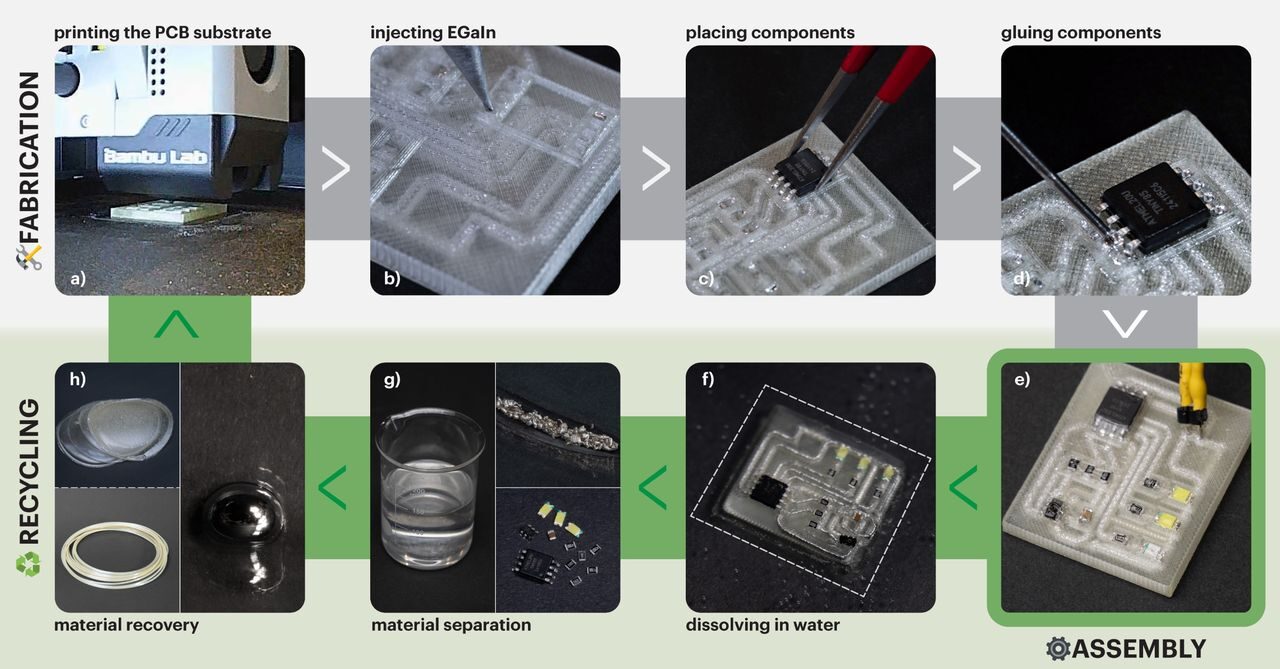
The researchers also released an open-source FreeCAD macro that converts KiCad layouts directly into printable board files, making the process accessible for makerspaces and labs. While not suited for wet environments or ultra-compact routing, DissolvPCB offers a compelling eco-alternative for prototyping and short-life devices—and adds momentum to sustainable electronics innovation.
This work highlights how additive manufacturing can directly impact electronics sustainability. By combining standard FDM hardware, common water-soluble materials, and open-source design tools, DissolvPCB demonstrates a circular approach to prototyping that fits neatly into makerspaces and research labs.
It also raises intriguing questions about sourcing and handling conductive fluids like EGaIn, and whether similar dissolvable-print workflows could extend to other domains—perhaps even creating temporary or adaptive electronic systems.
For 3D printing, it’s another step toward reshaping not just how we make things, but how we unmake them.
Via ArXiv
