
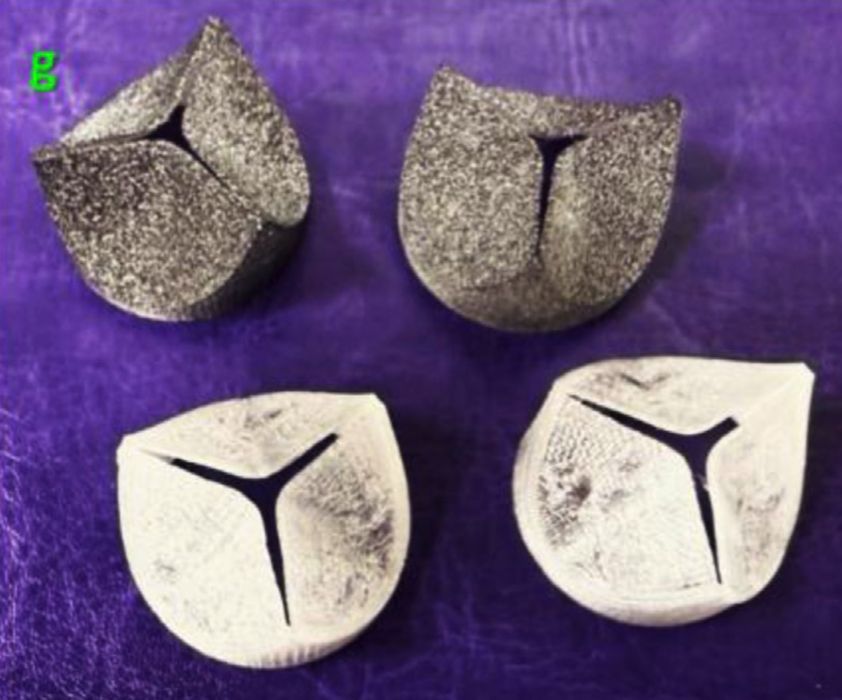
A new study suggests that the toolpath in an FFF printed heart valve may be almost as important as the material.
Researchers from Sirius University of Science and Technology and partner institutions printed experimental aortic valve leaflet structures in TPU and SEBS. Their target is a polymeric transcatheter aortic valve implantation, or TAVI, prosthesis: it’s a replacement valve compressed into a catheter, deployed inside the damaged valve, and then expected to open and close for an enormous number of cycles.
Traditional TAVI valves are commonly made from animal tissue and can structurally degrade or calcify over time. Mechanical valves are durable but usually require lifelong anticoagulation. Polymeric valves are being explored as an alternative, with several developers already pursuing them. AM presents a new option: make the leaflet geometry and mechanical response specific to an individual anatomy.
The Slicer Becomes A Material Tool
The researchers printed dogbone coupons and leaflet samples with axial, transverse, and diagonal filament alignments. An extrusion running along the load direction generally performs better in tension than one depending on interlayer bonds across it.
In a heart valve, however, that ordinary print behavior becomes a design issue. Native valve tissue is anisotropic, meaning its response changes with loading direction. The team found the same directional effect in both printed polymers: axial alignment produced the highest tensile modulus, and transverse alignment the lowest.
SEBS was substantially stiffer. In tensile testing, its Young’s modulus ranged from 97.34 MPa to 174.71 MPa depending on filament orientation, versus 22.50 MPa to 28.49 MPa for TPU. Under compression, TPU ranged from 11.70 MPa to 16.62 MPa, a range the authors say is close to reported native leaflet values of roughly 10 MPa to 30 MPa. SEBS ranged from 39.51 MPa to 60.08 MPa.
In other words, TPU may offer a more compliant valve, while SEBS provides a firmer response. More intriguingly, a valve maker might tune either material further by deliberately directing the deposited filaments, instead of leaving the extrusion direction to the slicer.
Promising Mechanics, Not A Clinical Valve
The team also compressed six TPU and six SEBS leaflet specimens and used digital image correlation to map deformation. TPU valves bent inward and closed the gap between lateral valves during the test. The stiffer SEBS valves resisted that motion more strongly. Their finite element models measured TPU displacement within 5% and SEBS within 10%.
But this was only a lab test, and there are some questions here: these were room temperature, static mechanical tests, not experiencing blood flow at 37C. A functioning TAVI valve must survive hundreds of millions of opening and closing cycles, remain compatible with blood, resist thrombus formation, tolerate sterilization, and retain its properties after crimping and deployment. Surface roughness, seams between extrusions, and stress concentration near leaflet attachments all become much more serious in real life.
The paper also identifies a particularly uncomfortable result for the SEBS samples: simulations showed stress concentrating near the valve attachment points. Stiffer material may help a leaflet hold shape, but it also raises the chance that fatigue begins at those high stress regions.
In any case, this is quite an interesting development that might be applied to other areas of 3D printing: can you customize the extrusions to match the engineering needs of a part?