
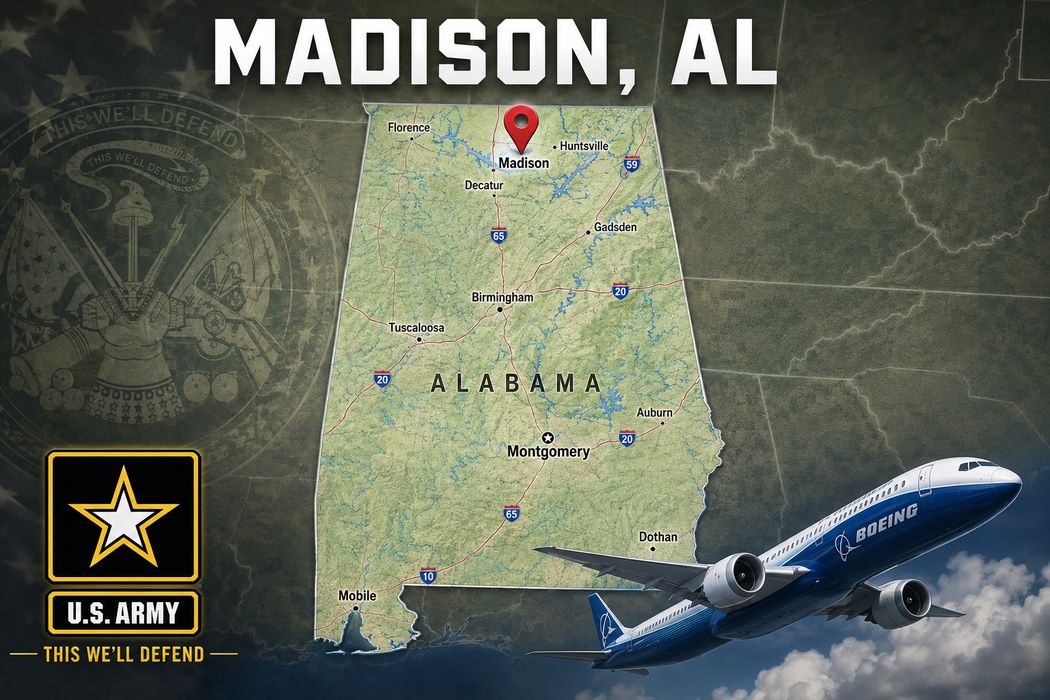
Charles R. Goulding and Preeti Sulibhavi investigate how Madison’s proximity to Huntsville, Redstone Arsenal and Marshall Space Flight Center is helping turn 3D printing into a production technology for America’s aerospace and defense industries.
Madison, Alabama, is becoming an increasingly important location for advanced manufacturing, sitting at the intersection of the Huntsville region’s aerospace, defense and space industries. The city is adjacent to Huntsville and close to Redstone Arsenal, NASA’s Marshall Space Flight Center and a growing concentration of major defense contractors.
That industrial ecosystem is also creating fertile ground for 3D printing.
While Madison may not yet have the name recognition of traditional additive manufacturing centers, its combination of aerospace engineering, missile defense, military logistics and high-rate manufacturing makes it an important emerging hub. The region demonstrates how 3D printing is moving beyond prototyping and into production, sustainment and the broader defense supply chain.
Redstone Arsenal and Marshall Space Flight Center
The story begins with Redstone Arsenal, the U.S. Army installation that anchors much of the region’s aerospace and defense activity. Redstone is home to Army organizations involved in aviation, missiles, logistics and materiel management, including Army Materiel Command and the Army Aviation and Missile Command.
3D printing has been part of that mission for years, but the technology is increasingly moving into practical manufacturing applications. In December 2025, AMCOM highlighted additive manufacturing, advanced materials, digital engineering and data-driven production as part of its ongoing effort to improve readiness and sustainment. The Army described the transition as moving from experimentation toward full-scale application.
The potential value is particularly clear for military sustainment. Additive manufacturing can produce replacement components, tooling and other parts without requiring the Army to maintain conventional production lines for every component. That can be especially valuable for older platforms where original parts may be difficult to source.
One recent example illustrates the point. In October 2025, Army engineers initiated a project to 3D print a replacement tail fin for the UH-60 helicopter’s external fuel system after encountering a shortage of components from the original equipment manufacturer. The project involved structural analysis and technical evaluation, with Redstone Arsenal personnel determining that the component could be manufactured through additive manufacturing.
The neighboring Marshall Space Flight Center adds another dimension. NASA Marshall has been developing additive manufacturing for rocket propulsion and spaceflight applications for more than a decade. Today, NASA lists additive manufacturing and digital manufacturing among Marshall’s advanced manufacturing capabilities, including metal additive manufacturing for propulsion applications.
Marshall’s work has included 3D printed rocket engine components, including injectors and nozzles, as well as research into large-scale additive manufacturing. NASA has also worked on a one-piece liquid rocket thrust chamber assembly using 3D printing that can reduce weight by more than 40% compared with a conventional design.
This is important because Madison’s 3D printing story isn’t simply about making plastic prototypes. The surrounding ecosystem is tackling some of additive manufacturing’s most demanding applications: high-temperature metals, propulsion components, aerospace structures and parts that must eventually meet rigorous qualification requirements.
Given recent combat operations around the world, it has been reported that stockpiles of weapons have been significantly depleted. The Pentagon has issued a memo on August 5, 2026, indicating that all major defense contractors must submit formal plans illustrating how they can produce and deliver critical weapons systems at “a much higher pace.”
This is an opportunity for additive manufacturing to shine. We will illustrate, throughout this article, how that could be the case.
Northrop Grumman Brings Additive Manufacturing to High-Rate Defense Production
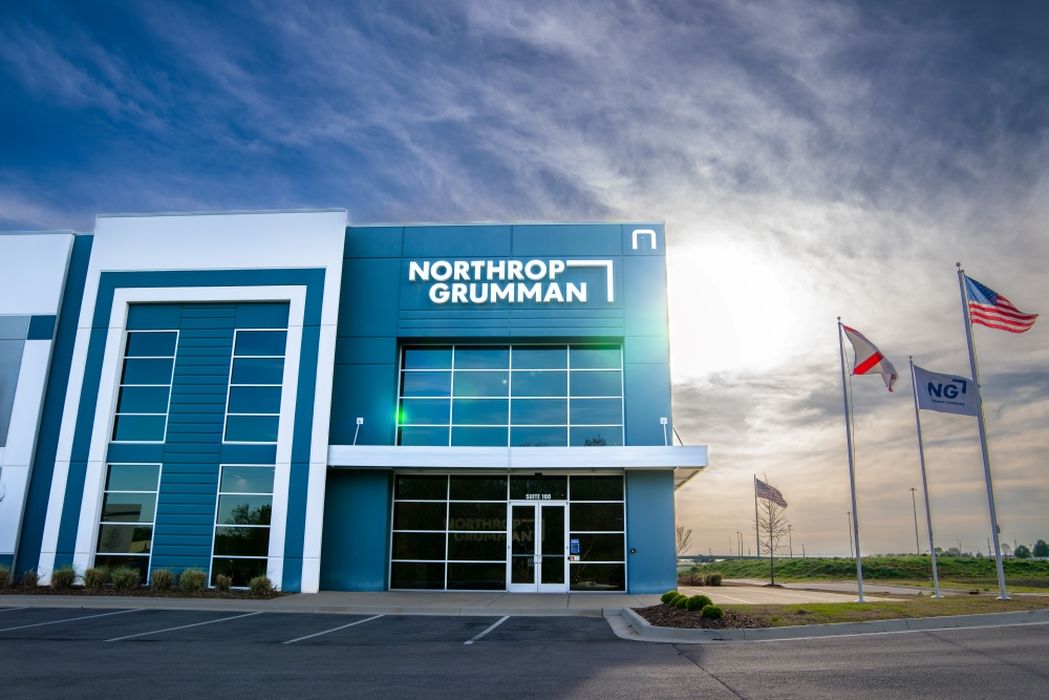
The most visible recent development in Madison itself is Northrop Grumman’s new Enhanced Production and Integration Center, or EPIC.
Opened in April 2025, the US$20 million facility covers approximately 175,500 square feet, including more than 129,500 square feet of flexible manufacturing space and 35,000 square feet of office space. EPIC is designed to support production of the Integrated Battle Command System (IBCS), the Army’s networked air and missile defense system.
The scale is significant. Northrop Grumman says EPIC can support annual production of up to 96 Engagement Operation Centers, 96 Integrated Collaborative Environments and 192 Integrated Fire Control Network relays. The company describes the facility as part of a broader strategy to scale domestic manufacturing quickly in response to defense requirements.
Importantly for the 3D printing industry, EPIC is equipped with advanced manufacturing technologies that include additive manufacturing as well as precision laser systems. A 2026 report on Northrop Grumman’s IBCS production specifically identifies the Madison facility as using additive manufacturing and precision laser systems to support high-rate production.
That combination is worth watching. Additive manufacturing is often discussed in terms of prototypes and one-off parts, but a facility such as EPIC shows how the technology can become one component of a larger production system. In a modern defense factory, 3D printing can work alongside conventional machining, laser processing, digital engineering, electronics integration, inspection and final assembly.
Northrop Grumman’s Madison investment also strengthens the region’s manufacturing workforce. The company has more than 3,000 employees across North Alabama, according to the company and local economic-development reporting.
Boeing, Lockheed Martin and a Deep Aerospace Ecosystem
Northrop Grumman isn’t operating in isolation. Boeing is another major aerospace employer in the Huntsville region. Boeing says it has more than 3,000 employees in Alabama, with operations centered in Huntsville, supporting defense, space and security programs including the Patriot Advanced Capability-3 seeker, Space Launch System and International Space Station.
Lockheed Martin is also deeply established in the region. Its Huntsville operation supports major missile-defense programs including Ground-Based Midcourse Defense, Next Generation Interceptor and THAAD. The company’s current Huntsville careers listings include engineering, manufacturing, systems integration and other technical positions, illustrating the depth of the local industrial base.
For 3D printing, the significance of these companies goes beyond whether every component is printed locally. Large aerospace and defense employers create demand for advanced materials, digital engineering, rapid prototyping, specialized tooling, production automation and qualified additive manufacturing suppliers.
That creates opportunities for smaller manufacturers and technology companies to become part of the same ecosystem.
3D Printing in Madison Alabama and IRC 41 Credits
Madison’s additive manufacturing projects are a strong fit for IRC § 41 when companies are not merely printing known parts but are solving technical uncertainty. Examples include testing whether a printed aerospace component can meet strength, heat, weight, tolerance, or performance requirements; determining the right metal powder, print orientation, laser parameters, or post-processing method; or redesigning a component with complex geometry that cannot be made efficiently through conventional tooling.
Prototypes and pilot models are especially relevant. Tax guidance recognizes a pilot model as a representation or model produced to evaluate and resolve development uncertainty, including a functional component. A printed rocket nozzle, replacement aircraft part, or defense-system component may therefore support credit eligibility if it is built and tested to resolve design or manufacturing uncertainty, even if a later version is sold or used in business.
The main limitation is that routine production, ordinary quality control, and duplicating another party’s proven design generally do not qualify. Testing a new design to determine whether it works is different from inspecting finished units for conformity.
Assuming that the work is performed in the US, Madison-area 3D printing developments can help companies support IRC § 41 R&D credit claims when projects involve documented technical uncertainty, iterative experimentation, and development of new or improved aerospace or defense components or processes. Companies should capture project records, test results, engineering time, supply costs, prototype costs, and qualified supplier or contractor costs while separating routine production and quality-control activities. R&D Tax Savers has been helping companies navigate the complexities of the R&D credit since it was introduced into the Internal Revenue Code in 1981.
Below is a table that presents the recent research and development expenses that Boeing and Northrop have invested in comparison to their human capital.
| THE BOEING COMPANY | ||||
| Book per Capita R&D Expenses | ||||
| Company | Year | R&D Expenses | Number of Employees | R&D Expenses per Employee |
| Boeing | 2025 | $ 3,615,000,000 | 182,000 | $ 19,863 |
| 2024 | $ 3,770,000,000 | 172,000 | $ 21,919 | |
| 2023 | $ 3,150,000,000 | 156,000 | $ 20,192 | |
| 2022 | $ 2,780,000,000 | 171,000 | $ 16,257 | |
| 2021 | $ 1,840,000,000 | 142,000 | $ 12,958 | |
| NORTHROP GRUMMAN CORPORATION | ||||
| Book per Capita R&D Expenses | ||||
| Company | Year | R&D Expenses | Number of Employees | R&D Expenses per Employee |
| Northrop Grumman | 2025 | $ 2,420,000,000 | 95,000 | $ 25,474 |
| 2024 | $ 3,610,000,000 | 97,000 | $ 37,216 | |
| 2023 | $ 2,100,000,000 | 101,000 | $ 20,792 | |
| 2022 | $ 1,200,000,000 | 95,000 | $ 12,632 | |
| 2021 | $ 1,100,000,000 | 88,000 | $ 12,500 | |
Madison’s Place in the Emerging 3D Printing Map
Madison’s advantage is its proximity to an unusually concentrated collection of aerospace and defense capabilities. Redstone Arsenal brings the Army’s requirements for readiness and sustainment. Marshall brings decades of NASA research into advanced manufacturing and propulsion. Northrop Grumman is adding high-rate production capacity directly in Madison, while Boeing and Lockheed Martin contribute major aerospace and missile-defense programs across the Huntsville area.
The result is an ecosystem in which 3D printing has multiple reasons to grow: shorter development cycles, complex aerospace geometries, reduced tooling requirements, supply-chain resilience and the ability to manufacture replacement parts when conventional sources are unavailable.
It also fits a broader trend Fabbaloo has been tracking. Our earlier hub article on 3D printing in America’s emerging economic hubs examined how advanced manufacturing is helping reshape regional economies. We have also explored 3D printing’s role in Huntsville’s economic comeback, the competition between Auburn and the University of Alabama in additive manufacturing, and the changing role of Boeing and 3D printing in aerospace.
Madison deserves to be considered the next addition to that map. With advanced manufacturing moving into the factory floor and aerospace and defense investment continuing around Huntsville, the city is emerging as a new hub for 3D printing, not because of a single printer or company, but because of the industrial ecosystem being built around it.