
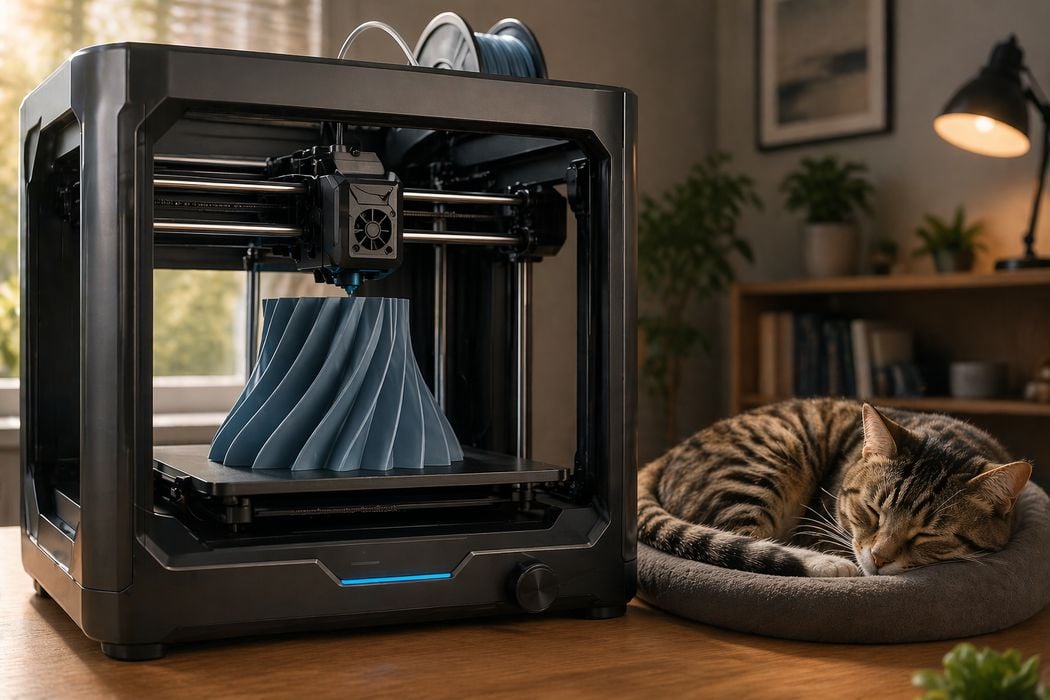
A new Chinese patent application by Anycubic proposes tuning 3D printer noise reduction by speed range.
Noise has become one of the more irritating side effects of the current speed race in desktop FFF systems. Faster motion systems, input shaping, vibration compensation and higher flow hot ends have moved inexpensive machines closer to speeds once associated with tuned professional platforms. That has been great for throughput, but not always for the ears.
Most users already understand the obvious noise sources: fans, stepper motors, linear motion, belts, bearings and the occasional resonance from a flimsy desk. The more subtle issue is that motion noise does not behave the same way at every speed. A motor and axis assembly can sound acceptable at one velocity, whine at another and rattle unpleasantly at a third.
That seems to be the problem being solved by a new patent application, CN121871113A, from Shenzhen Zongwei Cube Technology Co., Ltd. (a.k.a. Anycubic). The application, titled “Noise reduction methods, devices, storage media, and computer equipment for 3D printers,” describes a calibration method for active noise reduction on a printer motion axis.
Speed Segments Instead Of One Setting
The patent’s method starts when the machine receives a calibration trigger operation. It then acquires calibration configuration information, including calibration speed information. That speed data is divided into multiple speed segments based on the printer’s maximum printing speed.
The printer then controls a motion component on a target motion axis to perform calibration movements at the calibration speed for each segment. During those movements, the system collects motor feedback information for that axis. It uses that feedback to calibrate active noise reduction parameters for each speed segment.
This appears to be a speed aware noise tuning routine. Instead of applying one blanket noise reduction profile across the entire motion range, the machine would characterize the motor and axis behavior at different speeds and tune the control parameters accordingly.
Too much noise reduction at low speeds could interfere with positioning accuracy, especially where the printer needs controlled motion for outer walls, small features or precision travel. Too little noise reduction at higher speeds could leave the machine loud just when the mechanical system is moving hardest.
The patent does not specify a printer model, motion architecture, motor type, firmware stack or measurable decibel reduction. However, it’s likely that Anycubic would implement the feature on future FFF systems, where noise can be a factor.
A Quieter Speed Race
This could be quite useful if implemented well. Desktop 3D printers increasingly operate in homes, classrooms, small offices and design studios, not just noisy workshops. A faster printer that sounds annoying when running is less attractive in those settings, even if the part comes off the build plate sooner.
The competitive angle is also interesting. Anycubic is not quite as visible as Bambu Lab, Creality, or Prusa Research, but this type of feature fits the general direction in the market. The next round of differentiation between machines might not be only about print speed. It might also be about how quietly a printer behaves while running at those speeds.
A useful implementation of this patent would need to balance noise, accuracy and time. For example, operators may not tolerate a really long calibration cycle unless the result is very noticeable. The best way to implement this would be to fold it in with existing vibration, resonance and motor tuning routines so the user experiences it as one machine health check rather than a separate task to complete.
As 3D printers move into higher accelerations and higher travel speeds, motion control becomes less about moving fast and more about managing the side effects of moving fast.
