
Charles R. Goulding and Preeti Sulibhavi highlight the critical differences that make animal prosthetics a specialized field requiring new approaches to 3D printed design.
In the April 8 episode of the Prosthetics and Orthotics Podcast titled The Animal Side of O & P, hosts Joris Peels and Brad Wright introduced Danielle Robins, a specialist focused on four-legged animal braces. Her background is an interesting blend of science and creativity. With a physician father and a sculptor mother, Danielle brings both anatomical understanding and artistic problem-solving to a field that demands both.
Danielle does not fabricate devices herself. Instead, she serves as an advisor and facilitator, helping veterinarians, pet owners, and orthotics and prosthetics professionals navigate a highly specialized space. Her role highlights something important: animal prosthetics and orthotics is still a fragmented and developing field, especially when compared to human care.
As 3D printing continues to reshape human prosthetics and orthotics, there is growing interest in applying the same tools to animals. But as the podcast discussion makes clear, this is not a simple translation. Animal anatomy, biomechanics, and behavior introduce a set of challenges that require a different mindset and, in many cases, entirely different technical solutions.
The Fundamental Difference: Anatomy and Movement
The most obvious distinction between human and animal prosthetics lies in limb structure. Human limbs are relatively vertical and linear. They are designed for upright walking, with predictable load paths from hip to foot. This makes it easier to design devices that align with the body’s natural mechanics.
Animal limbs, particularly in dogs, are very different. They operate at varying acute angles, with joints that flex and extend in ways that do not map cleanly to human biomechanics. A dog’s front and rear legs also function differently, distributing weight and absorbing impact in unique ways.
Ground reaction forces are another major factor. In humans, these forces are relatively consistent and well studied. In animals, especially active dogs, they vary widely depending on gait, speed, breed, and even terrain. A sprinting greyhound, for example, experiences very different forces than a slow-moving bulldog.
The link provided in the source material highlights this variability, showing how force distribution across canine limbs can shift dramatically during movement. This makes designing supportive devices far more complex. A brace or prosthetic must not only fit the limb but also adapt to dynamic, multidirectional forces that change moment by moment.
No Shoes, No Predictability
Another key difference is something simple but critical: animals do not wear shoes.
Human prosthetics and orthotics often rely on footwear as part of the overall system. Shoes provide cushioning, stability, and a consistent interface between the device and the ground. They also help distribute pressure and protect the device from wear.
Dogs and other animals lack this layer. Their paws are in direct contact with the ground, which introduces variability in traction, temperature, and surface conditions. A device designed for a dog must account for grass, pavement, mud, and everything in between.
This has direct implications for 3D printing. Materials and designs that work well for human devices may fail quickly in animal applications due to abrasion, moisture, or impact. It also means that the interface between the device and the paw must be carefully engineered to avoid discomfort or injury.
Limited Training and a Niche Industry
Despite the growing interest in animal prosthetics, formal training remains limited. Most orthotics and prosthetics programs devote only a small portion of their curriculum to animal applications. As a result, practitioners often enter the field with little hands on experience in designing for non human anatomy.
This has created a niche industry with a relatively small number of experienced professionals. Rehabilitation veterinarians are among the few experts who regularly work in this space. They combine knowledge of animal physiology with practical experience in mobility and recovery.
There are also research organizations that study animal physiology in great detail, particularly in the context of drug testing. Mouse model companies, for example, analyze biological responses at a highly granular level. However, these studies typically focus on internal systems rather than external support devices, and the small size of these animals makes braces and prosthetics less relevant.
For larger animals like dogs, horses, and even zoo animals, the need for effective orthotic and prosthetic solutions is real and growing. Injuries, congenital conditions, and age related issues all create demand for devices that can restore mobility and improve quality of life.
Why 3D Printing Has Not Fully Translated Yet
In human prosthetics and orthotics, 3D printing has already made a significant impact. It allows for rapid customization, lower production costs, and faster turnaround times. Devices can be tailored to the exact anatomy of the patient using digital scans and advanced modeling software.
In animal care, however, adoption has been slower. This is not due to a lack of potential, but rather the complexity of the problem.
First, capturing accurate anatomical data from animals is more difficult. Dogs do not stay still for scans in the same way humans can. Sedation is sometimes required, which adds cost and risk.
Second, the presence of fur creates challenges for both scanning and device fit. Fur can interfere with accurate measurements and create friction or pressure points once a device is applied. Materials must be chosen carefully to avoid irritation while still providing the necessary support.
Third, animals cannot communicate discomfort in the same way humans can. A poorly fitted device may lead to subtle changes in behavior rather than clear feedback. This makes iterative design more challenging and increases the importance of careful initial design.
Where 3D Printing Can Make a Difference
Despite these challenges, there are clear opportunities for 3D printing to improve animal prosthetics and orthotics.
One of the most promising areas is customization. Every animal is different, not just in size but in anatomy, gait, and behavior. Traditional manufacturing methods struggle to accommodate this level of variability. 3D printing, on the other hand, is inherently suited to producing one-off or small-batch customized devices.
For example, a dog recovering from a ligament injury could benefit from a brace that is precisely shaped to its leg and designed to support specific movements while restricting others. Using 3D scanning and modeling, such a device could be created more quickly and accurately than with traditional methods.
Another area is lightweight design. Animals are often more sensitive to added weight than humans. A heavy device can alter gait and lead to secondary issues. 3D printing allows for complex internal structures that reduce weight while maintaining strength.
Durability is also a key consideration. By selecting appropriate materials and optimizing design, 3D printed devices can be made robust enough to withstand the demands of active animals. This may include reinforced joints, flexible sections, and wear resistant surfaces.
Real World Examples
There are already emerging examples of 3D printed animal prosthetics making a difference.
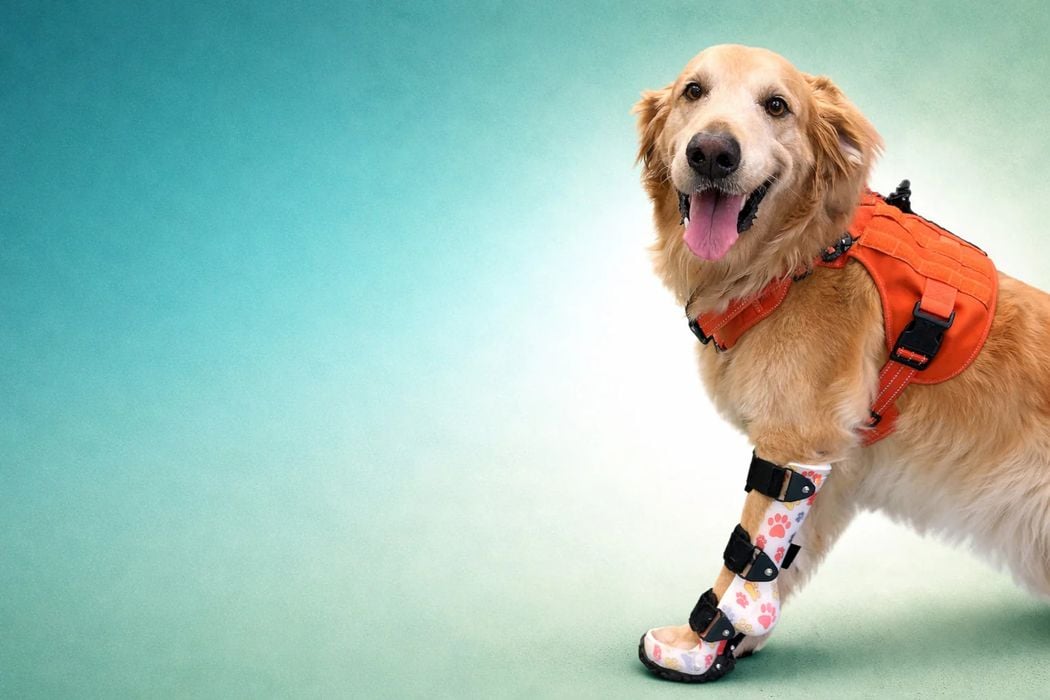
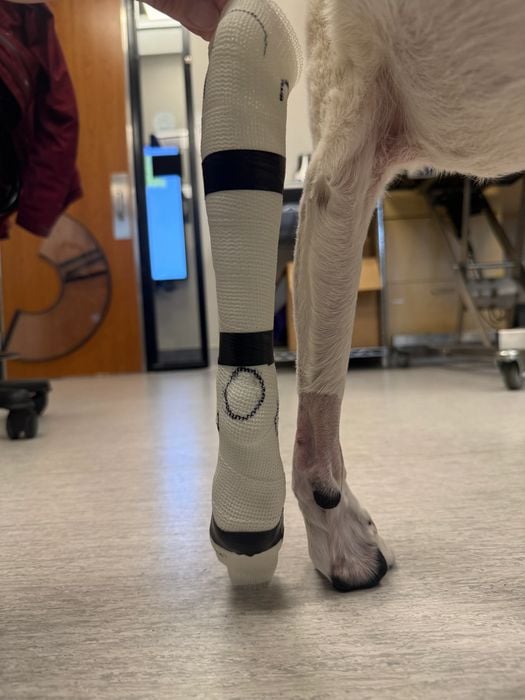
Dogs that have lost limbs due to injury or illness have been fitted with custom 3D printed prosthetics that restore mobility and allow them to run and play again. In some cases, these devices are designed with flexible joints that mimic natural movement, improving comfort and function.
Braces for conditions such as carpal hyperextension or ligament injuries are another area of growth. These devices help stabilize the limb while allowing controlled movement, aiding in recovery and reducing pain.
Even outside of dogs, 3D printing has been used to create prosthetics for animals such as turtles, birds, and elephants. Each case presents unique challenges, reinforcing the idea that animal prosthetics is not a one-size-fits-all field.
The Need for Specialized Attention
What becomes clear from both the podcast discussion and the broader industry landscape is that animal prosthetics and orthotics cannot simply follow the path of human care.
The differences in anatomy, movement, environment, and communication all require specialized approaches. 3D printing is a powerful tool, but it must be applied with an understanding of these differences.
This is where professionals like Danielle Robins play an important role. By bridging the gap among veterinary medicine, design, and manufacturing, they help ensure that solutions are both technically sound and practical.
Looking Ahead
As technology continues to evolve, the role of 3D printing in animal care is likely to expand. Advances in scanning, materials, and design software will help address many of the current challenges.
At the same time, greater awareness and education will be needed to build expertise in this niche field. Training programs, research initiatives, and collaboration between engineers and veterinarians will all play a role.
The potential benefits are significant. Improved mobility, reduced pain, and better quality of life for animals are outcomes that resonate with both professionals and pet owners.
The Research & Development Tax Credit
The now permanent Research & Development Tax Credit (R&D) is available for companies developing new or improved products, processes, and/or software.
3D printing can help boost a company’s R&D Tax Credits. Wages for technical employees who create, test, and revise 3D printed prototypes can be included as a percentage of eligible time spent for the R&D Tax Credit. Similarly, when used as a method of improving a process, time spent integrating 3D printing hardware and software counts as an eligible activity. Lastly, when used for modeling and preproduction, the costs of filaments consumed during the development process may also be recovered.
Whether it is used for creating and testing prototypes or for final production, 3D printing is a strong indicator that R&D-eligible activities are taking place. Companies implementing this technology at any point should consider claiming R&D tax Credits.
Conclusion
Animal prosthetics and orthotics represent a unique and demanding application of 3D printing. While the technology has already transformed human care, its use in animals requires a deeper understanding of biomechanics, materials, and behavior.
The differences are not small. They are fundamental.
By recognizing these challenges and approaching them with the right combination of expertise and innovation, the industry has an opportunity to extend the benefits of 3D printing to a new and important group of patients: pets.
In doing so, it will not only advance technology but also improve the lives of animals that depend on it.